
Select Your Region
Region-Based Optimized Content
Building a Headless Commerce Backend with Strapi + Shopify API
Learn how to build a headless commerce backend with Strapi + Shopify API for flexible, scalable, and high-performance online stores.


In today's dynamic digital landscape, traditional monolithic eCommerce platforms often struggle to keep pace with evolving customer expectations and the need for agile, multi channel experiences. Businesses, from ambitious startups to established enterprises, are increasingly seeking greater flexibility, scalability, and control over their online storefronts. This pursuit inevitably leads to headless commerce a powerful architectural shift that decouples the front end presentation layer from the back end commerce engine.
At RW Infotech, we understand that true innovation lies in leveraging best of breed tools to create bespoke solutions. This article will guide you through the strategic advantages and practical implementation of building a headless commerce backend with Strapi + Shopify API. We'll explore how this potent combination empowers businesses to create a future-ready eCommerce ecosystem, offering unparalleled control over product data, custom workflows, and seamless multi-channel distribution. Prepare to unlock a world of possibilities for fast performance, personalized user experiences, and robust API integrations, making your online store truly exceptional.
Understanding Headless Commerce and Its Core Components
Before diving into the technical specifics, it's crucial to grasp the foundational concepts that underpin a headless commerce strategy. Headless commerce fundamentally separates the "head" (the customer-facing presentation layer like a website, mobile app, or IoT device) from the "body" (the back-end commerce functionalities like product management, inventory, orders, and payments).
What is Headless Commerce?
Headless commerce is an architectural approach where the e-commerce platform's back-end (data, logic, and functionality) is decoupled from its front-end (the user interface). This separation allows businesses to use any front-end technology they desire, connecting to the back-end via APIs. The result is greater flexibility, faster innovation, and the ability to deliver unique customer experiences across diverse touchpoints.
Key Benefits of a Headless Approach
Unmatched Flexibility: Choose any front-end framework (React, Vue, Angular, Next.js, Gatsby, etc.) to build a custom user experience without limitations imposed by a monolithic platform.
Scalability: Scale your front-end and back-end independently, optimizing performance and resource allocation.
Multi-Channel Readiness: Easily deliver content and products to websites, mobile apps, IoT devices, smart mirrors, and social commerce platforms from a single source of truth.
Faster Performance: Optimized front-ends built with modern frameworks can offer superior loading speeds and responsiveness, directly impacting SEO and user satisfaction.
Personalization: Gain granular control over data to create highly personalized shopping experiences.
Future-Proofing: Adapt to new technologies and trends without overhauling your entire commerce infrastructure.
Why Strapi and Shopify API are a Winning Combination
When it comes to building a robust headless commerce backend, the synergy between Strapi and the Shopify API is particularly compelling. Each platform brings distinct strengths that, when combined, create a powerful and flexible e-commerce ecosystem.
Strapi: The Flexible Headless CMS for Content and Custom Data
Strapi is an open-source, Node.js-based headless CMS that empowers developers to build custom APIs with ease. Its highly extensible nature makes it an ideal choice for managing not only traditional content but also custom data types that go beyond standard e-commerce product attributes. For a headless CMS commerce setup, Strapi serves as your central content hub, managing product descriptions, rich media, marketing content, blog posts, landing pages, and even custom data models for personalized recommendations or unique business logic.
Custom Content Types: Define any data structure required for your specific business needs, from detailed product specifications to custom promotions or customer segments.
Developer-Friendly: Offers a powerful API generator, GraphQL and REST API support out-of-the-box, and a plugin system for extended functionality.
Self-Hosted or Cloud: Deploy Strapi on your own infrastructure for maximum control or leverage Strapi Cloud for managed convenience.
Rich Text Editor & Media Management: Streamline content creation and asset management for your product pages and marketing materials.
Shopify API: The Robust Commerce Engine
Shopify, while known for its monolithic platform, also offers a comprehensive suite of APIs that expose its powerful commerce engine. These APIs allow developers to programmatically interact with core e-commerce functionalities such as products, inventory, orders, customers, and payments. By integrating with the Shopify API, you leverage Shopify's battle-tested infrastructure for transactions, security, and global reach, while maintaining full control over your front-end and custom data through Strapi.
Product Management: Access and manage product listings, variants, pricing, and images.
Inventory Control: Keep track of stock levels and manage inventory across multiple locations.
Order Processing: Retrieve, create, and update orders, manage fulfillment, and handle refunds.
Customer Management: Access customer data, manage accounts, and segment users.
Payment Gateway Integration: Leverage Shopify's secure payment processing capabilities.
Webhooks: Set up real-time notifications for events like new orders, inventory changes, or customer updates.
Architectural Overview: Integrating Strapi with Shopify
The core idea behind this architecture is to use Strapi as the primary content and data management layer for everything except the core transactional commerce logic, which remains with Shopify. Shopify handles the heavy lifting of inventory, pricing, checkout, and order fulfillment, while Strapi provides the rich content experience and custom data capabilities.
Data Flow and Synchronization
A crucial aspect of this integration is establishing a clear data flow between Strapi and Shopify. While Shopify remains the source of truth for core product attributes (SKU, price, stock), Strapi can enrich this data with custom fields, marketing copy, and SEO metadata. Synchronization can be achieved through various methods:
One-Way Sync (Shopify to Strapi): When a product is created or updated in Shopify, a webhook can trigger an update in Strapi. Strapi then stores a subset of Shopify's product data (e.g., ID, price, image URLs) and adds its own custom content fields. This is often the simplest approach.
Two-Way Sync (Selective): For certain attributes, you might want to update Shopify from Strapi. For example, if you manage product descriptions or SEO meta tags in Strapi, you could push these updates back to Shopify's product meta fields via its API. However, caution is advised to avoid data conflicts, especially with core commerce attributes like price or inventory.
API Aggregation at Front-end: The front-end application can query both Strapi (for rich content, custom attributes) and Shopify (for real-time pricing, availability, add-to-cart functionality) and combine the data before rendering it to the user. This is a common and highly flexible approach.
Example Workflow: Product Page Rendering
User navigates to a product page on your custom front-end.
Front-end fetches core product data (ID, price, inventory status) from Shopify API.
Simultaneously, front-end fetches rich product content (long description, unique selling propositions, related articles, custom FAQs, media galleries) from Strapi API using the Shopify product ID as a reference.
Front-end combines this data to render a comprehensive, highly customized product page.
When the user clicks "Add to Cart," the front-end interacts directly with the Shopify Storefront API to manage the cart and initiate checkout.
Loading...
Practical Implementation: Key Steps and Considerations
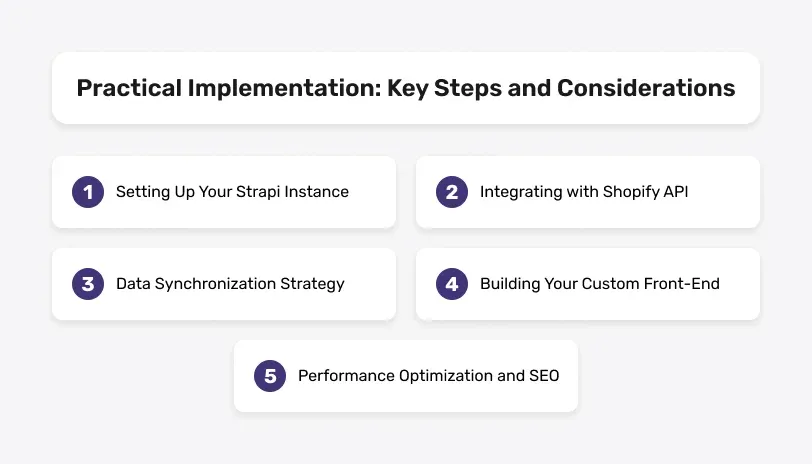
1. Setting Up Your Strapi Instance
Begin by installing and configuring Strapi. You can opt for a self-hosted solution (on a VPS, AWS, Azure, Google Cloud) or use Strapi Cloud. Define your custom content types for products, categories, blog posts, landing pages, and any other unique data your business requires.
For products, you'll likely want fields such as:
shopifyId(Text, Unique): To link to the Shopify product.title(Text): Can be synced from Shopify or managed here.longDescription(Rich Text): Detailed product description.seoMetaTitle(Text),seoMetaDescription(Text): For SEO optimization.customAttributes(JSON or Repeater): For unique product features not supported by Shopify.relatedArticles(Relation): Link to blog posts in Strapi.
2. Integrating with Shopify API
You'll primarily interact with two types of Shopify APIs:
Admin API: For back-end operations like managing products, orders, inventory, and customers. Used for synchronization between Strapi and Shopify, or by your custom back-end services.
Storefront API: For customer-facing operations like fetching product data, managing carts, and checkout. Used directly by your front-end application.
Generate API keys and tokens in your Shopify admin panel. Securely store these credentials in your Strapi environment variables or a dedicated secrets manager.
3. Data Synchronization Strategy
Implement webhooks from Shopify to Strapi for product updates. When a product is created or updated in Shopify, a webhook payload is sent to a custom Strapi endpoint. This endpoint then processes the data and creates/updates the corresponding entry in Strapi.
Loading...
4. Building Your Custom Front-End
Choose a modern front-end framework like Next.js or Gatsby for optimal performance and developer experience. Your front-end will be responsible for:
Fetching data from both Strapi and Shopify.
Rendering dynamic product pages, category listings, and custom content.
Handling user interactions, search, filtering, and personalization.
Interacting with the Shopify Storefront API for cart management and checkout.
5. Performance Optimization and SEO
Leverage the benefits of a headless architecture for superior performance:
Static Site Generation (SSG) / Server-Side Rendering (SSR): Pre-render pages for fast load times and better SEO.
Image Optimization: Integrate image CDNs and optimize image sizes and formats.
Caching: Implement caching strategies for both your Strapi API and front-end assets.
SEO Best Practices: Manage meta titles, descriptions, canonical tags, and structured data through Strapi.


Hi, my name is Jaswinder, let's talk about your business needs.
I will do my best to find a reliable solution for you!
The RW Infotech Advantage: Your Partner in Headless Commerce
Building a sophisticated headless commerce backend with Strapi and Shopify API offers unparalleled flexibility and power, but it requires a deep understanding of modern web architecture, API integrations, and performance optimization. This is precisely where RW Infotech excels.
As a leading IT agency specializing in Headless Solutions and Jamstack website development since 2012, we possess the expertise to transform your e-commerce vision into a high-performing reality. Our team of seasoned strategists and developers can guide you through every stage, from initial consultation and architectural design to seamless implementation and ongoing support.
We leverage our extensive experience in Headless CMS migrations, Full Stack Development, and Digital Marketing for Headless websites to ensure your solution is not only technically robust but also strategically aligned with your business goals. We integrate AI automation for enhanced efficiency and implement rigorous performance optimization techniques to guarantee your online store delivers an exceptional user experience and achieves superior search engine rankings. Partner with RW Infotech to unlock the full potential of headless commerce and future-proof your digital presence.
Conclusion
The combination of Strapi and the Shopify API represents a powerful paradigm for modern e-commerce. By carefully orchestrating these two platforms, businesses can achieve a highly flexible, scalable, and performant online store that is truly future-proof. Strapi provides the agility to manage rich content and custom data models, while Shopify offers a robust, battle-tested commerce engine for transactions and inventory. This headless approach empowers you to deliver unparalleled user experiences across any channel, adapt quickly to market changes, and maintain complete control over your digital storefront.
Embracing this architecture means investing in a solution that scales with your ambition, allowing you to innovate without the constraints of traditional platforms. The journey of building a headless commerce backend with Strapi + Shopify API is a strategic move towards a more resilient, personalized, and efficient e-commerce future.
Frequently Asked Questions
Find answers to the most common questions about Building a Headless Commerce Backend with Strapi + Shopify API.
While technically possible to manage most product data in Strapi and push it to Shopify via the Admin API, it's generally not recommended for core commerce attributes like price, inventory, and SKU. Shopify is designed to be the authoritative source for these transactional data points. Strapi is best utilized for enriching Shopify's core product data with custom descriptions, media galleries, SEO metadata, and unique content fields.
Exposing APIs directly to the front-end requires careful security considerations. For the Shopify Storefront API, ensure you're using a public access token which only allows read-only access to product data and cart management. For Strapi, implement robust API token management and role-based access control (RBAC). Never expose Shopify Admin API or Strapi Admin API keys in client-side code. SSR or SSG helps mitigate exposure.
Complex pricing, discounts, and subscription models are primarily handled by Shopify's commerce engine and ecosystem of apps. Strapi manages related content like marketing descriptions, banners, or promotional messages, while Shopify handles transactional logic.
An outage in Shopify API impacts orders, inventory, and real-time product data. However, Strapi content and custom front-end can remain operational. Cached product info or static content can be displayed, allowing graceful degradation. Robust error handling and monitoring are crucial.
While setup complexity might seem high, the Strapi + Shopify API approach benefits businesses of all sizes. Small to medium businesses gain unique experiences, faster performance, and multi-channel reach. Large enterprises achieve control, scalability, and integration with complex legacy systems. Consider trade-offs between customization, future-proofing, and development investment.
News & Insights
We like to share our thoughts on topics we find inspiring. Explore our news and insights.
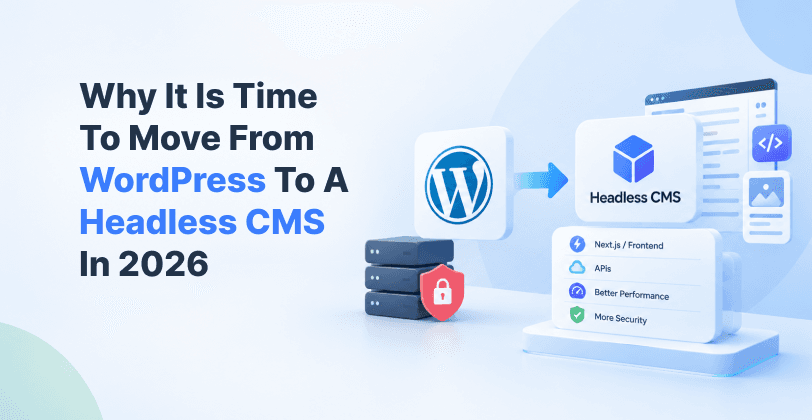

How Marketing Teams Add New Products and Landing Pages Without Dev
Waiting on developers to add a product or change a discount slows every sale. Here is how headless commerce lets marketing teams do it on their own.
Legacy PHP Website to Sanity and Next.js: A Step-by-Step Migration Guide
Learn how to migrate a legacy PHP website to Sanity and Next.js step by step, from content modeling and data import to redirects, SEO protection, and launch.