
Select Your Region
Region-Based Optimized Content
REST vs GraphQL in Builder.io Content API – Complete Guide
Compare REST vs GraphQL in Builder.io Content API. Learn performance, caching, flexibility, and use cases to choose the best API for your project.

Jaswinder Singh
Choosing the right API strategy is fundamental for building performant and scalable digital experiences. For teams leveraging Builder.io as their headless content platform, understanding the nuances between its REST and GraphQL Content APIs is critical. This guide provides a comprehensive comparison, enabling developers, product leaders, and decision-makers to select the optimal approach for their specific project requirements.
Builder io Content API empowers developers to fetch structured content, dynamic pages, and personalized experiences. Both REST and GraphQL offer robust mechanisms to interact with this content, yet they cater to different architectural preferences and data fetching needs. This article will delve into their respective strengths, trade-offs, and ideal use cases, focusing on how each impacts development efficiency, performance, and long-term maintainability.
Understanding Builder.io's Content API Endpoints
Builder.io provides both RESTful and GraphQL endpoints for accessing content. The choice between them influences how data is requested, received, and managed within your application. Each approach adheres to distinct paradigms for data interaction.
REST API in Builder io
The REST (Representational State Transfer) API is a widely adopted architectural style for distributed hypermedia systems. In Builder.io, the REST API allows access to content models, entries, and pages through standard HTTP methods (GET, POST, PUT, DELETE) and a resource-based URL structure. For example, fetching a specific page might involve a URL like:
api.builder.io/api/v3/content/page?url=/your-path&apiKey=YOUR_KEYREST APIs are stateless, meaning each request from a client to a server contains all the information needed to understand the request. They leverage standard HTTP caching mechanisms, making them straightforward to integrate with existing web infrastructure. However, they often lead to over-fetching or under-fetching of data, as the server defines the response structure for each endpoint.
GraphQL API in Builder io
GraphQL is a query language for APIs and a runtime for fulfilling those queries with your existing data. It allows clients to request exactly the data they need, no more and no less. Builder.io's GraphQL API provides a single endpoint (e.g., api.builder.io/api/v1/graphql/YOUR_SPACE_ID) where clients send queries describing their data requirements.
With GraphQL, the client specifies the fields it needs, even across related content types. This flexibility can significantly reduce network payload size and the number of requests required, especially for complex data structures or dynamic content requirements. GraphQL also offers strong typing, which can improve developer experience through auto-completion and validation.
Strategic Considerations for Choosing Your API
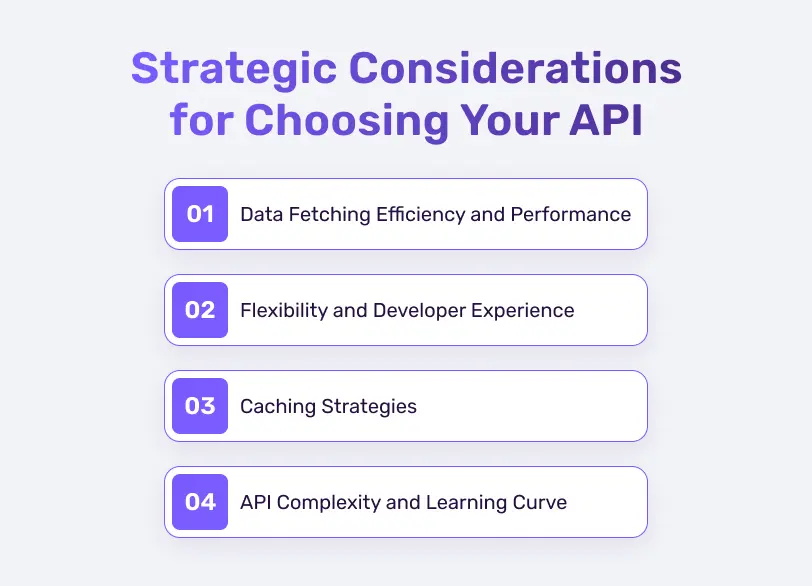 The decision between REST and GraphQL for Builder.io's Content API extends beyond technical preference; it impacts project timelines, performance goals, and future scalability. Teams must evaluate their specific needs against the inherent characteristics of each API style.
Data Fetching Efficiency and Performance
REST: Typically, REST APIs involve multiple requests to different endpoints to gather all necessary data for a complex UI component or page. For instance, rendering a product page might require one call for product details, another for related recommendations, and a third for customer reviews. This can lead to "over-fetching" (receiving more data than needed) or "under-fetching" (needing multiple round trips), increasing latency and bandwidth consumption, especially on mobile networks.
GraphQL: GraphQL excels in data fetching efficiency by allowing clients to specify exactly what data they need in a single request. This "single round trip" advantage significantly reduces network overhead and latency. For a Builder.io-powered dynamic page, a single GraphQL query can retrieve page content, associated metadata, author details, and related articles, optimizing performance and reducing load times. This is particularly beneficial for complex UIs or applications with varying data requirements across different views.
Decision Point: For applications demanding highly optimized data fetching, minimal network requests, and tailored data payloads (e.g., mobile apps, single-page applications with rich UIs, or performance-critical marketing sites), GraphQL offers a clear advantage. For simpler content retrieval or applications where standard resource fetching aligns with requirements, REST can be sufficient.
Flexibility and Developer Experience
REST: REST APIs are well-understood and have a mature ecosystem of tools and libraries. Developers familiar with traditional web services often find REST's resource-oriented approach intuitive. Each endpoint serves a specific resource, and the API contract is typically defined through documentation. However, evolving data requirements can lead to versioning challenges or the need for new endpoints, potentially slowing down development cycles when content models frequently change.
GraphQL: GraphQL provides unparalleled flexibility. Developers can query arbitrary combinations of fields and relationships, adapting to UI changes without requiring backend modifications or new API endpoints. This empowers frontend teams to iterate faster. The strong typing system, introspection capabilities, and tools like GraphiQL enhance developer experience by providing clear schemas, auto-completion, and real-time validation, making it easier to explore and consume the API. This is especially valuable when working with diverse Builder.io content models.
Decision Point: If your project requires rapid iteration, frequent UI changes, or a highly dynamic content structure from Builder.io, GraphQL's flexibility and developer tooling can significantly accelerate development. For projects with stable content models and predictable data needs, REST's simplicity might be preferred.
Caching Strategies
REST: REST APIs naturally leverage standard HTTP caching mechanisms. Browsers, CDNs, and proxy servers can cache responses based on HTTP headers (e.g., Cache-Control, ETag). This makes caching straightforward to implement and manage at various layers, improving performance for frequently accessed, immutable resources. For Builder.io content, caching static pages or common content blocks via a CDN can drastically reduce server load and improve delivery speed.
GraphQL: Caching with GraphQL is more complex due to its single-endpoint, query-based nature. Standard HTTP caching is less effective because every request is a POST to the same endpoint, and the response depends on the query body. Client-side caching often requires more sophisticated solutions like Apollo Client's normalized cache, which stores data by ID and updates components reactively. Server-side caching typically involves query result caching or data-loader patterns. While powerful, these approaches demand more custom implementation and management.
Decision Point: For applications where robust, easily implementable caching at the network level is a priority (e.g., high-traffic static sites, marketing pages), REST's native HTTP caching is a strong advantage. If fine-grained, intelligent client-side caching and dynamic content updates are more critical, GraphQL's ecosystem offers advanced solutions, albeit with increased complexity.
API Complexity and Learning Curve
REST: The REST architectural style is widely understood. Its principles are taught broadly, and most developers have experience interacting with RESTful APIs. The learning curve for consuming a new REST API is generally low, provided the documentation is clear. Builder.io's REST API is intuitive for developers familiar with resource-based interactions.
GraphQL: While gaining popularity, GraphQL has a steeper initial learning curve. Developers need to understand query syntax, schemas, types, and concepts like fragments and mutations. Integrating GraphQL clients (e.g., Apollo Client, Relay) also introduces additional libraries and patterns. However, once mastered, the productivity gains and flexibility can be substantial, especially for complex applications interacting with rich content models.
Decision Point: For teams with limited experience in modern API paradigms or projects with tight deadlines where simplicity is paramount, REST might offer a quicker start. For teams willing to invest in learning a new technology for long-term benefits in flexibility and performance, GraphQL is a powerful tool.


Hi, my name is Jaswinder, let's talk about your business needs.
I will do my best to find a reliable solution for you!
Real-World Use Cases with Builder io
Let's examine how REST and GraphQL apply to common scenarios when integrating with Builder.io's Content API.
Dynamic Page Rendering and CMS Integration
Scenario: A marketing website built with a modern frontend framework (React, Next.js, Vue) needs to render pages designed in Builder.io, fetch dynamic content blocks, and display personalized components.
REST Approach: You might use Builder.io's REST API to fetch page content based on a URL path. If the page contains references to other content models (e.g., blog posts, product features), additional REST calls would be needed for each referenced item. This could result in multiple API requests per page load.
GraphQL Approach: A single GraphQL query can fetch the entire page structure, including nested content blocks, referenced content entries, and associated metadata. This significantly streamlines the data fetching process for complex pages, making it ideal for high-performance dynamic page rendering and Jamstack architectures where build times or serverless function execution times are critical.
Personalized Content Delivery and A/B Testing
Scenario: Delivering personalized content variations or running A/B tests on specific elements of a page, managed within Builder.io.
REST Approach: You would typically fetch the base content via REST and then use Builder.io's personalization APIs (which might also be RESTful) to determine and fetch the specific variation. This often involves client-side logic to combine data from different sources.
GraphQL Approach: GraphQL queries can be designed to fetch content and its personalized variations within a single request. By passing context (e.g., user ID, segment) as variables to the query, you can retrieve the correct content variant directly from the API. This simplifies client-side logic and ensures all necessary data is available in one go, enhancing the efficiency of personalized experiences.
Multi-Channel Publishing (Web, Mobile, Kiosk)
Scenario: Publishing content from Builder.io to various platforms, each with unique data requirements and display constraints.
REST Approach: Each channel might need to make slightly different REST requests or process the same REST response to extract relevant data. This can lead to redundant data fetching or complex client-side parsing logic.
GraphQL Approach: GraphQL shines here. Each client (web, iOS, Android, smart display) can define its own specific query, requesting only the fields and relationships relevant to its UI and context. This eliminates over-fetching and allows each channel to consume the Builder.io content API optimally, reducing bandwidth and improving responsiveness across diverse platforms.
RW Infotech's Expertise in API Strategy
At RW Infotech, we specialize in guiding businesses through complex architectural decisions, particularly concerning headless solutions and API integrations. Our expertise in Headless CMS migrations, Jamstack website development, and Full Stack Development allows us to design and implement robust content delivery strategies using both REST and GraphQL with platforms like Builder.io.
We help teams evaluate their specific needs, considering factors like performance targets, development velocity, existing infrastructure, and long-term scalability. Whether you're building a high-performance e-commerce site, a dynamic content portal, or a multi-channel publishing platform, we provide strategic guidance to ensure your API choice aligns with your business objectives. Our approach focuses on delivering efficient, future-ready digital experiences that leverage the full potential of modern content APIs.
Conclusion
The choice between REST and GraphQL for Builder.io's Content API is a strategic one, with implications for performance, flexibility, and developer experience. REST offers simplicity, widespread familiarity, and straightforward HTTP caching, making it a solid choice for projects with predictable content structures and standard resource retrieval needs. GraphQL, conversely, provides unparalleled flexibility, efficient data fetching, and a superior developer experience for complex, dynamic, and multi-channel applications, though it introduces a steeper learning curve and more complex caching strategies.
Ultimately, the best choice depends on your project's specific requirements, your team's expertise, and your long-term vision. By carefully evaluating the trade-offs discussed in this complete comparison guide, product leaders and development teams can make an informed decision that drives efficiency, performance, and scalability for their Builder.io-powered digital experiences.
Frequently Asked Questions
Find answers to the most common questions about REST vs GraphQL in Builder.io Content API.
GraphQL with Builder.io offers precise data fetching, reducing over-fetching and network requests, which improves performance. It provides greater flexibility for complex UIs and multi-channel delivery, allowing clients to request exactly what they need in a single query.
Choose REST when your content fetching needs are straightforward, data models are stable, and you want to leverage standard HTTP caching mechanisms. It's also suitable if your team has limited experience with GraphQL or prefers a simpler, resource-based API approach.
Yes, Builder.io provides both RESTful and GraphQL endpoints for its Content API. You can use either or even combine them within different parts of your application based on specific use cases and requirements.
REST benefits from native HTTP caching at various layers (browser, CDN, proxy) due to its resource-based URLs. GraphQL caching is more complex, often requiring client-side normalized caches (e.g., Apollo Client) or custom server-side query caching due to its single-endpoint, POST-based nature.
RW Infotech specializes in Headless Solutions and Full Stack Development. We can help you evaluate your project needs, design an optimal API strategy (REST, GraphQL, or hybrid) for Builder.io, and implement high-performance content delivery systems tailored to your specific requirements.
News & Insights
We like to share our thoughts on topics we find inspiring. Explore our news and insights.