
Select Your Region
Region-Based Optimized Content
How AI Chatbots Handle eCommerce Customer Support at Scale
Learn how AI chatbots help eCommerce stores automate customer support, handle high query volumes, and improve response time with scalable solutions.

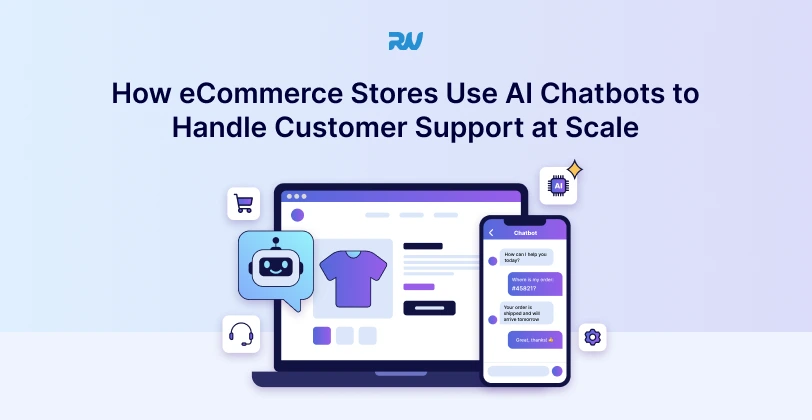
The rapid growth of eCommerce has fundamentally shifted customer expectations. Modern consumers demand instant gratification, 24/7 availability, and personalized interactions. For eCommerce businesses, meeting these demands while scaling operations efficiently presents a significant challenge. Traditional human-centric customer support models often struggle with high query volumes, leading to increased operational costs, longer response times, and potential customer dissatisfaction. This is where AI chatbots emerge as a transformative solution.
AI chatbots are no longer simple rule-based systems; they are sophisticated tools powered by natural language processing (NLP) and machine learning (ML) that can understand context, learn from interactions, and provide accurate, personalized responses. By integrating these intelligent agents, eCommerce stores can automate a substantial portion of their customer service, enabling them to handle support at scale without compromising quality or efficiency. This article will explore the strategic implementation of AI chatbots in eCommerce, detailing their capabilities, integration pathways, and the critical considerations for businesses looking to leverage this technology for sustainable growth.
Leveraging AI Chatbots for Scalable Customer Support in eCommerce
The core value proposition of AI chatbots in eCommerce is their ability to automate and streamline customer interactions across various touchpoints. This automation is crucial for businesses experiencing high volumes of inquiries, particularly during peak seasons or promotional events. Instead of expanding human support teams linearly with customer growth, AI chatbots provide an elastic solution that can handle an almost unlimited number of concurrent queries.
Key areas where AI chatbots significantly impact customer support include:
Instant Answers to FAQs: A large percentage of customer inquiries revolve around frequently asked questions regarding shipping policies, return processes, payment options, and product specifications. AI chatbots can provide immediate, accurate answers, freeing human agents to focus on more complex issues.
Order Management and Tracking: Customers frequently inquire about their order status, shipping details, or delivery estimates. Chatbots can seamlessly integrate with order management systems to retrieve and provide real-time tracking information, reducing the need for manual lookups.
Product Recommendations and Assistance: By analyzing customer browsing history, purchase patterns, and conversational context, AI chatbots can offer personalized product recommendations, guide customers through product features, and assist with sizing or compatibility questions, enhancing the shopping experience.
Returns and Exchanges: Chatbots can initiate return or exchange processes, guide customers through policy details, and even generate return labels, simplifying a process that often requires significant human intervention.
Lead Generation and Qualification: Beyond support, chatbots can engage potential customers, answer pre-sale questions, qualify leads based on their needs, and direct them to relevant products or human sales agents when appropriate.
The strategic decision to deploy AI chatbots is driven by the need to maintain a high level of customer service quality while managing operational costs and enabling business scalability. For product leaders and decision-makers, understanding these core applications is the first step toward a successful integration.


Hi, my name is Jaswinder, let's talk about your business needs.
I will do my best to find a reliable solution for you!
Strategic Integration: Connecting AI Chatbots with eCommerce Ecosystems
Effective AI chatbot deployment goes beyond simply adding a chat widget to a website. It requires deep integration with an existing eCommerce ecosystem to access and leverage critical customer and operational data. This interconnectedness allows chatbots to provide personalized, accurate, and context-aware support.
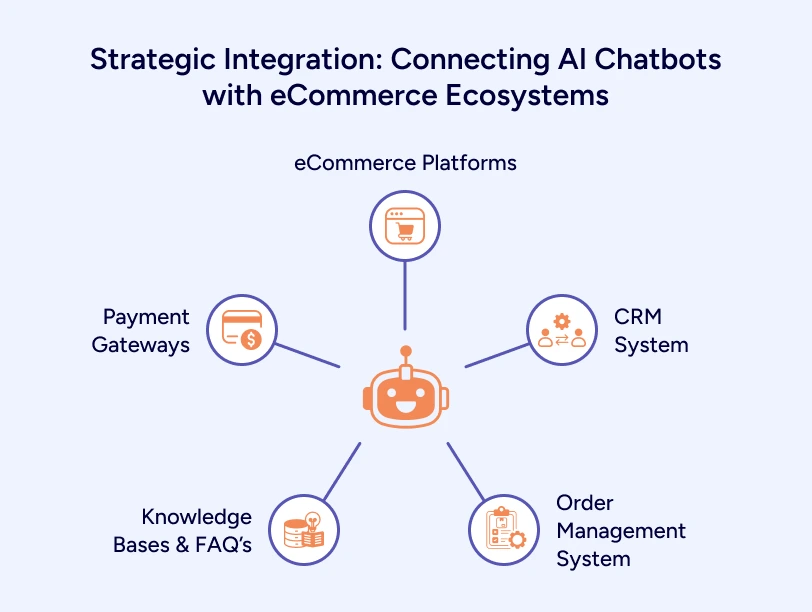
Typical integration points include:
eCommerce Platforms (e.g., Shopify, Magento, WooCommerce): Direct integration with the eCommerce platform allows chatbots to access product catalogs, inventory levels, pricing, and customer account information. This enables them to answer product-specific questions, check stock availability, and even facilitate purchases or add items to a cart.
Customer Relationship Management (CRM) Systems (e.g., Salesforce, HubSpot): Connecting with CRM systems provides chatbots with a comprehensive view of customer history, previous interactions, purchase records, and preferences. This data allows for highly personalized conversations and ensures that the chatbot's responses are consistent with past communications.
Order Management Systems (OMS): Integration with an OMS is crucial for handling order-related queries. Chatbots can pull real-time data on order status, shipping updates, and delivery information, providing customers with instant tracking and resolution.
Knowledge Bases and FAQs: AI chatbots are trained on extensive knowledge bases containing company policies, product manuals, and detailed FAQs. This ensures they have a robust foundation of information to draw upon for accurate responses.
Payment Gateways: While chatbots typically do not process payments directly, they can guide customers through payment options, troubleshoot common payment issues, and provide links to secure payment portals.
The decision to integrate requires careful planning regarding API availability, data security, and the potential impact on existing workflows. Teams must assess the compatibility of their current systems with potential chatbot solutions and consider the development effort required for seamless data exchange. A phased integration approach, starting with core functionalities and gradually expanding, can mitigate risks and ensure a smoother transition.
Decision Criteria for Adopting AI Chatbots
Implementing AI chatbots is a strategic investment that requires careful consideration of several factors. Decision-makers must evaluate the potential benefits against the associated costs, complexities, and long-term implications.
Key decision criteria include:
Volume and Nature of Customer Inquiries: Businesses with a high volume of repetitive, rule-based inquiries are prime candidates for AI chatbot adoption. If a significant portion of support tickets can be categorized and automated, the ROI for a chatbot solution will be higher.
Customer Experience Goals: Evaluate whether instant responses, 24/7 availability, and consistent information delivery align with your desired customer experience. Chatbots can significantly enhance these aspects, but they must be designed to maintain a human-like, empathetic tone where appropriate.
Budget and Resources: Consider the initial investment in chatbot platform licenses, development, integration, and ongoing maintenance. While chatbots reduce operational costs in the long run, there is an upfront expenditure. Assess the availability of internal technical resources or the need for external expertise.
Scalability Requirements: For eCommerce businesses anticipating rapid growth, chatbots offer a scalable solution that can expand capacity without a proportional increase in human agent headcount. This is a critical factor for sustainable scaling.
Data Privacy and Security: Given that chatbots interact with customer data, ensuring compliance with data privacy regulations (e.g., GDPR, CCPA) and implementing robust security measures is paramount. Choose platforms that prioritize data encryption and secure data handling.
Integration Complexity: Assess the technical feasibility and effort required to integrate the chatbot with existing eCommerce platforms, CRM, and OMS. Complex integrations may require specialized development skills.
Hybrid Model Strategy: Determine the optimal balance between AI chatbot automation and human agent intervention. A successful strategy often involves a hybrid model where chatbots handle routine tasks and seamlessly escalate complex or sensitive issues to human agents, ensuring a smooth handoff.
Teams should conduct a thorough cost-benefit analysis, considering both direct cost savings and indirect benefits such as improved customer satisfaction and brand loyalty. Pilot programs can be invaluable for testing the solution's effectiveness and gathering feedback before a full-scale rollout.
Trade-offs and Risks in AI Chatbot Implementation
While AI chatbots offer substantial benefits, their implementation is not without trade-offs and potential risks. Acknowledging these challenges is crucial for developing a robust deployment strategy and mitigating adverse outcomes.
Trade-offs:
Initial Investment vs. Long-term Savings: The upfront cost for developing, integrating, and training an AI chatbot can be significant. Businesses must weigh this against the projected long-term savings in operational costs and increased efficiency.
Automation Efficiency vs. Human Empathy: Chatbots excel at efficiency and consistency but can lack the nuanced empathy and understanding that human agents provide for highly sensitive or emotionally charged issues. Striking the right balance is key.
Data Dependency vs. Privacy Concerns: Effective chatbots rely on access to vast amounts of customer data for personalization. This data dependency introduces privacy and security risks that must be carefully managed through stringent protocols and compliance.
Standardization vs. Flexibility: Chatbots standardize responses, ensuring consistency. However, this can sometimes limit flexibility in handling highly unusual or custom requests that fall outside predefined scripts or training data.
Risks:
Poor User Experience: If a chatbot is poorly designed, lacks adequate training data, or fails to understand user intent, it can lead to frustrating customer experiences, eroding trust and potentially driving customers away.
Integration Challenges: Incompatible systems, complex APIs, or insufficient technical expertise can lead to significant integration hurdles, delaying deployment and increasing costs.
Data Security Breaches: As chatbots handle sensitive customer information, a security vulnerability could lead to data breaches, resulting in severe reputational damage and regulatory penalties.
Lack of Human Handoff: A poorly implemented escalation process, where chatbots fail to recognize when a human agent is needed or execute a clumsy handoff, can create a disjointed and frustrating customer journey.
Maintenance and Training Overhead: AI chatbots require ongoing maintenance, training with new data, and updates to their knowledge base to remain effective and relevant as products, policies, and customer behaviors evolve.
Mitigating these risks involves thorough planning, selecting reputable chatbot platforms, investing in robust security measures, and continuously monitoring chatbot performance. Establishing clear human escalation paths and ensuring agents are well-equipped to take over conversations is also critical.
Conclusion: The Future of eCommerce Customer Support
The strategic adoption of AI chatbots is no longer a luxury but a necessity for eCommerce stores aiming to provide exceptional customer support at scale. By automating routine inquiries, offering instant responses, and personalizing interactions, AI chatbots enable businesses to meet evolving customer expectations while optimizing operational efficiency. The journey involves careful planning, strategic integration with existing systems, and a clear understanding of both the opportunities and the challenges. Ultimately, a well-implemented AI chatbot solution empowers eCommerce businesses to foster stronger customer relationships, reduce costs, and achieve sustainable growth in a competitive digital landscape.
At RW Infotech, we specialize in developing sophisticated AI automation solutions, including custom AI chatbots, tailored for eCommerce businesses. Our expertise extends to seamless integration with your existing platforms, ensuring your customer support operations are not just efficient but also intelligent and scalable. We focus on delivering robust, secure, and high-performing AI agents that enhance your customer experience and drive business value.
Frequently Asked Questions
Find answers to the most common questions about How eCommerce Stores Use AI Chatbots to Handle Customer Support at Scale.
AI chatbots can handle a wide range of queries including product information, order status, shipping details, return policies, payment options, FAQs, and even personalized product recommendations.
AI chatbots integrate via APIs (Application Programming Interfaces) with eCommerce platforms (e.g., Shopify, Magento), CRM systems (e.g., Salesforce), and order management tools to access and share data for personalized support.
Primary benefits include 24/7 availability, instant responses, reduced operational costs, improved customer satisfaction, consistent information delivery, and the ability to scale support without increasing human agent headcount proportionally.
AI chatbots are designed to handle routine and predefined queries efficiently. For complex, sensitive, or highly nuanced issues, they are typically configured to seamlessly escalate to a human agent, ensuring a smooth handoff.
RW Infotech specializes in developing and integrating custom AI automation solutions, including AI chatbots, tailored for eCommerce businesses. We provide end-to-end services from strategy and development to seamless integration with your existing platforms and ongoing optimization.
News & Insights
We like to share our thoughts on topics we find inspiring. Explore our news and insights.