
Select Your Region
Region-Based Optimized Content
How to Detect Fraudulent eCommerce Orders Using AI in Shopify + Sanity
Learn how to detect fraudulent eCommerce orders using AI in Shopify + Sanity. Identify card testing fraud, chargebacks, fake account orders, bot attacks, and automate fraud prevention workflows.


eCommerce fraud presents a persistent and evolving threat to online businesses, impacting revenue, operational efficiency, and customer trust. As digital transactions grow in volume and complexity, traditional fraud detection methods often prove insufficient against sophisticated attacks. This article will explain how online stores can leverage AI-powered fraud detection systems with Shopify and Sanity CMS to identify and prevent suspicious transactions before they impact the business. We will explore common eCommerce fraud issues, how AI can analyze various risk signals in real-time, and how Shopify and Sanity can integrate with automation tools and AI workflows to create smarter fraud monitoring systems, helping businesses reduce losses and improve order security.
The Evolving Landscape of eCommerce Fraud
Online retailers face a range of fraudulent activities that can severely impact their bottom line and reputation. Understanding these common threats is the first step toward building resilient defense mechanisms. Each type of fraud exploits different vulnerabilities and requires a nuanced detection strategy.
Common eCommerce Fraud Types
Card Testing Fraud: Attackers use automated bots to test stolen credit card numbers on an eCommerce site by making small, legitimate-looking purchases. This activity generates numerous failed transactions and can lead to payment gateway blacklisting, increased processing fees, and significant operational overhead from managing false positives.
Chargeback Fraud (Friendly Fraud): A customer makes a purchase and then disputes the charge with their bank, even after receiving the product or service. This often occurs due to buyer's remorse, misunderstanding, or intentional deception. Chargebacks result in lost revenue, products, and additional fees from payment processors, negatively impacting seller ratings.
Fake Account Orders: Fraudsters create multiple fake accounts using stolen identities or synthetic data to place orders, often for resale or to exploit promotional offers. These accounts can be difficult to distinguish from legitimate ones, leading to inventory depletion and potential legal issues if stolen identities are involved.
Address Manipulation: This involves slight alterations to delivery addresses to bypass address verification systems, often redirecting packages to an intermediary or an entirely different location after initial verification. Such schemes are complex to detect manually and result in lost goods and shipping costs.
Bulk/Bot Orders: Automated bots are used to place large quantities of orders, often to hoard limited-edition products for resale at inflated prices, exploit discounts, or overwhelm a store's inventory. This not only impacts legitimate customers but can also crash a site and deplete stock, leading to significant revenue loss and customer dissatisfaction.
These fraudulent activities collectively drain resources, erode customer confidence, and can lead to severe financial penalties. Proactive and intelligent detection is crucial for sustained eCommerce success.
The Role of AI in Fraud Detection for eCommerce
Artificial Intelligence offers a significant advantage in combating eCommerce fraud by moving beyond static rules-based systems to dynamic, predictive analysis. AI models can process vast amounts of data in real-time, identifying patterns and anomalies that human analysts or traditional systems might miss.
How AI Transforms Fraud Detection
AI algorithms, particularly machine learning models, are trained on historical transaction data, including both legitimate and fraudulent orders. This training enables them to learn the characteristics associated with different types of fraud. When a new order comes in, the AI system analyzes various data points and assigns a risk score, indicating the likelihood of it being fraudulent.
Pattern Recognition: AI excels at identifying subtle patterns in transaction data, such as unusual purchase timings, repeat failed payment attempts, or specific product combinations often linked to fraud.
Behavioral Analysis: It can analyze customer behavior across multiple sessions and orders, flagging deviations from typical user activity, such as rapid checkout processes from new accounts or frequent changes in shipping addresses.
Anomaly Detection: AI can detect outliers that don't conform to established norms, like an unusually large order value for a first-time customer or a purchase from a high-risk geographic location.
Predictive Modeling: Beyond just identifying current fraud, AI can predict future fraud attempts by recognizing emerging patterns and adapting its models to new attack vectors.
Key Data Points AI Analyzes
Effective AI fraud detection relies on a rich dataset. The more comprehensive the data, the more accurate the AI's predictions will be. Key data points include:
Order Behavior: Purchase frequency, average order value, product types, use of discount codes, and shipping speed preferences.
Customer Activity: Account creation date, login patterns, browsing history, number of previous orders, and customer support interactions.
Device Fingerprinting: IP address, device type, operating system, browser version, and location data. This helps identify if multiple orders originate from the same device or network, even with different user accounts.
Payment Anomalies: Card type, issuing bank, billing address matching, number of payment attempts, and use of gift cards or unusual payment methods.
Risk Signals: Proxy usage, email domain reputation, discrepancies between billing and shipping addresses, and velocity of transactions from a single IP.
By correlating these diverse data points, AI systems can build a holistic risk profile for each transaction, enabling real-time decisions to flag, hold, or block suspicious orders automatically.
Integrating AI Fraud Detection with Shopify and Sanity
For businesses utilizing modern eCommerce stacks like Shopify for the storefront and Sanity for content management, integrating AI-powered fraud detection requires a strategic approach. This combination leverages Shopify's robust transaction processing capabilities with Sanity's flexible data management, augmented by external AI services and automation.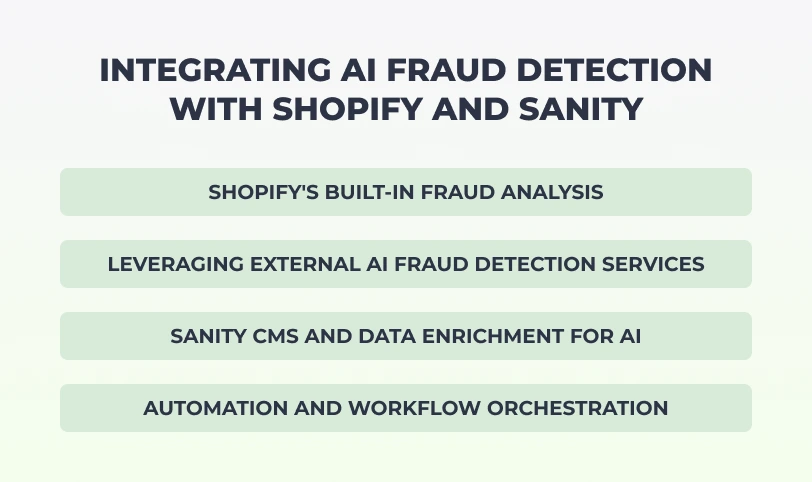
Shopify's Built-in Fraud Analysis
Shopify provides a baseline level of fraud analysis, offering risk indicators and recommendations for orders. It uses machine learning to identify suspicious transactions based on several factors, including:
IP address matches other fraudulent orders.
Billing and shipping addresses are in different geographic regions.
Multiple orders from the same IP address in a short period.
High-risk email addresses.
While useful, Shopify's native tools may not be sufficient for high-volume stores or those facing sophisticated, evolving fraud schemes. This is where integrating specialized AI fraud detection services becomes critical.
Leveraging External AI Fraud Detection Services
To enhance fraud detection, businesses often integrate third-party AI solutions. These services, such as Sift, Signifyd, or Forter, specialize in advanced machine learning for fraud prevention. They connect to your Shopify store via APIs, receiving real-time transaction data for analysis.
The workflow typically involves:
Data Ingestion: When an order is placed on Shopify, relevant order data (customer info, shipping, billing, device data) is sent to the AI fraud detection service via a webhook or API call.
Real-time Analysis: The AI service analyzes this data against its vast datasets and proprietary algorithms, generating a fraud risk score and recommendations (e.g., "approve," "review," "decline").
Decision & Action: The risk score and recommendation are sent back to Shopify. Based on pre-configured rules in Shopify or an automation platform, the order can be automatically approved, flagged for manual review, or canceled.
This integration allows businesses to leverage cutting-edge AI without developing their own complex models.
Sanity CMS and Data Enrichment for AI
While Sanity primarily manages content, it can play a supporting role in fraud detection by providing enriched customer and product data that AI models can leverage. For example:
Customer Profiles: Sanity could store extended customer profiles beyond basic Shopify data, such as loyalty program status, past interactions, or custom segments that help AI differentiate legitimate high-value customers from potential fraudsters.
Product Attributes: Detailed product information, including high-risk categories, items frequently targeted by fraudsters, or stock levels, can be managed in Sanity and fed into AI models to provide context for order analysis.
Content-driven Insights: If Sanity manages user-generated content or reviews, AI could potentially analyze sentiment or patterns in this data to identify suspicious user behavior.
The key is to ensure that any relevant data stored in Sanity is accessible via APIs and can be seamlessly integrated into the AI fraud detection workflow, either directly or through an intermediary automation platform.
Automation and Workflow Orchestration
The true power of AI fraud detection in a Shopify + Sanity environment comes from automating actions based on AI insights. Tools like Zapier, Make (formerly Integromat), or custom middleware can orchestrate complex workflows:
Automated Order Status Updates: If an AI service flags an order as high-risk, an automation can automatically change the order status in Shopify to "On Hold" and trigger an internal notification.
Manual Review Queue: For orders requiring human intervention, an automation can create a task in a project management tool (e.g., Asana, Trello) or a dedicated fraud review dashboard, pulling in all relevant order details.
Customer Communication: If an order is canceled due to high fraud risk, an automated, polite email can be sent to the customer explaining the cancellation (without revealing specific fraud detection methods).
Data Synchronization: Automation can ensure that customer data, product details, and order statuses are consistent across Shopify, Sanity, and the AI fraud detection service, providing a unified view for decision-making.
This orchestration reduces manual effort, speeds up decision-making, and ensures consistent application of fraud prevention policies.
Strategic Considerations for Implementing AI Fraud Detection
Implementing AI for fraud detection is a strategic decision that requires careful planning beyond just technical integration. Teams and decision-makers must weigh various factors to ensure the solution aligns with business goals and operational realities.
Decision Criteria and Trade-offs
Cost vs. Benefit: Evaluate the financial impact of current fraud losses against the investment in AI solutions (subscription fees, integration costs, maintenance). Consider the ROI in terms of reduced chargebacks, saved operational time, and improved customer trust.
Accuracy vs. False Positives: AI models aim for high accuracy, but there's a trade-off between aggressively blocking potential fraud and minimizing false positives (legitimate orders flagged as fraudulent). Too many false positives can lead to customer frustration and lost sales. The system should allow for tuning sensitivity.
Real-time vs. Batch Processing: For eCommerce, real-time detection is crucial to prevent fraudulent orders from being fulfilled. Ensure the chosen AI solution can provide near-instantaneous risk scores.
Customization vs. Off-the-Shelf: While custom AI models offer tailored solutions, off-the-shelf services are often quicker to implement and benefit from vast datasets across many merchants. Assess if your specific fraud patterns warrant a highly customized approach.
Scalability: The solution must scale with your business growth, handling increasing order volumes without performance degradation.


Hi, my name is Jaswinder, let's talk about your business needs.
I will do my best to find a reliable solution for you!
Risks and Long-term Implications
Data Privacy and Compliance: Ensure any AI solution complies with data privacy regulations (e.g., GDPR, CCPA) regarding customer data handling. Understand how data is stored, processed, and used by third-party AI providers.
Model Drift: Fraudsters constantly evolve their tactics. AI models need continuous monitoring and retraining to adapt to new patterns, preventing "model drift" where the model's performance degrades over time.
Integration Complexity: Integrating multiple systems (Shopify, Sanity, AI service, automation tools) can be complex. Plan for robust API integrations, error handling, and monitoring to ensure data flow integrity.
Operational Impact: While automation reduces manual work, a fraud detection system still requires oversight. Teams need to be trained on how to review flagged orders, interpret AI insights, and manage exceptions.
Customer Experience: While preventing fraud, ensure the process doesn't unduly inconvenience legitimate customers. Transparent communication for review processes and quick resolutions are key.
A well-implemented AI fraud detection system can significantly bolster an eCommerce business's defenses, leading to substantial savings and a more secure shopping environment. The strategic decisions made during planning and implementation will determine the long-term success and effectiveness of such a system.
Conclusion
Detecting fraudulent eCommerce orders using AI in Shopify + Sanity represents a critical evolution in online retail security. By moving beyond reactive measures to proactive, predictive analysis, businesses can significantly mitigate the financial and reputational damage caused by various fraud types, from card testing to sophisticated bulk orders. The strategic integration of AI-powered services with robust platforms like Shopify, complemented by flexible content management from Sanity and intelligent automation, empowers businesses to build resilient, adaptive fraud prevention systems.
For teams and decision-makers, the journey involves careful consideration of the right AI tools, seamless integration, and a clear understanding of the trade-offs between aggressive fraud blocking and maintaining a frictionless customer experience. Embracing AI for fraud detection is not merely a technical upgrade; it is a strategic imperative for safeguarding revenue, optimizing operations, and fostering enduring customer trust in the dynamic world of eCommerce.
RW Infotech specializes in developing and integrating headless solutions, AI automation, and performance optimization for modern digital platforms. Our expertise extends to architecting robust eCommerce ecosystems that leverage advanced technologies to solve complex business challenges, including enhanced security and fraud prevention. We can help your team design and implement a tailored AI fraud detection strategy that seamlessly integrates with your existing Shopify and Sanity setup, ensuring your business is protected against evolving threats.
Frequently Asked Questions
Find answers to the most common questions about How to Detect Fraudulent eCommerce Orders Using AI.
AI, particularly machine learning, can analyze vast datasets to identify subtle, non-obvious correlations and evolving patterns that indicate new fraud schemes. Unlike static rules, AI models adapt and learn from new data, allowing them to detect novel attack vectors as they emerge, improving their accuracy over time.
AI analyzes a wide range of data points including order behavior (e.g., order value, frequency), customer activity (e.g., account age, login patterns), device fingerprinting (e.g., IP address, device type), payment anomalies (e.g., multiple failed attempts), and risk signals (e.g., proxy usage, address discrepancies).
Yes, AI fraud detection services typically integrate with Shopify via APIs and webhooks for real-time transaction data. While Sanity CMS primarily handles content, it can serve as a source for enriched customer or product data that AI models can leverage, often orchestrated through automation platforms that connect all systems.
When an AI system flags an order as high-risk, pre-defined automated actions can be triggered. This might include automatically placing the order on hold for manual review, canceling the order, or requesting additional verification from the customer. The specific action depends on the business's fraud policy and the risk score assigned by the AI.
RW Infotech can help by designing and implementing custom AI automation workflows, integrating advanced third-party AI fraud detection services with your Shopify and Sanity setup, and optimizing your overall eCommerce platform for security and performance. We focus on creating robust, scalable solutions tailored to your business needs.
News & Insights
We like to share our thoughts on topics we find inspiring. Explore our news and insights.