
Select Your Region
Region-Based Optimized Content
Why Logistics Businesses Need a Custom Mobile App in 2026
Discover why logistics businesses need a custom mobile app in 2026 to manage drivers, enable live tracking, optimize routes, and scale operations efficiently.


The logistics industry is a relentless machine, constantly evolving to meet the demands of global commerce. In 2026, the pace is faster than ever, driven by eCommerce proliferation, last-mile delivery complexities, and heightened customer expectations. To thrive in this environment, businesses must embrace digital transformation, and at the heart of this evolution lies the custom mobile app. It's no longer a luxury but an indispensable tool for managing modern logistics operations efficiently.
From tracking driver attendance and streamlining shift management to facilitating real-time updates from the field, a bespoke mobile application addresses the daily operational challenges that plague traditional systems. This article will delve into why logistics businesses need a custom mobile app in 2026, exploring how these powerful tools empower drivers, optimize company-wide operations, and pave the way for scalable growth and unparalleled transparency.
The Evolving Landscape of Logistics in 2026
The logistics sector is characterized by its dynamic nature. Consumer expectations for speed and transparency have never been higher, fueled by the instant gratification of online shopping. This necessitates a supply chain that is not just efficient but also agile and highly responsive. Manual processes, fragmented communication, and outdated data management systems are no longer viable. The sheer volume and complexity of operations demand a robust, integrated solution.
Moreover, the rise of AI automation and advanced analytics offers unprecedented opportunities for optimization. Logistics companies that fail to integrate these technologies risk falling behind competitors who leverage data for predictive insights, optimized routing, and enhanced operational control. A custom mobile app acts as the central nervous system, connecting all these disparate elements into a cohesive, intelligent network.
Solving Daily Operational Challenges with Mobile Apps
The daily grind of logistics presents a myriad of challenges, from managing a mobile workforce to ensuring timely deliveries. A custom mobile app is specifically designed to tackle these pain points head-on, transforming operational bottlenecks into streamlined workflows.
Driver Attendance and Shift Management
For a workforce that is constantly on the move, traditional punch-in/punch-out systems are impractical. Custom mobile apps offer geo-fencing and GPS-based attendance tracking, allowing drivers to clock in and out from their designated locations. This not only ensures accurate payroll but also provides real-time visibility into workforce availability. Shift scheduling becomes dynamic, allowing managers to assign routes and tasks based on driver availability, location, and even traffic conditions. Drivers can view their schedules, accept or decline shifts, and request leave directly through the app, significantly reducing administrative overhead.
Real time Updates from the Field
One of the most critical aspects of logistics is timely information dissemination. Drivers, who are often the first point of contact with customers and the last mile of the supply chain, need a seamless way to communicate. A custom app enables them to update delivery checkpoints, confirm order statuses, capture proof of delivery (e.g., photos, signatures), and input tracking numbers instantly. This real-time data flow ensures that dispatchers, customer service, and end-customers are always in the loop, enhancing transparency and customer satisfaction. It also allows for immediate reporting of issues like traffic delays, vehicle breakdowns, or delivery exceptions, enabling rapid response and problem-solving.
Leave Approvals and Communication
Managing leave requests and internal communication for a large, distributed team can be a logistical nightmare. A mobile app centralizes this process. Drivers can submit leave requests directly through the app, which are then routed to the appropriate manager for approval. Automated notifications keep all parties informed. Furthermore, the app can serve as a communication hub, allowing for company-wide announcements, individual messages to drivers, and even group chats for specific routes or teams. This fosters better communication and reduces reliance on phone calls or emails, which can be inefficient during active operations.
Key Benefits for Logistics Companies
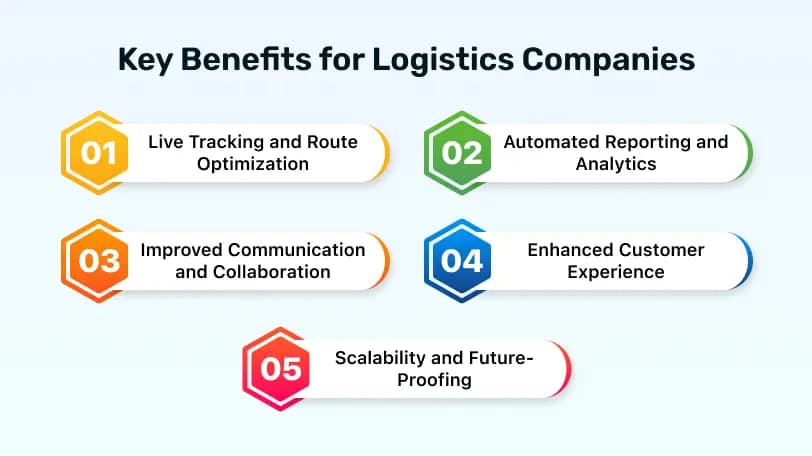
Beyond solving immediate operational hurdles, a custom mobile app delivers substantial strategic advantages that contribute to a logistics company's bottom line and long-term success.
Live Tracking and Route Optimization
The ability to track vehicles and shipments in real time is transformative. GPS integration within a custom app provides dispatchers with an accurate overview of their entire fleet's location and progress. This visibility is crucial for proactive management, allowing for immediate adjustments to routes in response to traffic, weather, or unexpected delays. Furthermore, advanced route optimization algorithms can be integrated, leveraging historical data and real time conditions to calculate the most efficient paths, saving fuel, reducing delivery times, and minimizing operational costs. This capability is a cornerstone of modern supply chain efficiency.
Automated Reporting and Analytics
Manual data entry and report generation are time-consuming and prone to errors. A custom mobile app automates the collection of vast amounts of operational data from delivery times and mileage to fuel consumption and driver performance. This data is then automatically compiled into customizable reports and dashboards, offering actionable insights. Companies can analyze trends in delivery efficiency, identify bottlenecks, monitor driver productivity, and assess vehicle utilization. This data-driven approach supports continuous improvement and strategic decision making.
Improved Communication and Collaboration
Effective communication is the lifeblood of logistics. A custom app creates a unified communication channel between drivers, dispatchers, warehouse staff, and management. Instant messaging, push notifications, and integrated voice/video calls ensure that critical information is shared promptly. This improves coordination, reduces miscommunications, and fosters a more collaborative working environment. For instance, a driver encountering an issue can instantly communicate with support, who can then access relevant order details and provide immediate guidance.
Enhanced Customer Experience
In today's competitive market, customer experience is a key differentiator. A custom mobile app can extend its functionality to customers, offering real-time tracking of their shipments, estimated delivery times, and direct communication channels. This transparency builds trust and reduces anxiety. Automated notifications keep customers informed at every stage of their delivery, from dispatch to arrival. The ability to provide accurate, up-to-the-minute information significantly elevates customer satisfaction and loyalty.
Scalability and Future Proofing
As logistics businesses grow, their operational needs become more complex. A custom mobile app is built with scalability in mind, designed to adapt to increasing fleet sizes, new service offerings, and expanding geographical reach. Unlike off-the-shelf solutions, a custom app can be easily integrated with existing enterprise systems (ERP, WMS) and can incorporate new features as business requirements evolve. This future-proofs the investment, ensuring the technology remains relevant and effective for years to come, supporting long-term business objectives.
Practical Examples and Use Cases
Let's consider some real-world scenarios where a custom mobile app proves invaluable:
Last-Mile Delivery Optimization: A food delivery service uses its custom app to assign orders to the nearest available driver, optimize delivery sequences based on traffic, and provide customers with a live map of their driver's location. Drivers use the app to confirm deliveries with photo proof and collect digital signatures.
Freight Management for Long Haul: A trucking company equips its drivers with an app that tracks their hours of service (HOS) to ensure compliance, provides real-time weather alerts along their route, and allows them to report vehicle maintenance issues directly from the road, scheduling repairs proactively.
Warehouse to Store Distribution: A retail logistics provider uses an app for warehouse staff to scan items for loading, verify manifests, and communicate directly with store managers about incoming shipments. Drivers use it for route navigation and to confirm successful store deliveries.
Field Service Logistics: For businesses that deliver and install equipment, the app manages technician schedules, provides access to equipment manuals, allows for on-site inventory checks, and processes payment upon job completion.
The flexibility of a custom solution allows for the integration of various technologies, including:
Geofencing: For automated attendance and location-based task assignments.
QR/Barcode Scanning: For efficient inventory management and proof of delivery.
API Integrations: Connecting with mapping services (Google Maps, HERE Maps), payment gateways, ERP systems, and weather APIs.
AI-powered Predictive Analytics: For forecasting demand, optimizing fleet maintenance schedules, and predicting potential delivery delays.


Hi, my name is Jaswinder, let's talk about your business needs.
I will do my best to find a reliable solution for you!
Conclusion
As we navigate the complexities of 2026, the question for logistics businesses is no longer if they need a mobile app, but how sophisticated and tailored that app needs to be. A custom mobile app is a strategic imperative, offering a competitive edge by transforming operational challenges into opportunities for efficiency, transparency, and growth. It empowers your mobile workforce, provides invaluable data for decision-making, and significantly enhances the customer experience.
By investing in a custom solution, logistics companies can reduce manual work, mitigate risks, optimize resource allocation, and foster a culture of real-time communication. This leads to substantial cost savings, improved service delivery, and ultimately, a more resilient and profitable business model. The future of logistics is mobile, connected, and intelligent, and a bespoke application is the key to unlocking that future.
How RW Infotech Can Help
At RW Infotech, we understand the intricate demands of the logistics sector. Since 2012, we've been at the forefront of developing innovative digital solutions that drive real business value. Our expertise spans Headless Solutions, Jamstack website development, Headless CMS migrations, and Full Stack Development, making us uniquely positioned to architect and build custom mobile applications tailored to your specific logistics needs. We also help businesses build scalable multi-service platforms similar to a gojek clone, enabling companies to integrate transportation, delivery, and service management into a single digital ecosystem.
We leverage cutting-edge technologies and best practices to create robust, scalable, and intuitive mobile apps that seamlessly integrate with your existing systems. From AI automation for predictive analytics and route optimization to performance optimization for lightning-fast user experiences, we ensure your custom app is not just functional but truly transformative. Partner with RW Infotech to design, develop, and deploy a custom mobile app that will empower your logistics business to thrive in 2026 and beyond.
Frequently Asked Questions
Find answers to the most common questions about Why Logistics Businesses Need a Custom Mobile App in 2026.
The timeline for developing a custom logistics mobile app varies significantly depending on the complexity of features, integrations required, and the size of the development team. A basic app with core functionalities might take 3-6 months, while a more comprehensive solution with advanced features like AI-driven route optimization, complex integrations with ERP/WMS systems, and intricate reporting could extend to 9-18 months or even longer. At RW Infotech, we follow an agile development methodology, allowing for iterative releases and continuous feedback to ensure timely delivery without compromising quality.
Security is paramount for logistics apps, as they often handle sensitive data such as customer information, shipment details, driver locations, and payment data. Key considerations include end-to-end encryption for data in transit and at rest, robust authentication mechanisms (e.g., multi-factor authentication, biometric login), secure API design, regular security audits and penetration testing, and compliance with relevant data protection regulations like GDPR or CCPA. Implementing role-based access control ensures that users only access the data necessary for their specific tasks, minimizing potential vulnerabilities.
Absolutely. One of the primary advantages of a custom mobile app is its ability to integrate seamlessly with existing legacy systems such as Enterprise Resource Planning (ERP), Warehouse Management Systems (WMS), Transportation Management Systems (TMS), and accounting software. This is typically achieved through Application Programming Interfaces (APIs). Our development process at RW Infotech includes a thorough analysis of your current infrastructure to design and implement robust API integrations, ensuring a smooth flow of data between your new mobile app and your established backend systems, preserving your existing investments while modernizing your operations.
The Return on Investment (ROI) for a custom logistics mobile app can be substantial, though it varies based on the initial investment and the scope of implementation. Benefits that contribute to ROI include significant reductions in operational costs (e.g., fuel savings from optimized routes, reduced administrative overhead), improved efficiency and productivity (faster deliveries, less manual data entry), enhanced customer satisfaction leading to higher retention, better data for strategic decision-making, and increased scalability for future growth. While some benefits are tangible and directly measurable, others, like improved brand reputation and employee satisfaction, contribute to long-term value that can be harder to quantify but are equally important.
An off-the-shelf logistics software solution is a pre-built product designed to cater to a broad range of businesses. While often quicker to deploy and less expensive initially, they typically offer limited customization options, meaning businesses must adapt their processes to the software's capabilities. A custom app, conversely, is built from the ground up to address the unique workflows, challenges, and specific requirements of your business. This ensures a perfect fit, optimal efficiency, seamless integration with existing systems, and the flexibility to evolve with your business needs. While the upfront investment might be higher, a custom solution often provides greater long-term value, competitive advantage, and scalability that generic solutions cannot match.
News & Insights
We like to share our thoughts on topics we find inspiring. Explore our news and insights.
Why Marketing Teams Prefer Headless CMS for Modern Websites
Learn how headless CMS helps marketing teams manage content independently, launch campaigns faster, improve collaboration, personalize customer experiences, and deliver content across multiple channels.
Which Headless CMS Is Best for Content-Heavy Websites in 2026?
Discover the best headless CMS platforms for content-heavy websites in 2026. Compare Sanity, Strapi, Contentful, Storyblok, Directus, and other leading options.