
Select Your Region
Region-Based Optimized Content
How to Integrate AI Chat Shopping Assistants with Shopify Headless Stores
Learn how to integrate AI chat shopping assistants with Shopify headless stores to boost conversions, improve product discovery, and deliver personalized customer experiences.

Jaswinder Singh

The modern eCommerce landscape demands highly personalized and efficient customer interactions. For businesses leveraging Shopify headless stores, integrating AI chat shopping assistants represents a significant opportunity to enhance engagement, streamline the customer journey, and drive conversions. This approach moves beyond traditional chatbots to offer intelligent, context-aware assistance that mimics a human sales associate, available 24/7.
This article will explore the strategic advantages, technical considerations, and practical steps involved in integrating AI chat shopping assistants with Shopify headless setups. We will cover how these AI tools improve product discovery, offer personalized recommendations, provide real-time support, and guide customers through the purchasing process, ultimately creating a more interactive and satisfying shopping experience. For decision-makers and technical teams, understanding these integrations is crucial for maintaining a competitive edge in digital commerce.
The Strategic Value of AI Chat Shopping Assistants in Headless Commerce
Integrating AI chat shopping assistants into a headless Shopify store offers a distinct competitive advantage by addressing key customer pain points and operational inefficiencies. Unlike monolithic platforms, headless commerce separates the frontend presentation layer from the backend commerce engine, providing unparalleled flexibility. This architectural freedom is precisely what enables sophisticated AI integrations to thrive without being constrained by template limitations.
From a customer perspective, AI assistants provide immediate, personalized support. They can answer product-specific questions, offer tailored recommendations based on browsing history and stated preferences, and even assist with order tracking or returns. This reduces friction in the buying journey, making it smoother and more intuitive. For businesses, this translates into higher customer satisfaction, increased conversion rates, and a reduction in the workload on human support teams.
Operationally, AI chat assistants gather valuable data on customer interactions, common queries, and purchasing patterns. This data can be leveraged to refine product offerings, optimize marketing strategies, and improve the overall user experience. The ability to scale support without proportional increases in staffing costs is another significant benefit, particularly for businesses experiencing rapid growth or seasonal spikes in demand. The investment in AI integration for a headless setup positions a brand for future scalability and enhanced customer loyalty.
Key Capabilities of AI Chat Shopping Assistants
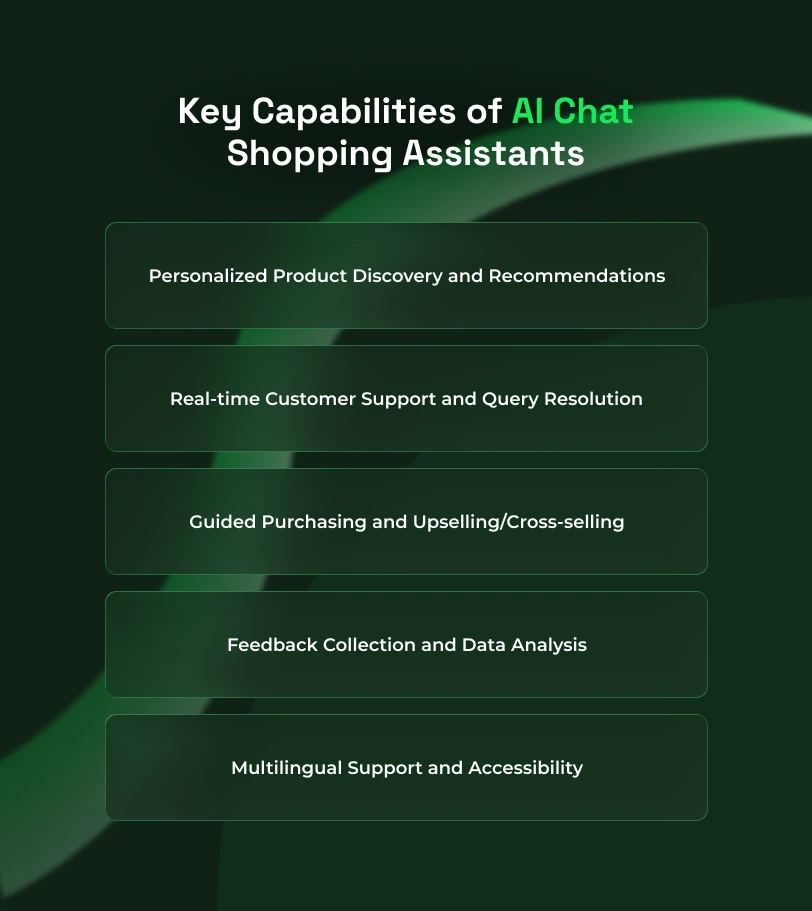 Effective AI chat shopping assistants go beyond simple FAQ responses. They leverage advanced natural language processing (NLP) and machine learning (ML) to provide a rich, interactive experience. Understanding these core capabilities is vital for selecting and configuring the right solution for a Shopify headless store.
Personalized Product Discovery and Recommendations: AI assistants can analyze a user's browsing behavior, past purchases, and explicit inquiries to suggest relevant products. For instance, if a customer asks for "a durable laptop for coding," the AI can cross-reference product specifications with user reviews to offer suitable options, complete with direct links to product pages within the headless frontend. This moves beyond static recommendation engines by engaging in dynamic dialogue.
Real-time Customer Support and Query Resolution: Beyond pre-programmed responses, AI can handle a wide array of customer service inquiries. This includes checking order status, providing shipping information, explaining return policies, and even troubleshooting minor product issues. By resolving common queries instantly, human support agents are freed to address more complex or sensitive customer needs.
Guided Purchasing and Upselling/Cross-selling: AI assistants can guide customers through the purchasing funnel, clarifying product features, comparing options, and answering questions that might otherwise lead to cart abandonment. They can also identify opportunities for upselling or cross-selling by suggesting complementary products or premium versions based on the current selection. For example, if a customer is viewing a camera, the AI might suggest a compatible lens or a protective case.
Feedback Collection and Data Analysis: Post-interaction, AI assistants can solicit feedback on the customer experience, providing valuable insights into pain points and areas for improvement. The aggregated data from these interactions offers a rich source of information for product development, marketing optimization, and overall business strategy. This continuous feedback loop is crucial for iterative improvement in a headless environment.
Multilingual Support and Accessibility: For global brands, AI assistants can offer support in multiple languages, significantly broadening reach and improving the experience for a diverse customer base. Their text-based nature also inherently supports accessibility requirements for users who may prefer or require non-verbal communication.
These capabilities collectively transform the online shopping experience from a passive interaction into an active, guided journey, fostering stronger customer relationships and driving business growth.
Architectural Considerations for Integration
Integrating AI chat shopping assistants with Shopify headless stores requires a well-planned technical architecture that ensures seamless data flow, responsiveness, and scalability. The headless nature of the setup means the AI assistant needs to interact with various independent services rather than a single monolithic platform.
Connecting the AI Assistant to Shopify APIs
The core of the integration lies in enabling the AI assistant to communicate with Shopify's robust APIs. Shopify provides both a Storefront API (for public data like products and collections) and an Admin API (for managing orders, customers, and inventory). The AI assistant will primarily leverage the Storefront API to retrieve product details, inventory levels, and customer-facing information.
Authentication for API access is critical. For the Storefront API, a public access token is typically sufficient for read-only operations. For more sensitive actions, such as creating a cart or managing customer data (if the AI is designed for such interactions), private app access tokens or OAuth flows might be necessary, ensuring secure communication. The AI platform will need to be configured with the appropriate API keys and endpoints.
// Example of fetching product data using Shopify Storefront API
const query = `
  query getProductByHandle($handle: String!) {
    productByHandle(handle: $handle) {
      id
      title
      descriptionHtml
      priceRange {
        minVariantPrice {
          amount
          currencyCode
        }
      }
      images(first: 1) {
        edges {
          node {
            url
          }
        }
      }
    }
  }
`;

const variables = { handle: "your-product-handle" };

fetch('https://YOUR_SHOPIFY_STORE_DOMAIN/api/2023-10/graphql.json', {
  method: 'POST',
  headers: {
    'Content-Type': 'application/json',
    'X-Shopify-Storefront-Access-Token': 'YOUR_STOREFRONT_ACCESS_TOKEN',
  },
  body: JSON.stringify({ query, variables }),
})
.then(response => response.json())
.then(data => console.log(data.data.productByHandle))
.catch(error => console.error('Error:', error));The AI assistant will parse user queries, translate them into API calls (e.g., "show me red t-shirts" becomes an API query filtering products by tag or color variant), and then present the results back to the user in a conversational format. This requires robust error handling and clear communication of API limitations.
Integrating with Headless Frontends
The AI chat interface itself will reside within the headless frontend application (e.g., built with React, Vue, Next.js, or Gatsby). This means the AI platform's SDK or API will be integrated directly into the frontend code. When a user interacts with the chat widget, the frontend sends the query to the AI service, which then processes it, potentially interacts with Shopify APIs, and returns a response. The frontend then renders this response.
Key considerations here include:
Widget Placement and Design: The chat widget should be unobtrusive yet easily accessible. Its design should align with the brand's aesthetic, which is fully controllable in a headless environment.
State Management: The frontend needs to manage the chat conversation state, ensuring continuity across interactions and potentially across different pages.
Performance: The AI integration should not negatively impact the frontend's performance. Asynchronous loading of the chat widget and efficient API calls are crucial.
User Experience: Clear loading indicators, quick response times, and intuitive conversation flows are essential for a positive user experience.
Data Flow and Orchestration
The overall data flow involves several components:
User input via the headless frontend chat widget.
Frontend sends input to the AI platform (e.g., Google Dialogflow, IBM Watson Assistant, custom LLM integration).
AI platform processes the input, identifies intent, and extracts entities.
Based on intent, the AI platform makes calls to relevant services:
Shopify Storefront API (for product data, collections, customer-facing info).
Shopify Admin API (for order tracking, if exposed securely).
Potentially other third-party services (e.g., inventory management, shipping providers for detailed tracking).
Responses from these services are processed by the AI platform.
AI platform generates a natural language response.
Response is sent back to the headless frontend.
Frontend displays the response to the user.
This orchestration layer, often handled by a middleware or serverless functions, is crucial for managing complex interactions and abstracting the underlying APIs from the AI platform. It ensures secure and efficient communication between all components.
Choosing the Right AI Chat Platform and Integration Strategy
The market offers various AI chat platforms, each with different strengths and integration complexities. The choice depends on factors such as budget, required sophistication, development resources, and long-term scalability goals.
Off-the-Shelf AI Chat Solutions
Many platforms offer pre-built AI chat functionalities that can be integrated with relatively less development effort. These often come with intuitive interfaces for training the AI, managing intents, and defining conversational flows.
Examples: Intercom, Zendesk Chat (with AI add-ons), Drift, LiveChat AI.
Pros: Faster time-to-market, lower initial development cost, often include robust analytics and reporting, pre-trained models for common eCommerce queries.
Cons: Less customization flexibility, potential vendor lock-in, recurring subscription costs, may not integrate as deeply with niche headless functionalities without custom development.
Integration Strategy: Typically involves embedding a JavaScript SDK into your headless frontend and configuring the platform to connect to Shopify APIs (often through webhooks or pre-built connectors).
Custom AI Solutions (Leveraging LLMs and Cloud AI Services)
For brands requiring highly specific interactions, deep integration with unique business logic, or a truly bespoke brand voice, building a custom AI solution using foundational models and cloud AI services is a viable path.
Examples: Google Dialogflow, IBM Watson Assistant, Microsoft Azure Bot Service, OpenAI's GPT models (via API).
Pros: Maximum customization, complete control over data and logic, ability to integrate with any custom backend service, potential for highly differentiated experiences.
Cons: Higher initial development cost and complexity, requires significant AI/ML expertise, ongoing maintenance and training.
Integration Strategy:
Frontend Integration: Develop a custom chat widget or integrate a minimalist SDK (e.g., a simple API client) into your headless frontend.
Backend Orchestration: Create a middleware layer (e.g., using Node.js, Python, or serverless functions like AWS Lambda, Google Cloud Functions) to handle communication between the frontend, the chosen AI service, and Shopify APIs. This layer will manage API keys, format requests, and parse responses.
AI Model Training: Train your chosen AI service (e.g., Dialogflow agent, custom GPT model) with intents (what the user wants to do), entities (key information in the user's request), and conversational flows specific to your product catalog and business rules.
Data Synchronization: Implement mechanisms to keep your AI model updated with product data from Shopify (e.g., daily syncs, webhooks for product updates).
Decision Criteria
Complexity of Interactions: For simple FAQs, off-the-shelf might suffice. For complex, multi-turn conversations requiring deep product knowledge and personalized recommendations, custom solutions offer more power.
Budget and Resources: Custom solutions demand more investment in development and ongoing AI training expertise.
Scalability Needs: Both approaches can scale, but custom solutions offer more granular control over infrastructure.
Data Privacy and Control: Custom solutions provide greater control over how customer data is processed and stored.
Time-to-Market: Off-the-shelf solutions are generally quicker to deploy.
For many Shopify headless stores, a hybrid approach might be optimal: starting with an off-the-shelf solution for basic support and progressively integrating more custom AI capabilities as needs evolve and data accumulates.


Hi, my name is Jaswinder, let's talk about your business needs.
I will do my best to find a reliable solution for you!
Implementation Best Practices and Long-Term Considerations
Successful integration of AI chat shopping assistants extends beyond initial setup; it requires continuous optimization and strategic foresight.
Phased Rollout and Iterative Improvement
Instead of a "big bang" launch, consider a phased rollout. Start with a limited set of capabilities (e.g., product search and basic FAQs) and progressively add more complex features like personalized recommendations or order tracking. This allows for testing, gathering user feedback, and refining the AI model without overwhelming the system or users. Continuous monitoring of conversation logs is crucial for identifying areas where the AI struggles and requires retraining or new intents.
Data Privacy and Compliance
Handling customer data through an AI assistant requires strict adherence to privacy regulations like GDPR and CCPA. Ensure that your chosen AI platform and integration strategy comply with these laws. Clearly communicate data usage policies to users. Avoid collecting unnecessary personal identifiable information (PII) through the chat and ensure secure handling of any data that is collected. For headless setups, which often involve multiple third-party services, a comprehensive data governance strategy is paramount.
Human in the Loop Strategy
AI assistants are powerful, but they are not infallible. Implement a "human-in-the-loop" strategy where complex or unresolved queries are seamlessly escalated to a human agent. This ensures that customers always receive satisfactory support and provides valuable training data for the AI. The AI should be able to hand over the conversation context to the human agent, avoiding repetitive questioning for the customer.
Performance and Scalability
The AI assistant must be performant, providing quick responses without noticeable delays. Optimize API calls, ensure efficient data processing, and leverage caching mechanisms where appropriate. As your business grows, the AI solution must scale to handle increased traffic and a broader range of inquiries. Cloud-native AI services are generally designed for scalability, but your custom orchestration layer must also be robust.
Monitoring and Analytics
Implement comprehensive monitoring for the AI assistant's performance. Track metrics such as resolution rate, escalation rate, customer satisfaction scores (e.g., through post-chat surveys), and conversion rates influenced by AI interactions. These analytics are vital for understanding the ROI of your AI investment and guiding future improvements. Identify common unanswered questions, frequently requested features, and areas where the AI provides incorrect information.
Maintaining Brand Voice
In a headless environment, you have complete control over the frontend and therefore the AI's persona. Ensure the AI assistant's language, tone, and personality align with your brand voice. This consistency across all touchpoints strengthens brand identity and improves the overall customer experience. Custom AI solutions offer greater flexibility in this regard compared to generic off-the-shelf options.
By adhering to these best practices, businesses can maximize the benefits of AI chat shopping assistants in their Shopify headless stores, creating a highly engaging, efficient, and scalable customer experience.
Conclusion
Integrating AI chat shopping assistants with Shopify headless stores is no longer a luxury but a strategic imperative for businesses aiming to deliver exceptional customer experiences and drive growth. By leveraging the flexibility of a headless architecture, brands can deploy intelligent assistants that offer personalized product discovery, real-time support, and guided purchasing, all while maintaining complete control over the user interface and brand narrative.
The decision to adopt an off-the-shelf solution or build a custom AI platform depends on specific business needs, resources, and desired levels of customization. Regardless of the chosen path, a focus on seamless API integration, robust data orchestration, and continuous improvement is critical for success. These AI-powered tools not only enhance customer satisfaction and reduce operational costs but also provide invaluable insights into customer behavior, fueling future business decisions.
For organizations looking to implement or optimize AI chat shopping assistants within their headless commerce ecosystem, RW Infotech offers expert guidance and development services. Our specialization in headless solutions, Jamstack development, and AI automation enables us to design and integrate sophisticated AI assistants that seamlessly connect with Shopify APIs and custom frontends, ensuring high performance, scalability, and a superior customer journey. Partner with us to transform your digital commerce experience.
Frequently Asked Questions
Find answers to the most common questions about AI Chat Shopping Assistants with Shopify Headless Stores.
AI assistants integrate with Shopify's Storefront API to fetch product variant data (e.g., sizes, colors). When a user asks for a specific variant, the AI queries the API, retrieves available options, and presents them in a conversational format, often with direct links to the correct product page or variant selection.
While AI assistants can typically provide order status updates by querying the Shopify Admin API (with appropriate secure access), direct order modifications or sensitive customer account management are usually escalated to human agents due to security and complexity concerns. It's best practice to limit AI to read-only or low-risk actions for security.
A custom AI chat assistant integration can range from 3 to 6 months or more, depending on the complexity of desired features, the extent of AI model training required, and the integration points with various APIs. This includes design, development of the orchestration layer, AI training, and testing phases.
RW Infotech specializes in headless solutions, AI automation, and full-stack development. We can assist with selecting the right AI platform, developing custom integration layers, connecting with Shopify APIs, and building a high-performance headless frontend to ensure your AI chat shopping assistant delivers a seamless and effective customer experience.
News & Insights
We like to share our thoughts on topics we find inspiring. Explore our news and insights.