
Select Your Region
Region-Based Optimized Content
Why AI-Generated Code Still Needs Human Review in Production Applications
Learn why AI-generated code still requires human review in production applications. Explore security risks, performance issues, business logic validation, and best practices for AI-assisted software development.


AI coding tools have rapidly evolved into powerful productivity enhancers, offering unprecedented speed in generating code snippets, automating repetitive tasks, and accelerating prototyping. These capabilities are transforming development workflows, enabling teams to move faster than ever before. However, the promise of fully autonomous code generation for production-ready applications remains a significant leap. While AI can produce functional code, deploying it without rigorous human review introduces substantial risks that can undermine application quality, security, and long-term maintainability.
This article explores the strategic advantages of leveraging AI in the development process while emphasizing why experienced human oversight is indispensable for production applications. We will examine the critical areas where AI-generated code often falls short including security, performance, and business logic and outline the essential human-led processes required to mitigate these risks. For teams and decision-makers, understanding this balance is crucial for harnessing AI's benefits without compromising software integrity.
The Strategic Advantages of AI-Generated Code
Integrating AI into development workflows offers several compelling benefits that can significantly boost efficiency and accelerate project timelines. These advantages make AI an invaluable tool when applied judiciously.
Accelerated Development and Prototyping: AI tools can generate boilerplate code, function stubs, and even complete components in seconds. This speed allows developers to rapidly prototype ideas, experiment with different approaches, and build out features much faster than manual coding.
Automation of Repetitive Tasks: AI excels at automating mundane and repetitive coding tasks, such as writing getter/setter methods, generating database schemas from models, or converting data formats. This frees up developers to focus on more complex, high-value problem-solving.
Code Suggestions and Refactoring: Advanced AI assistants provide real-time code suggestions, autocompletions, and refactoring recommendations, improving code quality and consistency. They can identify potential bugs or suggest more efficient algorithms based on common patterns.
Learning and Knowledge Sharing: AI can analyze vast codebases to identify patterns, enforce coding standards, and even generate documentation. This acts as a powerful learning tool for junior developers and helps maintain consistency across large teams.
These benefits position AI as a force multiplier, augmenting human capabilities rather than replacing them. The challenge lies in understanding its limitations and establishing robust guardrails for production deployment.
Critical Gaps: Why AI-Generated Code Still Needs Human Review
Despite its advancements, AI-generated code frequently exhibits deficiencies that necessitate expert human intervention before deployment to production. These gaps often stem from AI's lack of true contextual understanding, strategic foresight, and the ability to reason beyond patterns.
Security Vulnerabilities and Best Practices
One of the most significant risks of unreviewed AI-generated code is the introduction of security vulnerabilities. AI models are trained on vast datasets, which may include insecure patterns or outdated practices. While they can identify common vulnerabilities, they often struggle with nuanced security considerations or emerging threats. For instance, AI might generate code that:
Fails to properly sanitize user inputs, leading to SQL injection or cross-site scripting (XSS) vulnerabilities.
Uses insecure default configurations or weak cryptographic practices.
Exposes sensitive data through improper logging or error handling.
Lacks robust authentication and authorization checks tailored to specific application requirements.
Human security experts are crucial for identifying these subtle flaws, ensuring adherence to organizational security policies, and implementing defense-in-depth strategies. They understand the evolving threat landscape and can anticipate attack vectors that AI might overlook.
Logic Errors and Business Context Understanding
AI excels at pattern matching but often lacks the deep understanding of business logic and domain-specific requirements that human developers possess. This can lead to code that is syntactically correct but functionally flawed. Examples include:
Incorrectly implementing complex business rules, leading to erroneous calculations or workflows.
Misinterpreting edge cases or unusual scenarios that are critical for specific business operations.
Failing to account for implicit requirements or non-functional aspects that are not explicitly coded in the prompt.
Generating code that works in isolation but conflicts with existing system architecture or data models.
Human review ensures that the generated code accurately reflects the intended business logic, aligns with user expectations, and integrates seamlessly into the broader application ecosystem. Developers can ask clarifying questions, challenge assumptions, and validate the code against real-world scenarios.
Performance Bottlenecks and Scalability Concerns
While AI can generate functional code, it may not always produce the most performant or scalable solutions. AI models often prioritize correctness over efficiency, leading to:
Inefficient algorithms or data structures that result in slow processing times.
Suboptimal database queries that can lead to performance degradation under load.
Lack of consideration for resource utilization, potentially causing high memory or CPU consumption.
Code that does not scale well with increasing user traffic or data volumes, leading to system instability in production.
Experienced developers, particularly those skilled in full stack development and performance optimization, can identify these bottlenecks. They can refactor code, optimize algorithms, and design systems that are inherently scalable and resilient, considering factors like caching strategies, asynchronous processing, and distributed architectures.
Compliance, Maintainability, and Technical Debt
Production applications must adhere to various compliance standards (e.g., GDPR, HIPAA), maintain high code quality, and avoid accumulating excessive technical debt. AI-generated code can present challenges in these areas:
Compliance Risks: AI may not be aware of specific regulatory requirements, potentially generating code that violates data privacy laws or industry standards.
Code Style and Consistency: While AI can adopt certain styles, maintaining consistent coding standards across a large codebase, especially with multiple developers and AI tools, requires human governance. Inconsistent code is harder to read, debug, and maintain.
Technical Debt: AI might generate overly complex, redundant, or difficult-to-understand code, increasing technical debt. This can make future modifications, bug fixes, and feature enhancements more time-consuming and costly.
Lack of Documentation: While some AI tools can generate comments, comprehensive, context-rich documentation and clear architectural decisions often require human input to be truly useful for future maintenance.
Human developers are essential for enforcing coding standards, conducting thorough code reviews for maintainability, and ensuring that the codebase remains clean, well-documented, and compliant over its lifecycle.
Integrating AI with Human Oversight for Production Readiness
The most successful development teams view AI as a powerful assistant, not a replacement. Integrating AI effectively involves a strategic framework that combines AI's speed with human intelligence, ensuring robust, secure, and maintainable applications. This is why AI-generated code still needs human review in production applications.
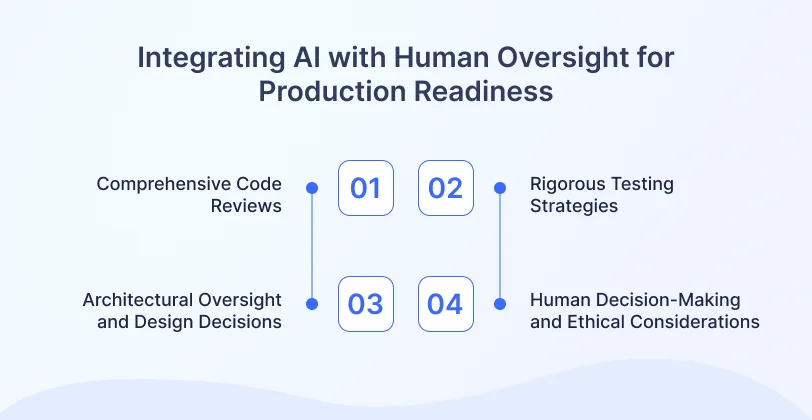
Comprehensive Code Reviews
Code reviews become even more critical when AI is part of the development process. Human reviewers must:
Validate Logic: Ensure the code accurately implements business requirements and handles edge cases correctly.
Assess Security: Scrutinize for potential vulnerabilities, insecure patterns, and adherence to security best practices.
Evaluate Performance: Identify potential bottlenecks, inefficient algorithms, and opportunities for optimization.
Ensure Maintainability: Check for code clarity, adherence to coding standards, and overall readability.
Verify Architecture Alignment: Confirm that the generated code integrates seamlessly with the existing system architecture and design principles.
This process is not just about finding errors but also about knowledge transfer and maintaining a shared understanding of the codebase within the team.
Rigorous Testing Strategies
Regardless of how code is generated, a comprehensive testing strategy is non-negotiable for production applications. This includes:
Unit Tests: Developers should write unit tests for AI-generated functions and components to verify their individual correctness.
Integration Tests: Ensure that AI-generated modules interact correctly with other parts of the system.
End-to-End Tests: Validate the complete user flow, verifying that the application behaves as expected from a user's perspective.
Performance Testing: Stress-test the application to identify performance bottlenecks and ensure scalability under anticipated load.
Security Testing: Conduct penetration testing, vulnerability scanning, and static/dynamic application security testing (SAST/DAST) to uncover security flaws.
Human expertise is vital in designing effective test cases, interpreting test results, and debugging complex issues that automated tests might flag.
Architectural Oversight and Design Decisions
AI tools are not architects. They cannot make strategic decisions about system design, technology stack choices, or long-term scalability. These critical architectural decisions require human expertise to:
Define the overall system architecture, considering factors like scalability, resilience, and maintainability.
Choose appropriate technologies and frameworks that align with business goals and team capabilities.
Design data models and API contracts that support current and future requirements.
Plan for disaster recovery, monitoring, and operational aspects of the application.
Human architects and senior developers provide the strategic vision and design leadership that AI cannot replicate, ensuring the application is built on a solid foundation.
Human Decision-Making and Ethical Considerations
Beyond technical aspects, human oversight is crucial for ethical considerations and responsible AI use. Developers must:
Understand the implications of the code they deploy, particularly concerning data privacy, fairness, and potential biases.
Make informed decisions about when and where to use AI, balancing its benefits with potential risks.
Maintain accountability for the software produced, regardless of its origin.
The final responsibility for the quality, security, and ethical implications of production software always rests with the human team.


Hi, my name is Jaswinder, let's talk about your business needs.
I will do my best to find a reliable solution for you!
Conclusion
AI-generated code represents a significant leap forward in developer productivity, offering unprecedented speed and automation. It excels at augmenting human capabilities, accelerating prototyping, and handling repetitive tasks. However, for production applications, AI remains a tool that requires expert human oversight, not a replacement for seasoned developers.
The complexities of security, nuanced business logic, performance optimization, and long-term maintainability demand the critical thinking, contextual understanding, and strategic decision-making that only human experts can provide. By integrating AI into a robust development process that includes comprehensive code reviews, rigorous testing, architectural validation, and human accountability, teams can harness the full power of AI to build secure, scalable, and high-quality production applications. The future of software development lies in this powerful synergy between advanced AI tools and indispensable human expertise.
Frequently Asked Questions
Find answers to the most common questions about AI-Generated Code Still Needs Human Review in Production Applications.
The biggest risks include introducing severe security vulnerabilities, implementing incorrect business logic, creating performance bottlenecks, accumulating significant technical debt, and facing compliance issues. These can lead to data breaches, operational failures, poor user experience, and high maintenance costs.
While AI can generate significant portions of an application, including boilerplate code, components, and even simple features, it generally cannot write an entire, complex production application from scratch without extensive human guidance, design, and integration work. It lacks the strategic vision and deep business context required for end-to-end development.
Teams can effectively integrate AI by using it for tasks like boilerplate generation, code completion, refactoring suggestions, and rapid prototyping. Crucially, they must establish clear guidelines for AI usage, implement mandatory human code reviews, maintain robust testing pipelines, and ensure senior developers provide architectural oversight and validate AI-generated solutions against business requirements.
RW Infotech leverages AI automation to accelerate development workflows while ensuring human expertise guides critical decisions. We offer services in full stack development, performance optimization, and robust mobile app development, ensuring AI-generated components are integrated securely, scalably, and aligned with your business logic. Our teams conduct thorough code reviews, security audits, and architectural validation to deliver production-ready applications.
News & Insights
We like to share our thoughts on topics we find inspiring. Explore our news and insights.