
Select Your Region
Region-Based Optimized Content
Mobile App Maintenance Cost in 2026: A Clear Guide to Plan Your Budget
Discover the real mobile app maintenance cost in 2026. Learn budgeting tips, cost factors, iOS vs Android updates, and ways to reduce long-term expenses.

Jaswinder Singh
In the rapidly evolving digital landscape, a mobile app is not a static product; it's a dynamic ecosystem requiring continuous care. For businesses that have invested in a mobile presence, understanding the ongoing financial commitment is crucial. This guide demystifies the mobile app maintenance cost in 2026, offering a clear roadmap for budgeting and strategic planning. We’ll break down the factors influencing these costs, from app complexity to platform specifics, and provide actionable insights to ensure your app remains performant, secure, and competitive.
At RW Infotech, we understand that launching an app is just the beginning. The real value, and the real challenge, lies in its sustained operation and evolution. This article will help you anticipate the financial demands of keeping your app at peak performance, enabling you to make informed decisions and allocate resources effectively for the years to come.
Understanding Mobile App Maintenance: An Ongoing Investment
Mobile app maintenance is an indispensable, ongoing investment that safeguards your initial development expenditure and ensures long-term success. It encompasses a spectrum of activities designed to keep your application functional, secure, updated, and relevant in a dynamic technological environment. Without consistent maintenance, even the most innovative app can quickly become obsolete, vulnerable, or user unfriendly.
Businesses must plan monthly and annual maintenance budgets in advance to avoid unexpected expenses and service disruptions. Proactive maintenance not only mitigates risks but also enhances user satisfaction, extends the app's lifespan, and protects your brand reputation. It's not merely about fixing what's broken; it's about continuous improvement and adaptation.
Why App Maintenance is Non Negotiable
Ensuring Stability and Performance: Regular updates and optimizations prevent crashes, reduce load times, and provide a seamless user experience.
Enhancing Security: Proactive security patches protect against emerging threats, data breaches, and compliance violations.
Adapting to OS and Device Updates: Operating systems (iOS, Android) and device hardware evolve constantly, requiring app adjustments to maintain compatibility.
Staying Competitive: Feature enhancements and UI/UX improvements keep your app appealing and relevant compared to competitors.
Meeting User Expectations: Users expect flawless functionality, new features, and a responsive interface.
Compliance and Regulations: Adhering to platform guidelines (App Store, Play Store) and data privacy regulations (GDPR, CCPA) is critical.
Factors Influencing Mobile App Maintenance Cost in 2026
Several key variables dictate the overall expenditure for mobile app maintenance. Understanding these factors is the first step toward accurate budgeting.
1. App Size and Complexity
The scale and intricacy of your application directly correlate with its maintenance demands. More features, integrations, and complex logic naturally require more attention.
| App Type | Features & Complexity | Annual Maintenance Cost (% of initial build) | Support Type |
|---|---|---|---|
| Small / MVP | Limited features, simple UI | 15-25% | Part-time developer |
| Mid-Scale | Moderate features, custom UI/UX, APIs | 20-35% | Dedicated developer |
| Enterprise | Extensive features, complex integrations | 30-50% | Full maintenance team |
2. Platform Specifics: iOS vs. Android Maintenance
While many maintenance activities overlap, there are distinct differences between managing iOS and Android applications due to their unique ecosystems
| Aspect | iOS Maintenance | Android Maintenance |
|---|---|---|
| OS Updates | Major updates annually, significant adjustments | Updates rolled out by manufacturers, slower adoption |
| Device Fragmentation | Less, fewer models | More, wide variety of devices and screen sizes |
| Store Policies | Strict App Store guidelines, frequent updates | Google Play Store policies, less strict but evolving |
| Language/Framework Updates | Swift / Objective-C updates | Java / Kotlin updates |
| Testing & Compatibility Effort | Moderate | Extensive due to variety of devices |
3. Essential Maintenance Activities and Their Impact on Cost
A comprehensive maintenance plan covers a wide range of activities, each contributing to the overall cost.
| Maintenance Activity | Description / Impact on Cost |
|---|---|
| Bug Fixing and Issue Resolution | Address unexpected errors, crashes, and performance glitches. Reactive but critical. |
| Performance Optimization | Enhance app speed, responsiveness, and resource consumption. Includes code and database tuning. |
| Feature Upgrades and Enhancements | Add or improve functionalities based on feedback and trends. Proactive investment. |
| Security Patches & Vulnerability Mgmt | Protect against new threats, fix vulnerabilities, ensure data privacy compliance. |
| OS Updates & Compatibility | Adapt the app to work with new iOS/Android versions, including APIs and hardware changes. |
| Third-Party API & SDK Updates | Maintain integrations with external services as APIs evolve. |
| Database Management | Backups, optimization, and scaling for growing user traffic and data. |
| UI/UX Improvements | Refine interface and experience based on analytics and trends. |
| Monitoring and Analytics | Track app performance and user behavior, identify issues before escalation. |
Budgeting Strategies and Cost Reduction Tips
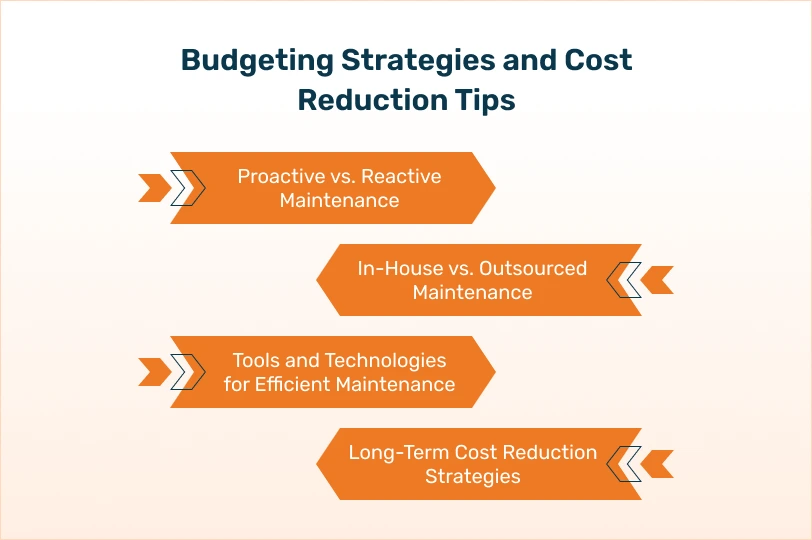 Strategic planning can significantly impact your mobile app maintenance cost in 2026. Here are practical approaches to optimize your budget without compromising app quality.
1. Proactive vs. Reactive Maintenance
Adopting a proactive maintenance strategy is almost always more cost effective in the long run. Reactive maintenance, where issues are addressed only after they arise, often leads to critical downtime, frustrated users, and more expensive emergency fixes. Proactive measures, such as regular security audits, performance monitoring, and scheduled updates, prevent major problems and ensure continuous operation.
2. In House vs. Outsourced Maintenance
The choice between an in house team and outsourcing significantly impacts costs and operational efficiency.
In House Maintenance:
Pros: Full control, deep institutional knowledge, immediate response for critical issues.
Cons: High overhead (salaries, benefits, training, infrastructure), difficulty scaling expertise, potential for developer burnout if workload is inconsistent.
Best For: Companies with complex, highly sensitive apps requiring constant, dedicated attention and a large, stable budget.
Outsourced Maintenance:
Pros: Cost effective (no overheads), access to specialized expertise, scalability (can ramp up/down resources as needed), focus on core business activities.
Cons: Less direct control, potential communication challenges, vendor lock in risks if not managed properly.
Best For: Most businesses, especially those seeking specialized skills for headless solutions, Jamstack development, or AI automation, without the commitment of full time staff. RW Infotech, for instance, offers tailored maintenance plans for modern applications.
Many businesses find a hybrid approach beneficial, handling minor internal updates in house while outsourcing complex security patches, major feature upgrades, or specialized performance optimization tasks.
3. Tools and Technologies for Efficient Maintenance
Leveraging the right tools can streamline maintenance processes and reduce manual effort.
Automated Testing Frameworks: Tools like Selenium, Appium, or Espresso automate regression testing, ensuring new updates don't break existing functionalities.
Performance Monitoring Tools: Services such as Firebase Performance Monitoring, New Relic, or Sentry help identify bottlenecks and crashes in real time.
Version Control Systems: Git (GitHub, GitLab, Bitbucket) is essential for tracking code changes, collaborating, and rolling back to previous versions if needed.
CI/CD Pipelines: Continuous Integration/Continuous Deployment tools (Jenkins, CircleCI, GitLab CI) automate the build, test, and deployment processes, speeding up updates and reducing errors.
Analytics Platforms: Google Analytics, Mixpanel, or Amplitude provide insights into user behavior, helping prioritize feature enhancements and identify areas for improvement.
4. Long Term Cost Reduction Strategies
Code Quality from Day One: Investing in clean, well documented, and modular code during development significantly reduces future maintenance headaches.
Scalable Architecture: Designing the app with scalability in mind (e.g., microservices, cloud native approaches) prevents costly refactoring later.
Regular Audits: Periodic code audits, security assessments, and performance reviews can catch issues early.
User Feedback Loop: Implementing a robust system for collecting and analyzing user feedback helps prioritize features that truly add value, avoiding unnecessary development.
Standardization: Using established frameworks, libraries, and coding standards reduces complexity and makes it easier for new developers to onboard.


Hi, my name is Jaswinder, let's talk about your business needs.
I will do my best to find a reliable solution for you!
RW Infotech's Expertise in App Maintenance and Modern Solutions
At RW Infotech, we understand that effective mobile app maintenance is intrinsically linked to the underlying architecture and ongoing strategic development. Our expertise extends beyond traditional app maintenance to encompass modern, performance driven solutions that inherently simplify and optimize long term care.
For businesses leveraging or considering advanced digital strategies, our services are specifically designed to enhance app stability, compliance, and long term performance:
Headless Solutions & Jamstack Development: We build highly performant, secure, and scalable mobile app backends using headless CMS and Jamstack principles. This modular approach simplifies content updates, reduces server side vulnerabilities, and often leads to more streamlined maintenance processes compared to monolithic architectures.
Headless CMS Migrations: If your app's content layer is a maintenance burden, we specialize in migrating to headless CMS platforms. This decouples content from presentation, making updates faster, more secure, and less prone to breaking the app's core functionality.
Full Stack Development: Our full stack expertise ensures that both your app's front end and back end are developed with maintainability, scalability, and security in mind from the outset. This holistic approach reduces the likelihood of complex, interconnected bugs.
AI Automation for App Operations: We integrate AI agents and automation tools to monitor app performance, identify anomalies, automate routine tasks, and even predict potential issues. This proactive approach significantly reduces manual maintenance effort and costs, making your app operations smarter and more efficient.
Performance Optimization: Our core focus on performance optimization ensures your app runs smoothly, quickly, and efficiently. This includes code optimization, database tuning, and infrastructure scaling, all of which contribute to reduced long term maintenance needs and improved user experience.
Digital Marketing: Beyond technical maintenance, we help ensure your app remains visible and engaging. Our digital marketing strategies are tailored for modern web and app architectures, ensuring your investment continues to yield returns.
By partnering with RW Infotech, you gain access to a team that not only fixes issues but also proactively implements strategies to reduce your mobile app maintenance cost in 2026 and beyond. We ensure your app remains a cutting edge asset, continually evolving to meet market demands and user expectations.
Conclusion
The journey of a mobile app doesn't end with its launch; it truly begins with a commitment to continuous maintenance and evolution. Understanding the mobile app maintenance cost in 2026 is not just about budgeting for fixes, but about strategically investing in the longevity, security, and competitiveness of your digital product.
By carefully considering factors like app complexity, platform specifics, and the scope of maintenance activities, businesses can develop a realistic and sustainable budget. Adopting proactive strategies, leveraging automation, and making informed decisions about in house versus outsourced support are crucial for optimizing these costs. Ultimately, a well maintained app is a resilient app—one that continues to deliver value, engage users, and drive business success in an ever changing digital world.
RW Infotech stands ready to be your partner in this journey, providing expert guidance and hands on support for all your mobile app maintenance needs, especially within the context of modern headless and Jamstack architectures. Let us help you ensure your app remains a powerful, high performing asset for years to come.
Frequently Asked Questions
Find answers to the most common questions about Mobile App Maintenance Cost in 2026.
Plan 15%–50% of the initial development cost yearly. Small/MVP apps: 15–25%, mid scale: 20–35%, large enterprise apps: 30–50%+. Costs vary based on app age, OS updates, and feature enhancements.
Poor code, outdated libraries, or non scalable architecture increases bugs, slows new features, and raises future maintenance costs. Addressing technical debt early reduces long term expenses.
Native apps (iOS/Android) need separate codebases and updates but offer better performance. Cross platform apps (React Native, Flutter) share a codebase, saving effort, but still require platform specific testing and occasional native integration.
Extra costs include server scaling, third-party licenses, storage, compliance audits, user support, and specialized talent for security or urgent fixes. Not updating features can also cost user engagement and revenue.
Yes. AI tools can automate testing, code reviews, monitoring, and optimization. CI/CD pipelines speed up updates, and AI driven analytics prioritize impactful feature development, cutting costs and improving efficiency.
News & Insights
We like to share our thoughts on topics we find inspiring. Explore our news and insights.