
Select Your Region
Region-Based Optimized Content
Choosing the Right Android Framework for Your Business App
Learn how to choose the best Android framework for your business app. Compare Kotlin, Flutter, React Native, and Ionic for scalability and growth.

Jaswinder Singh
Building a successful Android app is not only about having a great idea or attractive design. For businesses and startups, the real success of an app depends on strong technical decisions made at the beginning. One of the most critical decisions is choosing the right Android development framework.
The framework you select becomes the backbone of your application. It impacts how fast your app performs, how easily it scales, how much it costs to maintain, and how ready it is for future technologies like AI, automation, and cross-platform expansion. A well-chosen framework supports long-term business growth, while a poor choice can lead to technical limitations and higher costs.
This blog is written in simple and easy language to help business owners, founders, and decision-makers understand Android frameworks without technical confusion.
What Is an Android Development Framework?
An Android development framework is a collection of tools, libraries, and predefined components that developers use to build mobile applications. Instead of creating everything from scratch, frameworks provide a structured way to develop apps faster and more efficiently.
You can think of a framework as the foundation of a building. If the foundation is strong, the building can grow taller and remain stable for years. If the foundation is weak, even small changes can cause problems. In the same way, a good framework supports app growth, while a weak one creates long-term challenges.
For businesses, frameworks are not just a technical choice. They directly influence user experience, development cost, performance, and future expansion possibilities.
Why Choosing the Right Framework Is Important for Businesses
Many businesses focus heavily on app features and design but underestimate the importance of the underlying framework. However, the framework determines how well those features actually perform in real-world usage.
A well-selected framework ensures long-term stability and growth. From a business point of view, the right framework helps in multiple areas:
Better app performance and faster loading speed
Easier scalability as user base grows
Lower long-term maintenance and upgrade cost
Faster implementation of new features
Better support for future technologies
On the other hand, choosing the wrong framework can result in slow performance, frequent bugs, difficulty in scaling, and expensive redevelopment in the future. This is why framework selection should always align with business goals, not just development speed.
Key Factors to Consider Before Selecting an Android Framework
Before choosing any framework, businesses should clearly understand their requirements. Not every app needs the same level of performance or scalability.
Before making a decision, it is important to evaluate the following points:
Is the app an MVP or a long-term product?
Expected number of users in the next 1–3 years
Future plan for iOS or other platforms
Budget for development and maintenance
Need for AI, automation, or chatbot features
Taking time to analyze these factors helps in selecting a framework that supports both current needs and future growth.
Popular Android Frameworks for Business Applications
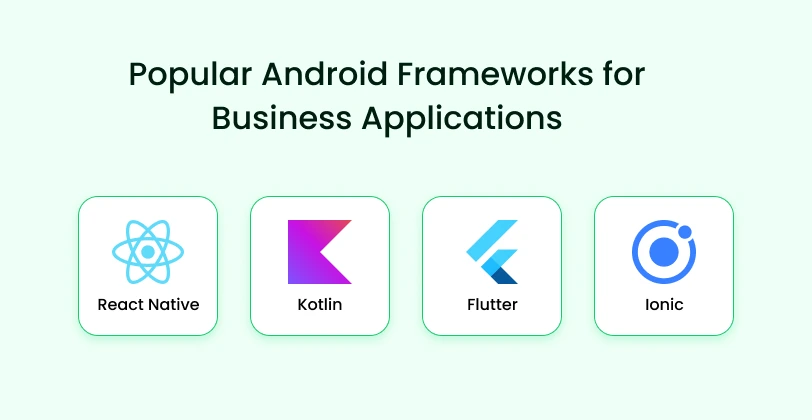 Below is a detailed explanation of the most widely used Android frameworks, explained from a business perspective.
Kotlin
Kotlin is Google’s officially preferred programming language for Android app development. It is fully supported in Android Studio and works seamlessly with existing Java code. Apps developed using Kotlin are designed specifically for the Android platform, ensuring modern architecture and cleaner code.
Kotlin-based Android apps deliver high performance, strong reliability, and improved developer productivity. The language allows full access to Android device features and APIs, making it ideal for building scalable, secure, and feature-rich applications.
Key Advantages
Officially recommended language by Google for Android
Cleaner, safer, and more concise code
Full access to Android hardware and system APIs
High performance with reduced chances of crashes
Long-term support and regular updates from Google
Limitations
Separate development required for iOS apps
Slight learning curve for teams new to Kotlin
Higher initial development cost compared to cross-platform solutions
Best Use Cases
Kotlin is ideal for enterprise-grade applications, banking and finance apps, healthcare platforms, eCommerce apps, and any Android application where performance, security, and long-term stability are essential.
Flutter
Flutter is a modern cross-platform framework developed by Google. It allows developers to build Android and iOS apps using a single codebase, which helps reduce development time and cost.
Flutter is well known for its smooth UI and fast development cycle. It is widely adopted by startups and growing businesses.
Key Advantages
Single codebase for Android and iOS
Faster development and testing
Consistent UI across platforms
Strong community and Google support
Limitations
Slightly larger app size
Limited access to some native features (improving regularly)
Best Use Cases
Flutter is ideal for startups, MVPs, and businesses planning cross-platform apps with modern design.
React Native
React Native is a cross-platform framework created by Meta. It uses JavaScript and allows businesses to reuse code between web and mobile applications.
It is popular among companies with existing web development teams and content-focused platforms.
Key Advantages
Code reuse between web and mobile
Faster development cycles
Large developer community
Limitations
Performance lower than native apps
Native modules needed for complex features
Best Use Cases
React Native works well for social apps, content-based platforms, and startups with JavaScript expertise.
Ionic
Ionic is a popular cross-platform framework that enables businesses to build mobile applications using web technologies such as HTML, CSS, and JavaScript. With Ionic, a single codebase can be used to create apps for Android and iOS, reducing development time and cost.
Ionic apps run inside a WebView and can access native device features through plugins, making it a practical choice for fast development and consistent user experiences across platforms.
Key Advantages
Single codebase for Android and iOS
Faster development and lower overall cost
Access to native device features via plugins
Consistent UI across platforms
Large community and ecosystem support
Limitations
Performance may be lower than fully native apps
Limited flexibility for highly complex animations or features
Depends on plugins for advanced native functionality
Best Use Cases
Ionic is well-suited for business apps, startup MVPs, enterprise dashboards, content-based applications, and projects that require quick development with cross-platform compatibility.
Comparison Table of Android Frameworks
| Framework | Performance | Cross-Platform Support | Scalability | Best For |
|---|---|---|---|---|
| Kotlin | Very High | No | Very High | Enterprise & performance-critical apps |
| Flutter | High | Yes | High | Startups & MVPs |
| React Native | Medium | Yes | Medium | Content & social apps |
| Ionic | Medium | Yes | Medium | Business apps, MVPs, dashboard and content-based apps |
How Framework Choice Affects Scalability
Scalability means an app can grow smoothly as user numbers increase, features expand, and data usage becomes more complex—without affecting performance.
Kotlin-based Android development offers strong structure, stability, and long-term scalability for applications that require high performance and complex business logic. Ionic, on the other hand, supports scalability for many business use cases by allowing a single codebase to serve multiple platforms efficiently when planned and optimized correctly.
Choosing the right framework early ensures your application can scale without requiring major redevelopment as your business grows.
Planning for iOS While Building Android Apps
Many businesses begin with Android and plan to expand to iOS in later stages. Selecting the right framework from the start can significantly simplify this transition.
Ionic enables code reuse across Android and iOS using a shared codebase, reducing development time and cost. While Kotlin focuses on Android-first development, its clean architecture and modular structure make future platform expansion more organized and manageable.
Early planning for iOS helps accelerate future launches and minimizes technical rework.


Hi, my name is Jaswinder, let's talk about your business needs.
I will do my best to find a reliable solution for you!
Supporting AI, Automation, and Chatbots
Modern applications increasingly depend on AI-powered features such as automation, smart recommendations, and customer support chatbots.
Kotlin provides strong support for integrating AI SDKs and advanced Android capabilities, making it suitable for intelligent and data-driven applications. Ionic supports AI and automation through web-based SDKs and third-party services, enabling consistent functionality across platforms.
Choosing a modern and flexible framework ensures your application remains future-ready and competitive in an evolving digital landscape.
Security and Maintenance Considerations
Security is a critical factor for business applications. Frameworks with strong community support and regular updates are safer and easier to maintain.
Native Android and Flutter currently offer excellent long-term support, making them reliable choices for business-critical apps.
Regular updates, security patches, and compatibility with new Android versions are essential for maintaining user trust.
Final Thoughts
Choosing the right Android app development framework is a strategic decision that directly impacts long-term success. At RW Infotech, we analyze your business goals, performance expectations, and scalability needs to recommend the most suitable technology rather than a one-size-fits-all solution.
By aligning the right framework with your business vision, RW Infotech ensures your Android application delivers strong performance, lower maintenance costs, and the flexibility to scale confidently as your organization grows.
Frequently Asked Questions
Find answers to the most common questions about Choosing the Right Android Framework for Your Business App.
Startups should consider budget, time-to-market, scalability, and future iOS plans. Flutter is often preferred for startups due to faster development and shared codebase.
Yes, Flutter and React Native support both Android and iOS using a single codebase. Kotlin Multiplatform allows shared logic while keeping native UI.
Yes, Flutter is suitable for long-term projects when scalability and UI consistency are required. It is backed by Google and has strong community support.
Yes, modern Android frameworks support AI features, automation, and chatbot integration through SDKs and APIs, enabling smarter and more interactive apps.
Yes, changing the framework later can increase cost, development time, and technical complexity. Choosing the right framework at the beginning helps avoid rebuilding the app and ensures smoother long-term growth.
News & Insights
We like to share our thoughts on topics we find inspiring. Explore our news and insights.