
Select Your Region
Region-Based Optimized Content
Best Open Source Headless CMS in 2026 – Complete Comparison Guide
Discover the best open source headless CMS in 2026. Compare Strapi, Directus, and KeystoneJS features, scalability, APIs, and use cases.

In 2026, the landscape of digital content delivery continues its rapid evolution, driven by the demand for omnichannel experiences and decoupled architectures. Modern businesses and development teams increasingly recognize the strategic advantage of a headless CMS, separating content management from its presentation layer. This approach offers unparalleled flexibility, scalability, and future-proofing for diverse digital touchpoints, from web and mobile applications to IoT devices and AI-driven interfaces.
Choosing the right open-source headless CMS is a critical decision that impacts development velocity, long-term maintenance, and the overall agility of your digital strategy. This guide provides a comprehensive comparison of leading open-source headless CMS platforms – Strapi, Directus, and KeystoneJS – to help product leaders, developers, and decision-makers identify the best fit for their specific project requirements in 2026.
Understanding the Strategic Value of a Headless CMS
A headless CMS functions as a content repository, exposing content via APIs (REST or GraphQL) rather than dictating its presentation. This architectural shift enables developers to use their preferred frontend frameworks and tools, fostering innovation and accelerating development cycles. For businesses, it means greater control over brand consistency across platforms, reduced vendor lock-in, and the ability to adapt quickly to new digital channels.
The strategic value lies in its ability to decouple content from presentation. This separation allows for independent scaling of the content layer and the presentation layer, improved security, and enhanced performance due to specialized optimization at each end. It supports a composable architecture, integrating seamlessly with other services like e-commerce platforms, authentication systems, and analytics tools.
Key Evaluation Criteria for Open Source Headless CMS Platforms
Selecting an open-source headless CMS requires evaluating several critical factors. These criteria directly influence the total cost of ownership, development experience, and the platform's ability to meet current and future business demands.
Flexibility and Customization: How easily can the data models be defined and extended? What are the capabilities for custom logic, plugins, and UI modifications?
Performance and Scalability: Can the CMS handle high content volumes and traffic spikes? What are its caching mechanisms and database optimization capabilities?
Ease of Use and Developer Experience (DX): How intuitive is the admin interface for content editors? How straightforward is the API for developers, and what tooling is available?
API Capabilities: Does it support REST, GraphQL, or both? What are the authentication, authorization, and filtering options?
Community Support and Ecosystem: How active is the community? What documentation, tutorials, and third-party integrations are available?
Deployment and Hosting: What are the typical deployment scenarios? Is it cloud-agnostic, and what are the infrastructure requirements?
Security Features: What security measures are built-in for data access, user roles, and API protection?
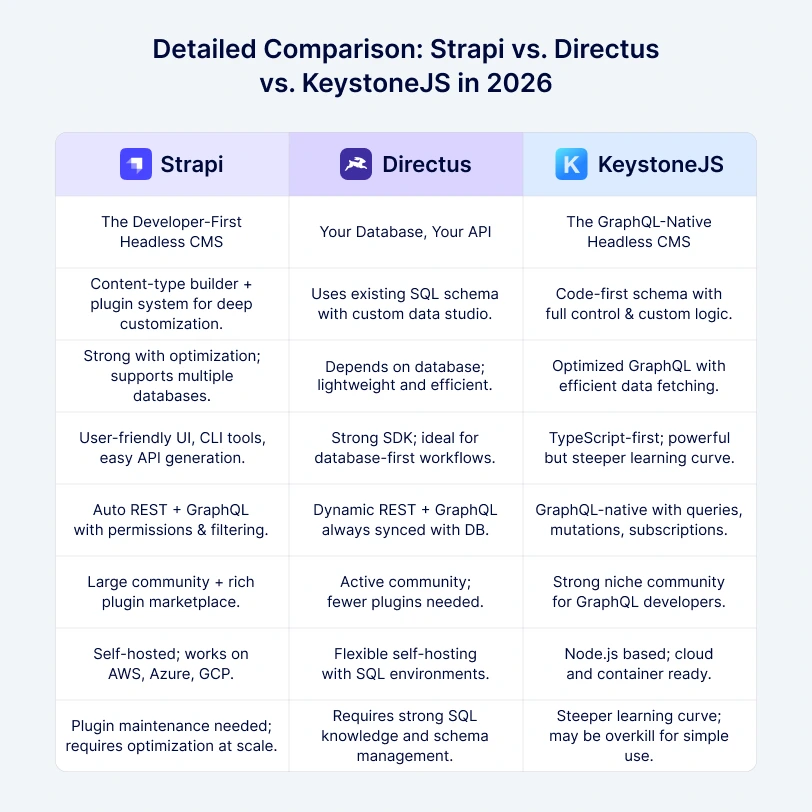
Detailed Comparison: Strapi vs. Directus vs. KeystoneJS in 2026
 Strapi: The Developer-First Headless CMS
Strapi has solidified its position as a leading open-source headless CMS, built on Node.js. It offers a highly customizable and extensible platform, designed to give developers full control over their API and content structure. Strapi's strength lies in its intuitive admin panel, robust plugin system, and strong community support, making it an excellent choice for a wide range of projects.
Flexibility and Customization: Strapi provides a powerful content-type builder that allows for rapid definition of data models. Its plugin architecture enables deep customization of the admin panel, API logic, and data processing. Developers can easily extend core functionalities or integrate third-party services.
Performance and Scalability: Strapi's performance is generally strong, especially when optimized with proper caching and database configurations. It supports various databases (PostgreSQL, MySQL, SQLite, MongoDB) and can scale horizontally. However, complex custom logic or unoptimized database queries can impact performance.
Ease of Use and Developer Experience: The admin UI is user-friendly for content creators, offering a clean interface for content entry and management. For developers, Strapi's CLI and clear documentation contribute to a positive DX. Generating APIs and managing content types is straightforward.
API Capabilities: Strapi natively generates both REST and GraphQL APIs based on your content types. It offers granular control over API endpoints, including permissions, roles, and filtering. The API documentation is automatically generated, aiding integration.
Community Support and Ecosystem: Strapi boasts a large and active community, with extensive documentation, tutorials, and a growing marketplace of plugins. This strong ecosystem ensures ongoing development and readily available support.
Deployment: Strapi is self-hostable and can be deployed on various cloud platforms (AWS, Azure, Google Cloud) or on-premise. It offers flexibility in infrastructure choices but requires managing the underlying server and database.
Considerations: While powerful, Strapi's reliance on Node.js and its plugin system means that maintaining and upgrading custom plugins requires attention. For very large-scale enterprise deployments, careful performance tuning and infrastructure planning are essential.
Directus: Your Database, Your API
Directus stands out by turning any SQL database into a headless CMS and a real-time API. It acts as a wrapper around your existing database, providing a powerful admin interface and a highly configurable API without dictating your data schema. This "database-first" approach offers unparalleled control and transparency over your data, making it ideal for projects that prioritize data sovereignty and complex relational data.
Flexibility and Customization: Directus allows you to use your existing SQL database schema directly. It provides a highly customizable data studio (admin panel) that can be tailored to specific user roles and workflows. Its modular architecture supports extensions and custom hooks for advanced logic.
Performance and Scalability: Performance is largely dependent on the underlying database's optimization. Directus itself is lightweight and designed for efficiency. It scales well with the database, and its real-time API capabilities (via WebSockets) are robust.
Ease of Use and Developer Experience: For content editors, the Data Studio is intuitive and highly configurable. For developers, Directus offers a powerful SDK and a well-documented API. The ability to directly interact with SQL is a significant advantage for those who prefer database-centric development.
API Capabilities: Directus provides a comprehensive REST and GraphQL API that automatically reflects your database schema. It offers advanced filtering, sorting, authentication, and authorization features. The API is generated dynamically, ensuring it's always in sync with your data.
Community Support and Ecosystem: Directus has a vibrant and engaged community, with good documentation and active forums. While its plugin ecosystem might be smaller than Strapi's, its "database-first" philosophy often reduces the need for extensive plugins.
Deployment: Directus is self-hostable and can run on virtually any server environment that supports PHP (for the API) and a modern SQL database. It offers extreme flexibility in deployment, fitting into diverse infrastructure setups.
Considerations: Directus's strength is its direct database interaction, which can also be a learning curve for developers unfamiliar with SQL database design principles. While it offers excellent control, it requires a clear understanding of database schema management.
KeystoneJS: The GraphQL-Native Headless CMS
KeystoneJS is a powerful open-source headless CMS built with Node.js and TypeScript, deeply integrated with GraphQL. It's designed for developers who appreciate a code-first approach and the benefits of a robust type system. KeystoneJS excels in providing a highly extensible and performant content platform, particularly for applications requiring complex data relationships and a strong developer experience.
Flexibility and Customization: KeystoneJS is a code-first CMS, meaning you define your content models and business logic directly in code using its powerful schema API. This offers unparalleled flexibility for custom fields, relationships, and access control. It also supports custom UI components for the admin panel.
Performance and Scalability: Built on Node.js and optimized for GraphQL, KeystoneJS offers excellent performance. Its schema-driven approach allows for efficient data fetching and strong typing. It scales well, especially when combined with a robust database and caching strategies.
Ease of Use and Developer Experience: KeystoneJS provides a clean and modern admin UI (Keystone Admin UI) for content editors. For developers, the TypeScript-first approach, strong typing, and GraphQL integration lead to a highly productive and enjoyable DX. The learning curve can be steeper for those new to GraphQL or TypeScript.
API Capabilities: KeystoneJS is fundamentally GraphQL-native. It automatically generates a comprehensive GraphQL API based on your schema, including queries, mutations, and subscriptions. It offers fine-grained access control and advanced filtering out of the box.
Community Support and Ecosystem: KeystoneJS has a dedicated and active community, particularly among developers who favor GraphQL and TypeScript. It has good documentation and a growing collection of examples and integrations.
Deployment: KeystoneJS is a Node.js application and can be self-hosted on any environment supporting Node.js. It integrates well with various databases (PostgreSQL, SQLite) and can be deployed on cloud platforms or containerized environments.
Considerations: Its code-first, GraphQL-native approach means a higher initial learning curve for teams unfamiliar with these technologies. While incredibly powerful for complex applications, it might be overkill for very simple content needs.
Comparison Table: Strapi vs. Directus vs. KeystoneJS (2026 Overview)
To summarize the key differences and help with decision-making, here's a comparative overview:
Core Philosophy:
Strapi: Developer-first, API-driven, content management system.
Directus: Database-first, wraps any SQL database into a headless CMS and API.
KeystoneJS: Code-first, GraphQL-native content platform.
Backend Language/Framework:
Strapi: Node.js
Directus: PHP (API), JavaScript/Vue (Admin App)
KeystoneJS: Node.js, TypeScript
Database Support:
Strapi: PostgreSQL, MySQL, SQLite, MongoDB
Directus: PostgreSQL, MySQL, SQLite, OracleDB, SQL Server, MariaDB
KeystoneJS: PostgreSQL, SQLite
API Types:
Strapi: REST & GraphQL (generated)
Directus: REST & GraphQL (dynamic)
KeystoneJS: GraphQL (native)
Content Modeling:
Strapi: Admin UI (Content-Type Builder), Code (via plugins)
Directus: Admin UI (Data Studio), Direct SQL
KeystoneJS: Code-first (schema definition)
Extensibility:
Strapi: Plugins, custom controllers/services
Directus: Hooks, custom modules, API extensions
KeystoneJS: Custom fields, hooks, UI extensions, GraphQL resolvers
Target Use Case:
Strapi: General-purpose websites, e-commerce, mobile apps, rapid API development.
Directus: Existing SQL database integration, complex relational data, data-centric applications, internal tools.
KeystoneJS: Complex web applications, SaaS platforms, GraphQL-heavy projects, TypeScript environments.


Hi, my name is Jaswinder, let's talk about your business needs.
I will do my best to find a reliable solution for you!
Choosing the Right Open Source Headless CMS for Your Project
The optimal choice depends heavily on your team's technical expertise, project requirements, and long-term strategic goals. Consider these scenarios:
For Rapid Development and General-Purpose Projects: Strapi
Choose Strapi if your team is comfortable with Node.js, prioritizes a user-friendly admin interface for content editors, and needs to quickly spin up REST and GraphQL APIs. It's excellent for marketing websites, e-commerce frontends, mobile applications, and projects where a rich plugin ecosystem is beneficial. Strapi strikes a good balance between developer control and ease of use for content managers.
For Database-First Approaches and Complex Data: Directus
Opt for Directus if you have an existing SQL database you want to expose as a headless CMS, or if your project inherently involves complex relational data and demands direct control over your database schema. It's ideal for internal tools, data-centric applications, and scenarios where data sovereignty and transparency are paramount. Directus empowers teams that prefer a "your data, your API" philosophy.
For GraphQL-Native and Code-First Applications: KeystoneJS
Select KeystoneJS if your team is proficient in TypeScript and GraphQL, and your project requires a highly customizable, code-first approach to content modeling and API generation. It's particularly well-suited for building sophisticated web applications, SaaS platforms, and projects that will heavily leverage GraphQL's capabilities for data fetching and real-time updates. The strong typing and developer experience are significant advantages for complex systems.
Conclusion
The choice of an open-source headless CMS in 2026 is a strategic decision that shapes your digital infrastructure for years to come. Strapi, Directus, and KeystoneJS each offer distinct advantages, catering to different technical preferences and project requirements. By carefully evaluating your team's skills, the complexity of your content models, your API needs, and your long-term scalability goals, you can select the platform that best empowers your digital initiatives.
RW Infotech specializes in leveraging leading headless CMS platforms to build robust, scalable, and high-performance digital experiences. Our expertise in Headless Solutions, Jamstack development, and Headless CMS migrations ensures that your content infrastructure is optimized for agility and future growth, aligning perfectly with the capabilities of platforms like Strapi, Directus, and KeystoneJS.
Frequently Asked Questions
Find answers to the most common questions about What Is OpenClaw and How It Helps Automate Business Workflows.
Businesses of all sizes can benefit, especially those with repetitive, high-volume tasks, complex data processing needs, or a strong desire to improve operational efficiency, accuracy, and scalability across departments like customer service, sales, marketing, HR, and finance.
OpenClaw is designed for seamless integration. It offers robust APIs and connectors to interact with a wide range of existing enterprise systems, CRM platforms, ERP solutions, and communication channels, minimizing disruption during implementation.
OpenClaw incorporates advanced security features and can be configured to adhere to various compliance standards (e.g., GDPR, HIPAA). It provides secure data handling, access controls, and audit trails to ensure data integrity and regulatory compliance.
Yes, OpenClaw is highly configurable and can be customized to meet specific industry requirements and unique business processes. Its modular architecture allows for tailored workflow design and integration with specialized applications relevant to particular sectors.
RW Infotech offers expert consultation, integration services, and custom development to help your business effectively implement and optimize OpenClaw. We can assist with workflow design, system integration, AI model training, and ongoing support to ensure maximum value from your automation investment.
News & Insights
We like to share our thoughts on topics we find inspiring. Explore our news and insights.