
Select Your Region
Region-Based Optimized Content
Using AI to Reduce Manual Assignment Checking Work in Education Platforms
Learn how AI helps education platforms automate assignment checking, grading, plagiarism detection, and student performance analysis to reduce manual work.


The volume of assignments in modern education, particularly within online and blended learning environments, presents a significant challenge for educators. Manual assignment checking is time-consuming, prone to inconsistencies, and diverts valuable instructional time away from student engagement and curriculum development. Artificial intelligence offers a transformative solution, enabling education platforms to automate and streamline the evaluation process. This article explores how AI-powered systems can reduce manual assignment checking work, enhance educational outcomes, and empower educators to focus on higher-value activities.
The Strategic Imperative for AI in Assignment Evaluation
For educational institutions and platform providers, the decision to integrate AI into assignment evaluation workflows is driven by several strategic imperatives. Scalability, consistency, and efficiency are paramount, especially as student populations grow and personalized learning models become more prevalent. AI addresses these needs by automating repetitive tasks, providing objective assessments, and generating actionable insights that improve both student learning and teaching effectiveness.
Implementing AI for assignment checking requires careful consideration of pedagogical goals, data privacy, and technological infrastructure. The objective is not to replace human educators but to augment their capabilities, freeing them from the burden of routine grading to concentrate on mentorship, complex problem-solving, and fostering critical thinking. This shift allows for a more impactful allocation of human expertise.
Core AI Capabilities for Streamlined Assignment Checking
AI's utility in assignment evaluation spans several critical areas, each contributing to a reduction in manual effort and an improvement in overall process quality. Understanding these capabilities is essential for developing a comprehensive AI strategy.
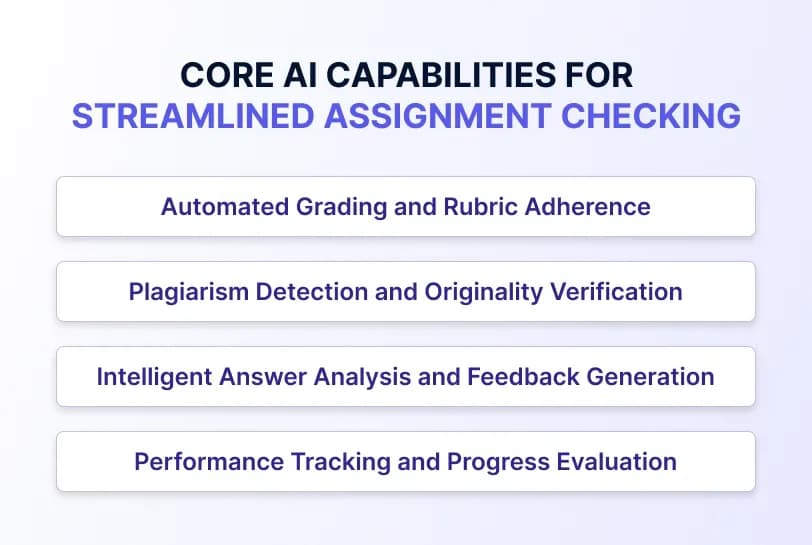
Automated Grading and Rubric Adherence
One of the most direct applications of AI is automated grading. For assignments with objective answers, such as multiple-choice questions, fill-in-the-blanks, or short numerical responses, AI systems can instantly evaluate submissions against predefined correct answers. For more complex assignments, such as essays or coding problems, AI can be trained on rubrics to assess specific criteria like grammar, syntax, logical structure, or code functionality.
AI algorithms can analyze textual content for keywords, sentence structure, coherence, and adherence to specific formatting requirements. In coding assignments, AI can execute code, test against various inputs, and identify errors or inefficiencies. This capability significantly reduces the time educators spend on initial evaluations, allowing them to review AI-generated scores and focus on qualitative feedback where human judgment is indispensable.
Plagiarism Detection and Originality Verification
Maintaining academic integrity is a perpetual challenge. AI-powered plagiarism detection tools are highly effective in identifying instances of unoriginal work. These systems scan submitted assignments and compare them against vast databases of academic papers, web content, and previously submitted assignments. They can detect direct copying, paraphrasing, and even AI-generated content that attempts to circumvent traditional detection methods.
Beyond simple matching, advanced AI can identify stylistic inconsistencies or sudden shifts in writing patterns that might indicate external authorship. This capability provides educators with a powerful tool to uphold academic standards, deter dishonest practices, and ensure that student work reflects genuine learning. The automation of this process saves considerable time that would otherwise be spent manually cross-referencing sources.
Intelligent Answer Analysis and Feedback Generation
AI can go beyond simple correctness to analyze the nuances of student answers. For open-ended questions, AI can identify common misconceptions, analyze the depth of understanding demonstrated, and even categorize types of errors. Natural Language Processing (NLP) models can interpret the meaning behind student responses, providing a more granular assessment than keyword matching alone.
Based on this analysis, AI can generate personalized feedback. This feedback can range from pointing out specific grammatical errors to suggesting resources for further study on a particular topic. While AI-generated feedback may not replace the depth of human insight, it can provide immediate, constructive guidance to students, accelerating their learning cycle and reducing the educator's burden of providing initial, basic corrections.
Performance Tracking and Progress Evaluation
AI systems can continuously track student performance across multiple assignments, quizzes, and projects. By analyzing patterns in performance data, AI can identify individual student strengths and weaknesses, predict potential learning difficulties, and highlight areas where curriculum adjustments might be beneficial. This capability moves beyond individual assignment grading to provide a holistic view of student progress over time.
For educators, this means less time spent manually compiling and analyzing performance metrics. AI dashboards can present clear visualizations of class performance, individual student trajectories, and areas requiring intervention. This data-driven approach enables more targeted teaching strategies and personalized learning paths, ultimately enhancing educational outcomes without increasing the administrative load.
Implementing AI for Assignment Checking: Strategic Considerations
The successful integration of AI into education platforms requires a strategic approach that addresses technology, pedagogy, and organizational change management.
Data Privacy and Ethical AI Deployment
Student data is sensitive. Any AI system deployed for assignment checking must adhere to strict data privacy regulations (e.g., GDPR, FERPA). Education platforms must ensure that data is encrypted, anonymized where appropriate, and used solely for its intended purpose. Transparency with students and parents about how AI is used and what data it collects is crucial for building trust.
Ethical considerations extend to bias in AI algorithms. If an AI model is trained on biased data, it can perpetuate or even amplify those biases in its evaluations, leading to unfair assessments. Regular auditing of AI models for fairness, explainability, and accountability is essential. Human oversight remains critical to mitigate these risks and ensure equitable outcomes for all students.
Integration with Existing Learning Management Systems (LMS)
For seamless adoption, AI assignment checking tools must integrate effectively with existing Learning Management Systems (LMS) such as Canvas, Moodle, or Blackboard. This integration should allow for easy submission of assignments, automated grading feedback to be pushed back into gradebooks, and performance data to be accessible within the LMS interface. A fragmented system will create new administrative burdens rather than alleviating existing ones.
API-driven integration is often the most robust approach, allowing for data exchange and functional interoperability. Platform providers should prioritize solutions that offer well-documented APIs and flexible integration options, minimizing disruption to current workflows and maximizing user adoption.
Educator Training and Role Redefinition
The introduction of AI changes the educator's role. While AI handles routine checking, educators can shift their focus to higher-order tasks: providing nuanced feedback on complex projects, fostering critical thinking through discussions, mentoring students, and designing innovative learning experiences. Effective training is paramount to help educators understand AI's capabilities and limitations, how to interpret AI-generated reports, and how to leverage the freed-up time effectively.
Change management strategies should address potential anxieties about job displacement and emphasize how AI serves as a powerful assistant. By reframing the educator's role as a facilitator of deeper learning, institutions can ensure a smoother transition and maximize the benefits of AI integration.
Scalability and Performance Optimization
Education platforms must handle varying loads, from small classes to thousands of students submitting assignments concurrently. AI systems for assignment checking must be designed for scalability, capable of processing large volumes of submissions efficiently without performance degradation. This involves robust backend infrastructure, optimized algorithms, and potentially cloud-based solutions that can dynamically scale resources.
Performance optimization also includes the speed of feedback delivery. Timely feedback is crucial for student learning. AI systems should be able to process and return results within a reasonable timeframe, ideally instantly for objective assessments and within hours for more complex evaluations, ensuring that students receive guidance when it is most impactful.


Hi, my name is Jaswinder, let's talk about your business needs.
I will do my best to find a reliable solution for you!
Conclusion
Using AI to reduce manual assignment checking work in education platforms is not merely about automation; it is about strategically enhancing the entire educational ecosystem. By offloading repetitive and time-consuming tasks to AI, educators regain valuable time to focus on personalized instruction, mentorship, and curriculum innovation. This leads to more consistent evaluations, faster feedback cycles, and deeper insights into student performance. For education platform providers and institutions, investing in AI automation offers a clear path to improved efficiency, scalability, and ultimately, better learning outcomes. As AI technologies continue to mature, their role in transforming education will only expand, making intelligent assignment evaluation an indispensable component of modern learning environments.
At RW Infotech, we specialize in developing robust AI automation solutions tailored for educational platforms. Our expertise in full-stack development and AI integration allows us to build scalable systems that streamline operations, enhance student engagement, and empower educators. We focus on secure, efficient, and ethically designed AI applications that meet the unique demands of the education sector, from intelligent grading engines to comprehensive performance analytics platforms.
Frequently Asked Questions
Find answers to the most common questions about Using AI to Reduce Manual Assignment Checking Work in Education Platforms.
AI analyzes student performance data, identifies individual strengths and weaknesses, and recommends tailored learning resources or activities. This allows educators to create adaptive learning paths that cater to each student's specific needs and pace.
AI excels at grading objective assignments, coding tasks, and initial evaluations of essays based on rubrics and grammar. For highly subjective or creative assignments, AI can assist but human oversight remains critical for nuanced assessment and qualitative feedback.
Data security is paramount. AI systems must comply with privacy regulations (e.g., GDPR, FERPA), ensuring data encryption, anonymization where possible, and strict access controls. Transparency with users about data handling is essential.
The timeline varies based on complexity and integration needs. A basic system for objective grading might take 3-6 months, while a comprehensive solution with advanced NLP and deep LMS integration could take 9-18 months, including development, testing, and training.
RW Infotech specializes in custom AI automation and full-stack development for education platforms. We design and implement intelligent grading systems, plagiarism detection, and performance analytics tools, ensuring secure, scalable, and efficient integration with your existing infrastructure.
News & Insights
We like to share our thoughts on topics we find inspiring. Explore our news and insights.


Why Marketing Teams Prefer Headless CMS for Modern Websites
Learn how headless CMS helps marketing teams manage content independently, launch campaigns faster, improve collaboration, personalize customer experiences, and deliver content across multiple channels.
Which Headless CMS Is Best for Content-Heavy Websites in 2026?
Discover the best headless CMS platforms for content-heavy websites in 2026. Compare Sanity, Strapi, Contentful, Storyblok, Directus, and other leading options.