
Select Your Region
Region-Based Optimized Content
Why Next.js Is the Default Choice for Enterprise Web Applications
Discover why Next.js is the preferred framework for enterprise web applications with superior performance, scalability, SEO, and developer productivity.


Enterprises face continuous pressure to deliver performant, scalable, and maintainable web applications. In this landscape, the choice of framework significantly impacts development velocity, user experience, and long-term operational costs. Next.js, a React framework, has rapidly emerged as a frontrunner, increasingly becoming the default choice for enterprise web applications due to its robust feature set and strategic advantages.
This article explores the core reasons behind Next.js's widespread adoption in enterprise environments. We will examine its architectural benefits, performance optimizations, scalability features, and the enhanced developer experience it provides. Understanding these aspects is crucial for product leaders, technical teams, and decision-makers evaluating their next-generation web platforms.
Strategic Advantages of Next.js for Enterprise Scale
The transition to Next.js in enterprise settings is driven by several strategic imperatives. These include the need for superior performance, efficient content delivery, and a future-proof architecture that supports evolving business requirements. Next.js addresses these by combining server-side rendering (SSR), static site generation (SSG), and incremental static regeneration (ISR) with a robust React foundation.
Optimized Performance and Core Web Vitals
Enterprise applications often serve a global audience and handle complex interactions. Performance is not merely a technical metric; it directly impacts user engagement, conversion rates, and SEO rankings. Next.js significantly improves application performance through:
Server-Side Rendering (SSR): For pages requiring dynamic, real-time data, SSR allows the server to render the initial HTML, sending a fully formed page to the browser. This reduces the time to first contentful paint (FCP) and improves perceived performance, especially on slower networks or devices.
Static Site Generation (SSG): For content that doesn't change frequently, SSG pre-renders pages at build time. These static HTML files can be served directly from a CDN, offering unparalleled speed, security, and lower server load. This is ideal for marketing pages, documentation, and e-commerce product listings.
Incremental Static Regeneration (ISR): ISR extends SSG by allowing developers to update static content without requiring a full site rebuild. This provides the performance benefits of static sites with the flexibility of dynamic content, crucial for frequently updated enterprise content.
Image Optimization: The built-in next/image component automatically optimizes images for different viewports and formats (e.g., WebP), lazy-loading them by default. This is critical for improving Largest Contentful Paint (LCP) and overall page load times.
Code Splitting and Bundling: Next.js automatically splits JavaScript bundles per page, ensuring that users only download the code necessary for the current view. This minimizes initial load times and improves interactivity.
These features collectively contribute to excellent Core Web Vitals scores, which are increasingly important for search engine visibility and user satisfaction. For enterprises, faster load times translate directly into better user retention and improved business outcomes.
Scalability and Maintainability for Complex Applications
Enterprise applications are characterized by their complexity, large codebases, and the need to scale horizontally. Next.js provides architectural patterns and features that facilitate both scalability and long-term maintainability.
API Routes: Next.js allows developers to create backend API endpoints directly within the same project. This simplifies development, especially for smaller microservices or serverless functions, by co-locating frontend and backend logic. While not a replacement for full-fledged backend services, it streamlines data fetching and form submissions.
Monorepo Compatibility: Next.js projects integrate well into monorepo structures, enabling large teams to manage multiple applications and shared components within a single repository. This promotes code reuse, consistency, and simplifies dependency management.
Modular Architecture with React Components: As a React framework, Next.js naturally encourages a component-based architecture. This modularity makes it easier to develop, test, and maintain complex UIs, allowing teams to work on different parts of the application concurrently.
React Server Components (RSC): A significant evolution, RSCs allow developers to render components entirely on the server, sending only the necessary HTML and JavaScript to the client. This reduces client-side bundle sizes, improves initial load performance, and simplifies data fetching logic by moving it closer to the data source. For enterprise applications with rich UIs and extensive data requirements, RSCs offer a powerful paradigm shift for performance and developer experience.
Global Deployment Ready: Next.js applications are inherently designed for deployment on modern platforms like Vercel, Netlify, and AWS. Their architecture, particularly with SSG and ISR, makes them highly suitable for global CDN distribution, ensuring low latency for users worldwide.
These features enable enterprises to build applications that can grow with their business, accommodating increased user loads and evolving feature sets without significant architectural overhauls.
Enhanced Developer Experience and Productivity
Developer productivity is a critical factor in enterprise software development. A framework that provides a streamlined workflow, clear conventions, and a rich ecosystem can significantly reduce time-to-market and operational costs. Next.js excels in this area:
File-System Based Routing: Next.js simplifies routing by mapping files and folders in the pages directory directly to URL paths. This intuitive convention reduces boilerplate and makes navigation logic easier to understand and manage.
Fast Refresh: During development, Fast Refresh provides instant feedback on changes to React components, preserving component state. This dramatically speeds up the development loop and improves developer satisfaction.
TypeScript Support: Next.js offers excellent out-of-the-box TypeScript support, which is invaluable for large enterprise projects. TypeScript enhances code quality, catch errors early, and improves collaboration among large teams.
Comprehensive Documentation and Community: Vercel, the creators of Next.js, maintain extensive and well-structured documentation. Coupled with a large and active community, developers have access to abundant resources, tutorials, and support, accelerating learning and problem-solving.
Integration with the React Ecosystem: Being built on React, Next.js benefits from the vast React ecosystem of libraries, tools, and components. This allows enterprises to leverage existing investments in React expertise and readily available solutions.
By fostering a productive and enjoyable development environment, Next.js helps enterprises attract and retain top talent, while accelerating the delivery of high-quality software.
Next.js in Action: Enterprise Use Cases
The versatility of Next.js makes it suitable for a wide range of enterprise applications across various industries. Its ability to handle dynamic data, deliver static content, and integrate with diverse backends makes it a powerful tool for complex business requirements.
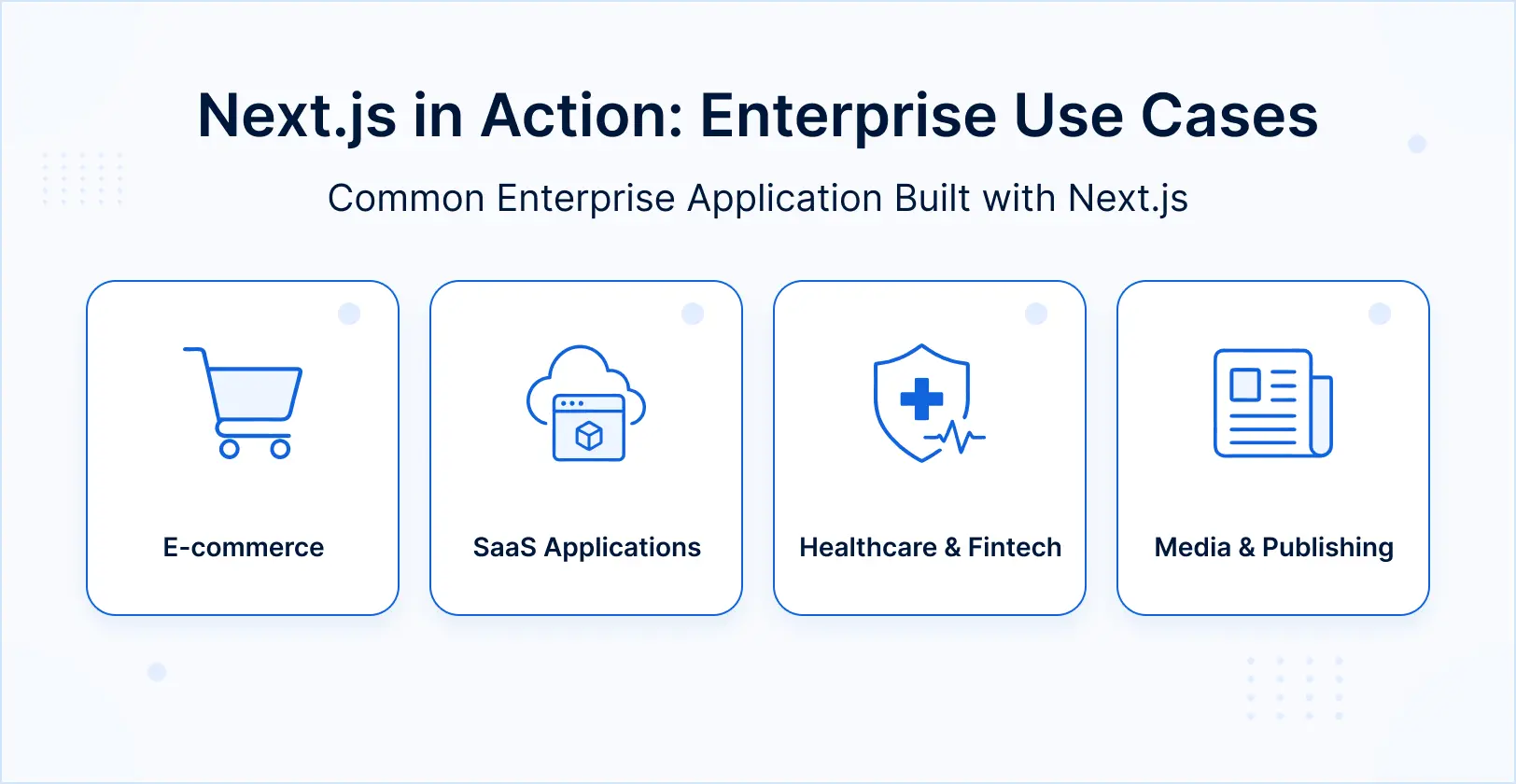
E-commerce Platforms
For e-commerce, performance and SEO are paramount. Next.js allows businesses to build lightning-fast storefronts that provide an excellent user experience and rank well in search engines. Product pages can be statically generated with ISR for speed, while shopping carts and checkout flows leverage SSR for real-time data and secure transactions. Integrations with headless commerce platforms like commercetools or Shopify Plus are seamless, allowing for flexible frontend experiences.
SaaS Applications
Software as a Service (SaaS) platforms often require rich user interfaces, complex data dashboards, and robust authentication. Next.js, combined with its API routes or external microservices, provides a solid foundation. Its performance benefits ensure smooth interactions, while a component-based architecture facilitates the development of intricate UIs. Secure authentication flows can be implemented using providers like Auth0 or NextAuth.js.
Healthcare and Fintech Portals
Applications in highly regulated industries like healthcare and fintech demand stringent security, data integrity, and often, complex data visualization. Next.js can be used to build secure, performant patient portals, financial dashboards, and internal management systems. Its focus on performance ensures quick access to critical information, and its extensibility allows for integration with specialized backend services and compliance frameworks.
Media and Publishing
Media companies and publishers rely on fast content delivery and strong SEO. Next.js, particularly with SSG and ISR, is ideal for delivering news articles, blogs, and multimedia content. Pages can be pre-rendered for speed, improving readability and reducing bounce rates. Integration with headless CMS solutions like Contentful, Strapi, or Sanity.io enables content teams to manage and publish content efficiently without developer intervention.
Comparing Next.js with Alternatives
Understanding why Next.js is becoming the default choice for enterprise web applications often involves comparing it to other prevalent approaches.
Next.js vs. Traditional React (CRA)
Traditional Create React App (CRA) projects are client-side rendered (CSR) by default. This means the browser downloads a minimal HTML file and then fetches and executes JavaScript to render the entire UI. While excellent for single-page applications (SPAs) that prioritize rich interactivity, CSR can suffer from slower initial load times, poorer SEO (as search engine crawlers may struggle with empty HTML), and a less optimal user experience on slower connections.
Next.js, by offering SSR, SSG, and ISR, fundamentally addresses these limitations. It provides the best of both worlds: the development experience and component model of React, combined with superior performance, SEO, and scalability features out-of-the-box. Enterprises migrating from CRA often see immediate improvements in site speed and search engine rankings.
Next.js vs. Other Modern Frameworks (e.g., Nuxt.js, SvelteKit)
While frameworks like Nuxt.js (for Vue) and SvelteKit (for Svelte) offer similar capabilities like SSR and SSG, Next.js benefits from the sheer scale and maturity of the React ecosystem. The availability of React libraries, components, and a massive developer community provides a significant advantage for enterprises. Next.js's consistent evolution, driven by Vercel, ensures it remains at the forefront of web development trends, including its pioneering work with React Server Components.
Decision-makers should consider their existing technology stack, developer skill sets, and long-term ecosystem support when choosing between these powerful frameworks. For organizations already invested in React, or those looking for the most robust and widely supported solution for enterprise-grade applications, Next.js presents a compelling case.


Hi, my name is Jaswinder, let's talk about your business needs.
I will do my best to find a reliable solution for you!
Conclusion
Next.js has cemented its position as a leading framework for enterprise web applications by strategically addressing critical business needs: performance, scalability, and developer efficiency. Its versatile rendering capabilities (SSR, SSG, ISR), coupled with features like image optimization, API routes, and React Server Components, enable enterprises to build applications that are fast, resilient, and future-proof.
For product leaders and technical teams, adopting Next.js means investing in a platform that enhances user experience, improves SEO, reduces infrastructure costs through efficient content delivery, and empowers developers to build complex systems with greater agility. As digital transformation continues to accelerate, Next.js is not just a framework; it is a strategic asset for enterprises aiming to maintain a competitive edge and deliver exceptional web experiences in 2026 and beyond. Its comprehensive approach to modern web development makes it the default choice for organizations committed to building scalable, high-performance digital platforms.
Frequently Asked Questions
Find answers to the most common questions about Why Next.js Is Becoming the Default Choice for Enterprise Web Applications
Next.js improves SEO by supporting Server-Side Rendering (SSR) and Static Site Generation (SSG), which ensure search engine crawlers receive fully rendered HTML content. This improves indexing and ranking, while features like image optimization and fast load times contribute to better Core Web Vitals, a key SEO factor.
Yes, Next.js can seamlessly integrate with existing enterprise backend systems. It supports data fetching from various sources, including REST APIs, GraphQL endpoints, and microservices. Its API routes can also serve as lightweight proxies or direct integrations for specific frontend needs.
React Server Components (RSC) in Next.js primarily reduce client-side JavaScript bundle sizes and improve initial page load performance by rendering components entirely on the server. This simplifies data fetching and reduces the amount of code sent to the browser, leading to faster, more efficient enterprise applications.
Yes, Next.js is highly suitable for large development teams. Its component-based architecture, strong TypeScript support, clear file-system routing conventions, and compatibility with monorepos facilitate collaboration, maintainability, and code quality across large-scale projects.
RW Infotech specializes in building and optimizing enterprise-grade Next.js applications. We offer end-to-end services including strategic consulting, Jamstack website development, Headless CMS migrations, performance optimization, and full-stack development to ensure your Next.js solution meets your business objectives for scalability, performance, and maintainability.
News & Insights
We like to share our thoughts on topics we find inspiring. Explore our news and insights.