
Select Your Region
Region-Based Optimized Content
Why Sanity is a Leading Headless Commerce Platform in 2026
Discover why Sanity is a top headless commerce platform in 2026. Learn about its real-time content architecture, API-first design, AI-ready features, and how RW Infotech can help businesses leverage its full potential.

Jaswinder Singh

The digital commerce landscape is evolving at an unprecedented pace. As businesses strive for faster, more flexible, and highly personalized customer experiences, the traditional monolithic eCommerce platforms are increasingly falling short. Enter headless commerce, a paradigm shift that decouples the frontend presentation layer from the backend commerce engine, offering unparalleled agility and innovation. Within this transformative space, Sanity has emerged as a formidable player, rapidly solidifying its position as a leading headless commerce platform in 2026.
Sanity's ascent is no accident. Its real time content architecture, structured content approach, API first design, and AI ready capabilities make it uniquely suited for the demands of modern eCommerce. From hyper personalization and seamless omnichannel delivery to rapid scalability and future proofing against evolving tech trends, Sanity empowers startups, growing brands, and enterprises alike to build high performance commerce experiences that are not only easy to manage but also inherently adaptable. This article will delve into the core reasons behind Sanity's dominance, exploring how its unique features address the critical needs of today's digital businesses and why partnering with an official Sanity agency like RW Infotech can unlock its full potential.
Understanding Headless Commerce and Sanity's Role
Before diving deep into Sanity's specific advantages, it's crucial to grasp the foundational concepts. Headless commerce refers to an eCommerce architecture where the frontend (the "head" customers interact with) is decoupled from the backend (the "body" that handles transactions, product data, and inventory). This separation allows businesses to use any frontend framework they desire, delivering content and commerce functionalities via APIs.
A Headless CMS like Sanity acts as the central content hub in this ecosystem. It's not a commerce platform itself, but rather a powerful content layer that integrates seamlessly with specialized eCommerce engines (like Shopify, BigCommerce, or commercetools), payment gateways, and other third party services. Sanity excels here by providing a flexible, API first content platform that fuels dynamic storefronts, marketing campaigns, and personalized customer journeys across all touchpoints.
The Jamstack architecture often complements headless commerce, leveraging JavaScript, APIs, and Markup to deliver blazing fast, secure, and scalable websites. Sanity's API driven nature makes it a perfect fit for Jamstack projects, enabling developers to pull content into static site generators or client side rendered applications with ease.
The Core Pillars of Sanity's Headless Commerce Leadership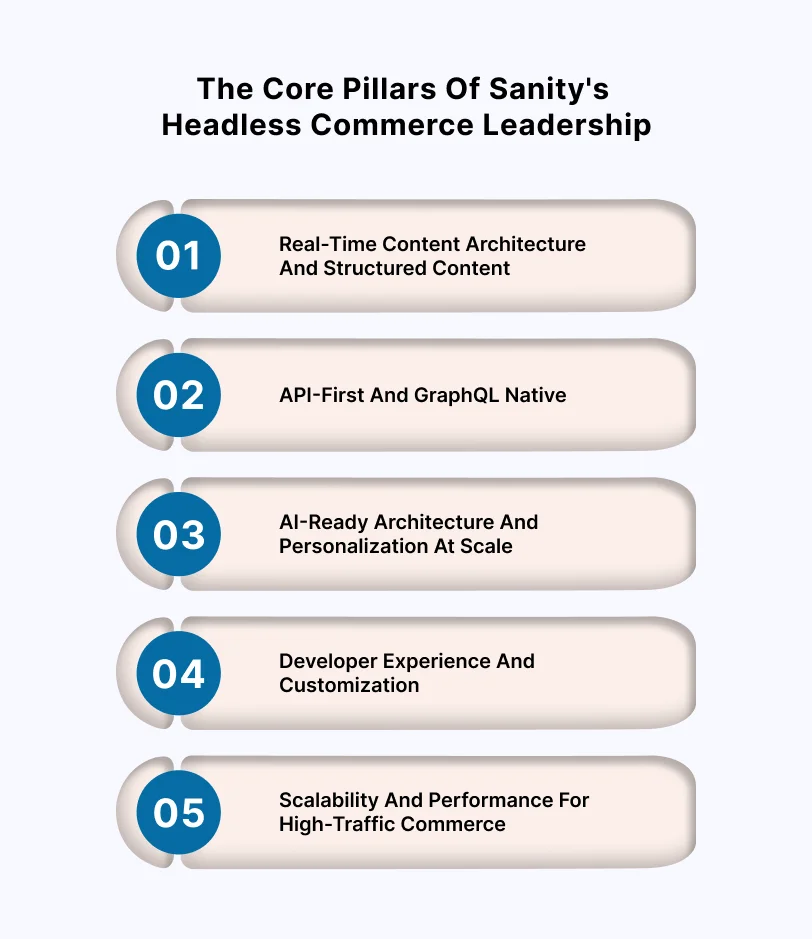
1. Real time Content Architecture and Structured Content
Sanity's foundation is its unique real time content architecture. Unlike traditional CMS platforms that store content in rigid, page centric formats, Sanity treats content as data. This means every piece of content a product description, an image, a blog post, a customer review is stored as a structured data object in its global content lake, Sanity Content Lake.
Content as Data: This approach allows content to be queried, filtered, and transformed programmatically. For an eCommerce business, this translates to unparalleled flexibility. Product data, marketing copy, and promotional banners can be reused and repurposed across multiple channels (web, mobile app, in store kiosks) without duplication.
Structured Content (Portable Text): Sanity's Portable Text editor is a game changer. It allows content creators to define rich text content not as a block of HTML, but as an array of JSON objects. This structured approach means content can be rendered beautifully and consistently on any frontend, eliminating formatting headaches and ensuring accessibility. For instance, a product description can include rich text, images, and embedded videos, all defined as structured data elements that any frontend can interpret and display correctly.
Real time Collaboration: Multiple users can work on the same document simultaneously, seeing changes instantly — akin to Google Docs for content. This significantly speeds up content creation workflows, especially in fast paced eCommerce environments where product launches and campaign updates are frequent.
2. API First and GraphQL Native
Sanity is built from the ground up as an API first platform, offering robust APIs for both reading and writing content. This is paramount for headless commerce:
Powerful APIs (GROQ & GraphQL): Sanity provides two primary ways to interact with its Content Lake: GROQ (Graph Relational Object Queries) and GraphQL. GROQ is Sanity's own powerful query language, optimized for fetching deeply nested and related content with minimal boilerplate. For teams already familiar with GraphQL, Sanity offers a native GraphQL API endpoint, allowing developers to query content using standard GraphQL syntax. This dual approach caters to diverse development preferences and ensures efficient data retrieval.
Seamless Integrations: The API first nature makes Sanity incredibly easy to integrate with any eCommerce platform (Shopify, BigCommerce, Magento, commercetools), payment gateway, CRM, analytics tool, or personalization engine. This flexibility allows businesses to build a best of breed commerce stack tailored precisely to their needs, rather than being confined by a monolithic system.
Omnichannel Delivery: With content accessible via APIs, delivering consistent and personalized experiences across web, mobile apps, smart devices, voice assistants, and even IoT devices becomes straightforward. Sanity acts as the single source of truth for all content, ensuring brand consistency and efficiency.
3. AI Ready Architecture and Personalization at Scale
As AI becomes indispensable in digital commerce, Sanity's architecture positions it perfectly for future innovations:
Structured Content for AI: AI models thrive on structured data. Since Sanity stores content as granular, well defined data points, it's inherently AI ready. This makes it easier to feed product descriptions, customer reviews, and marketing copy into AI algorithms for tasks like recommendation engines, dynamic content generation, automated tagging, and sentiment analysis.
Dynamic Personalization: The ability to query and filter content based on user behavior, demographics, or real time context is crucial for personalization. Sanity's flexible querying capabilities, combined with external personalization engines, allow brands to deliver highly relevant product recommendations, personalized promotions, and tailored content experiences to individual customers at scale. Imagine a customer seeing different product imagery or promotional text based on their browsing history or location — Sanity makes this achievable.
Automation Potential: With Sanity's APIs, businesses can automate various content related tasks. This could include automatically populating product pages with data from a PIM system, generating localized content variants, or even using AI to suggest content improvements based on performance data.
4. Developer Experience and Customization
Sanity is a developer's dream, offering an unparalleled experience that translates into faster development cycles and greater innovation:
Open Source Sanity Studio: The Sanity Studio is a fully customizable, open source React application that serves as the content editing interface. Developers have complete control over its UI and UX, allowing them to tailor the content management experience precisely to the needs of content editors. This means creating custom input fields, workflows, and preview environments that mirror the final frontend.
JavaScript/TypeScript Ecosystem: Built on modern web technologies, Sanity integrates seamlessly with popular frameworks and libraries. This reduces the learning curve for developers and allows them to leverage their existing skill sets.
Schema Driven Content: Sanity uses a schema driven approach where you define your content models (e.g., "product," "category," "author") using JavaScript/TypeScript. This provides strong typing and ensures data consistency, making content management robust and scalable.
Extensibility: The Studio can be extended with custom plugins and tools, allowing businesses to integrate specific functionalities directly into their content management workflow, such as image manipulation tools, SEO analyzers, or direct integrations with external commerce platforms.
5. Scalability and Performance for High Traffic Commerce
In eCommerce, speed and reliability are non negotiable. Sanity's architecture is designed for both:
Global CDN and Edge Caching: Sanity's Content Lake leverages a global CDN, ensuring that content is delivered quickly to users worldwide. This is vital for reducing load times and improving the overall user experience, directly impacting conversion rates.
Optimized Queries: GROQ and GraphQL queries are highly optimized for performance, allowing developers to fetch precisely the data they need, minimizing payload size and improving API response times.
Decoupled Architecture Benefits: By separating the content layer from the commerce engine and frontend, each component can scale independently. If your storefront experiences a traffic surge, your Sanity content layer remains stable and responsive. This inherent resilience is a major advantage over monolithic systems.
Cost Effective Scaling: Sanity's consumption based pricing model means you only pay for what you use, making it highly cost-effective for businesses of all sizes to scale their content operations without incurring massive infrastructure costs.


Hi, my name is Jaswinder, let's talk about your business needs.
I will do my best to find a reliable solution for you!
Practical Applications: Sanity in Action for Headless Commerce
Let's consider how these advantages translate into real world scenarios for businesses adopting Sanity as a leading headless commerce platform:
Personalized Product Merchandising: A fashion retailer uses Sanity to manage rich product data — images, videos, detailed descriptions, size guides, care instructions. By integrating Sanity with a personalization engine, they can dynamically display product recommendations and content blocks tailored to individual user preferences, browsing history, and real time context. For example, a returning customer interested in "sustainable denim" might see specific collections highlighted on the homepage.
Omnichannel Content Delivery: A consumer electronics brand uses Sanity as its central content hub. Product specifications and marketing assets are stored once and then deployed across their eCommerce website, mobile app, in store digital displays, and even voice assistant product descriptions, ensuring consistency and reducing content management overhead.
Rapid Campaign Launches: During peak sales seasons like Black Friday, a brand needs to launch new promotions and landing pages rapidly. With Sanity's real time collaboration and customizable Studio, marketing teams can quickly create and publish campaign specific content, A/B test variations, and update promotions without developer intervention, ensuring agility in a competitive market.
Content Rich Product Experiences: Instead of just basic product descriptions, a luxury goods company leverages Sanity to create immersive product stories, including high resolution imagery, designer interviews, craftsmanship videos, and interactive guides, all seamlessly integrated into the product page via a modern frontend framework.
Global eCommerce with Localization: An international brand uses Sanity to manage localized content for multiple regions and languages. The structured content approach makes it easy to manage translations, ensuring that product descriptions, pricing, and promotional messages are accurate and culturally relevant for each market.
Conclusion
As we look towards 2026 and beyond, the demands on eCommerce platforms will only intensify. Businesses need flexibility, speed, personalization, and an architecture that can adapt to unforeseen technological shifts. Sanity, with its real time content architecture, structured content approach, API first design, AI ready capabilities, and exceptional developer experience, stands out as a premier choice for headless commerce.
It empowers brands to move beyond the limitations of monolithic systems, build truly differentiated customer experiences, and future proof their digital presence. Whether you're a startup aiming for rapid innovation, a growing brand seeking scalability, or an enterprise looking to modernize your commerce stack, Sanity provides the robust and adaptable content layer necessary for success.
However, harnessing the full power of Sanity requires expert implementation and strategic guidance. This is where RW Infotech comes in. As a leading IT agency specializing in Headless Solutions, Jamstack development, and Headless CMS migrations, we are official Sanity agency partners. Our team brings deep expertise in architecting and developing high performance, scalable headless commerce solutions powered by Sanity. From initial strategy and custom Sanity Studio development to seamless integrations with your commerce platform and ongoing performance optimization, we ensure your investment in Sanity delivers maximum ROI. Partner with RW Infotech to build a future ready headless commerce experience that drives growth and innovation.
Frequently Asked Questions
Find answers to the most common questions about Why Sanity Is a Leading Headless Commerce Platform in 2026.
Sanity integrates seamlessly with existing eCommerce platforms through their respective APIs. Sanity serves as the content layer, managing product descriptions, marketing copy, blog posts, and other rich content. The eCommerce platform handles the core commerce functionalities like product catalog management (SKUs, pricing, inventory), cart, checkout, and order processing. Developers use Sanity's APIs (GROQ or GraphQL) to fetch content and combine it with data from the eCommerce platform's APIs to populate a unified frontend. This "best-of-breed" approach allows businesses to leverage the strengths of both systems.
Sanity is suitable for businesses of all sizes, from small startups to large enterprises. Its flexible pricing model, which scales with usage, makes it accessible for smaller businesses, while its robust architecture, scalability, and enterprise-grade features (like role-based access control, webhooks, and audit logs) cater to the complex needs of larger organizations. The open-source nature of the Sanity Studio also means that development costs can be optimized, making it a cost-effective solution in the long run.
To fully leverage Sanity, development teams typically need proficiency in modern web technologies. This includes JavaScript/TypeScript for defining content schemas and customizing the Sanity Studio, and experience with frontend frameworks like React, Next.js, Vue, or Svelte for building the presentation layer. Familiarity with APIs (REST, GraphQL) and query languages like GROQ is also beneficial. Sanity's developer-friendly documentation and active community make it relatively easy for skilled developers to get started.
Sanity's structured content approach is inherently SEO-friendly. By treating content as data, it allows developers to precisely control how content is rendered on the frontend, including meta titles, descriptions, canonical tags, and structured data (Schema.org markup). With a headless setup, developers have complete freedom to implement best-in-class SEO practices, such as server-side rendering (SSR) or static site generation (SSG) for faster page loads, clean URLs, and optimized image delivery — all factors that Google favors. Sanity itself doesn't directly handle SEO, but it provides the perfect foundation for implementing a highly optimized SEO strategy on the frontend.
While many excellent headless CMS platforms exist, Sanity differentiates itself primarily through its real-time content architecture, its unique "content as data" approach (powered by the Sanity Content Lake and GROQ query language), and the fully customizable, open-source Sanity Studio. Many other platforms are more document-centric or have less flexible content modeling. Sanity's focus on structured content, developer experience, and real-time collaboration provides a distinct advantage for complex, omnichannel, and AI-driven content scenarios, making it particularly powerful for modern headless commerce applications.
News & Insights
We like to share our thoughts on topics we find inspiring. Explore our news and insights.