
Select Your Region
Region-Based Optimized Content
When Should You Move from Shopify to a Custom Ecommerce Platform?
Thinking about moving from Shopify? Learn the signs that indicate it's time to switch to a custom ecommerce platform for better scalability, integrations, performance, and business growth.


Shopify stands as a dominant force in the e-commerce landscape, providing an accessible and robust platform for businesses of all sizes. For startups and small to medium-sized enterprises, it often represents the ideal entry point, offering quick setup, managed hosting, and a vast ecosystem of apps and themes. However, as businesses mature and their operational complexities increase, the very features that make Shopify appealing can evolve into limitations.
This article explores the critical juncture at which a business should consider moving beyond Shopify. We will identify the distinct signs that indicate a growing enterprise has outgrown its current platform, examine the strategic implications of such a transition, and provide a framework for evaluating whether Shopify, Shopify Plus, or a fully custom e-commerce platform is the most appropriate long-term solution. Understanding these decision points is crucial for product leaders, technical teams, and decision-makers aiming to sustain growth and optimize operational efficiency.
Recognizing When Your Business Has Outgrown Shopify
Shopify excels at standardization, but unique business models often require bespoke solutions. The decision to move from Shopify to a custom e-commerce platform is typically driven by specific operational bottlenecks or strategic ambitions that the off-the-shelf platform cannot adequately support. These indicators are not merely inconveniences but represent potential barriers to growth, efficiency, and competitive differentiation.
Complex Business Logic and Pricing Structures
Many businesses, particularly in B2B or hybrid B2C/B2B models, require intricate pricing rules that go beyond simple discounts or tiered pricing. This could include customer-specific catalogs, volume-based pricing that varies by product group and customer segment, contract pricing, or dynamic pricing based on external data feeds. Shopify's native capabilities for such complexity are limited, often necessitating multiple apps that can lead to performance issues and administrative overhead. A custom platform allows for the precise implementation of any pricing logic, directly integrated into the core system.
Advanced B2B Workflows and Customer Portals
B2B e-commerce demands functionalities distinct from B2C. This includes purchase order management, credit terms, multi-user accounts with approval hierarchies, custom quotation processes, and self-service customer portals for order history, reordering, and account management. While Shopify Plus offers some B2B features, deeply integrated and highly customized B2B workflows often push the boundaries of its capabilities. A custom platform provides the architectural freedom to build these workflows precisely to an organization's specifications, enhancing efficiency for both the business and its clients.
Unique Checkout Experiences and Custom Integrations
The checkout process is a critical conversion point. Businesses with specific compliance requirements, unique payment methods, or a need to integrate with proprietary fulfillment or ERP systems often find Shopify's rigid checkout flow restrictive. While Shopify Plus offers some API access for checkout customization, fundamental changes are difficult. A custom e-commerce solution provides full control over the checkout experience, enabling seamless integration with any third-party system, custom validation rules, and tailored user journeys that enhance conversion and meet specific operational needs.
Deep ERP, CRM, and WMS Integrations
As businesses scale, the need for real-time, bidirectional data synchronization between the e-commerce platform and enterprise resource planning (ERP), customer relationship management (CRM), and warehouse management systems (WMS) becomes paramount. Shopify offers numerous integrations via apps, but these are often limited in scope or rely on third-party connectors that introduce latency and potential points of failure. A custom platform allows for direct, robust API integrations, ensuring data consistency, automating order processing, inventory updates, and customer data management with precision and reliability. This is particularly crucial for businesses managing complex inventory, multiple warehouses, or extensive product catalogs.
Multi-Vendor or Marketplace Functionality
Businesses aiming to operate as a marketplace, supporting multiple vendors with their own product listings, order management, and payout structures, will quickly find Shopify unsuitable. Shopify is fundamentally designed for a single merchant. Building a marketplace requires a platform architecture that can manage multiple seller accounts, commissions, separate dashboards, and complex fulfillment logic. A custom e-commerce platform is essential for developing and scaling such a multi-vendor ecosystem, providing the flexibility to define unique rules for vendors, products, and transactions.
Performance Optimization and Scalability Requirements
While Shopify generally performs well, businesses with extremely high traffic volumes, large product catalogs, or complex search requirements may encounter performance limitations, especially when relying heavily on numerous apps. Furthermore, the underlying architecture of Shopify is shared, meaning certain optimizations are beyond a merchant's control. A custom platform, particularly one built on a headless architecture, offers unparalleled control over performance, caching strategies, database optimization, and infrastructure scaling, ensuring optimal speed and reliability even under peak loads.
Shopify vs. Shopify Plus vs. Custom Ecommerce Platform: A Strategic Comparison
The decision to move to a custom e-commerce platform is a significant investment, both in time and resources. It requires a thorough evaluation against existing options, primarily Shopify Plus, which is designed for larger enterprises. This comparison outlines key factors to consider.
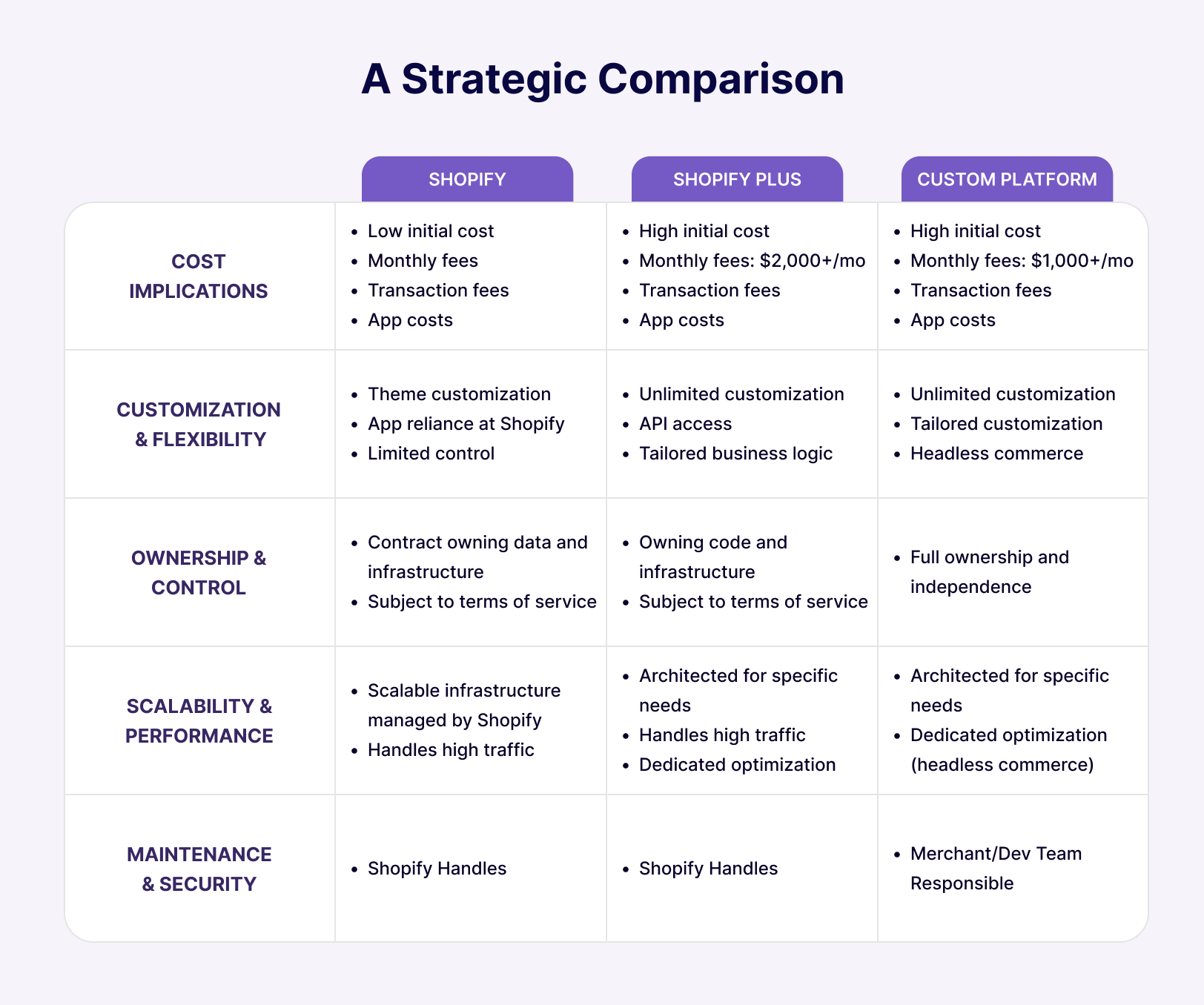
Cost Implications
Shopify: Low initial cost, subscription-based, transaction fees, and app costs. Predictable monthly expenses, but costs can escalate with numerous paid apps and higher transaction volumes.
Shopify Plus: Higher monthly subscription (starts at ~$2,000/month), lower transaction fees, includes some advanced features and dedicated support. Still subject to app costs and potentially costly development for advanced customizations.
Custom Platform: High initial development cost, ongoing maintenance, hosting, and security expenses. However, once built, there are no transaction fees to the platform provider, and total cost of ownership can be lower in the long run for businesses with very high transaction volumes or highly specific needs. Offers complete ownership of the codebase and infrastructure.
Customization and Flexibility
Shopify: Good theme customization, extensive app store for added functionality. Limited control over core logic, checkout process (without Plus), and backend architecture. Relies on third-party solutions.
Shopify Plus: More API access, script editor for checkout logic, dedicated launch engineer. Still operates within Shopify's ecosystem, limiting fundamental changes to the platform's core behavior.
Custom Platform: Unlimited customization. Every aspect of the platform—frontend, backend, database, integrations, business logic—can be tailored precisely. This provides unmatched flexibility to adapt to evolving business requirements and competitive landscapes. Ideal for headless commerce architectures.
Ownership and Control
Shopify: You own your data and content, but not the platform's underlying code or infrastructure. You are subject to Shopify's terms of service, feature roadmap, and potential price changes.
Shopify Plus: Similar to standard Shopify, with some enhanced support and contractual agreements. Still operates within Shopify's proprietary ecosystem.
Custom Platform: Full ownership of the codebase, infrastructure, and intellectual property. Complete control over data, security, hosting environment, and technology stack. This offers long-term strategic independence and the ability to pivot without external constraints.
Scalability and Performance
Shopify: Highly scalable for most businesses, with Shopify managing infrastructure. Performance can be impacted by app bloat or complex themes.
Shopify Plus: Enhanced infrastructure and support for higher traffic and sales volumes. Still shares a multi-tenant architecture.
Custom Platform: Architected for specific scalability needs. Can be optimized for extreme performance, high traffic, and large data volumes. Utilizes dedicated infrastructure and fine-tuned caching strategies. Particularly effective when implemented with a headless approach, allowing for independent scaling of frontend and backend.
Maintenance and Security
Shopify: Shopify handles all core platform maintenance, security updates, and PCI compliance. This reduces operational overhead for merchants.
Shopify Plus: Same benefits as standard Shopify, with enhanced support. Merchants still responsible for app security and custom code.
Custom Platform: Merchant (or their development partner) is responsible for all maintenance, security, updates, and PCI compliance. This requires dedicated technical expertise but offers complete control over security protocols and update schedules. Often built with modern security practices and continuous integration/continuous deployment (CI/CD) pipelines.
Decision Framework: When to Make the Move
Determining the right time to transition from Shopify to a custom e-commerce platform involves a strategic assessment of current pain points, future growth aspirations, and resource availability. Consider the following framework:
1. Identify Core Limitations
Are you consistently hitting roadblocks with Shopify's native features or app ecosystem?
Do you require unique business logic, complex integrations, or specific B2B functionalities that are cumbersome or impossible to implement on Shopify?
Is your current setup hindering operational efficiency or customer experience?
2. Evaluate Shopify Plus
Can Shopify Plus's enhanced features (e.g., more API access, script editor, dedicated support) address your critical pain points without significant compromises?
Is the cost of Shopify Plus justifiable given the additional features and reduced transaction fees?
Does Shopify Plus offer enough flexibility for your long-term strategic goals, or will you likely encounter similar limitations in the future?
3. Assess Long-Term Strategic Goals
Do you envision a highly differentiated customer experience that requires complete control over the frontend and backend?
Are you planning to expand into new markets, launch multi-vendor operations, or integrate deeply with proprietary systems?
Is owning your intellectual property and having full control over your technology stack a strategic imperative for competitive advantage?
4. Resource and Expertise Assessment
Do you have the internal technical expertise or the budget to partner with an experienced agency for custom development, ongoing maintenance, and security?
Are you prepared for a longer development cycle and higher upfront investment compared to a platform migration?
If your answers consistently point to significant limitations with Shopify (even Plus), a strong need for unique functionalities, and a strategic desire for complete control and differentiation, then investing in a custom e-commerce platform becomes a compelling option. This often involves adopting a headless commerce approach, where a custom frontend is decoupled from a commerce backend, offering maximum flexibility and performance.


Hi, my name is Jaswinder, let's talk about your business needs.
I will do my best to find a reliable solution for you!
Conclusion: Strategic Evolution for Sustained Growth
Shopify is an exceptional platform for launching and scaling many e-commerce businesses. However, for enterprises with highly specialized requirements, complex operational workflows, or a vision for truly differentiated customer experiences, the inherent limitations of a standardized platform can become a bottleneck. The decision to move from Shopify to a custom e-commerce platform is not merely a technical one; it is a strategic investment in the future scalability, flexibility, and competitive advantage of your business.
By carefully evaluating your current challenges against your long-term strategic objectives, and by understanding the trade-offs between off-the-shelf solutions and bespoke development, product leaders and decision-makers can make an informed choice. A custom solution, especially when built on a modern headless architecture, offers unparalleled control, performance, and the ability to adapt to an ever-evolving digital landscape, positioning your business for sustained growth and innovation.
Frequently Asked Questions
Find answers to the most common questions about When Should You Move from Shopify to a Custom Ecommerce Platform?
If you rely on multiple apps to manage your store, need advanced B2B features, require complex pricing rules, or struggle with custom integrations, your business may have outgrown Shopify. These limitations can affect performance, operational efficiency, and your ability to scale. A custom ecommerce platform provides greater flexibility, better performance, and complete control over your business workflows.
Shopify Plus is a strong option for businesses that need additional features, better API access, and higher scalability while staying within the Shopify ecosystem. However, if your business requires custom checkout experiences, deep ERP or CRM integrations, unique business logic, or complete ownership of the platform, a custom ecommerce solution is often the better long-term investment.
A custom ecommerce platform offers complete control over your website, business logic, and customer experience. It allows you to build custom features, integrate with enterprise systems, improve website performance, and create scalable solutions tailored to your business. Unlike standard ecommerce platforms, a custom solution can evolve as your business grows without being limited by platform restrictions.
Yes. A well-planned migration can securely transfer products, categories, customer accounts, order history, and other important business data from Shopify to a custom ecommerce platform. An experienced development team can also preserve your SEO structure, implement redirects, and minimize downtime to ensure a smooth transition without disrupting your business operations.
RW Infotech specializes in building scalable, high-performance custom ecommerce solutions using modern technologies and headless commerce architectures. Our team develops tailored platforms that support advanced business workflows, enterprise integrations, and unique customer experiences. From planning and migration to development, optimization, and ongoing support, we help businesses build ecommerce platforms designed for long-term growth and flexibility.
News & Insights
We like to share our thoughts on topics we find inspiring. Explore our news and insights.
Headless CMS vs Traditional CMS: Which Is Better for Content-Heavy Websites?
Compare Headless CMS vs Traditional CMS for content-heavy websites and understand the differences in performance, scalability, SEO, security, content management, and omnichannel delivery.
5 Signs Your Website Is Already Outdated Even If It Looks Fine
Learn the 5 key signs your website is already outdated, including poor AI readability, weak mobile performance, slow loading speeds, confusing CTAs, and security risks.