
Select Your Region
Region-Based Optimized Content
How Fintech Businesses Can Automate Support and KYC Workflows Using AI
Learn how fintech businesses automate customer support and KYC workflows using AI for onboarding, fraud detection, compliance, and workflow optimization.


The financial technology (fintech) sector operates under immense pressure to deliver rapid, secure, and compliant services. As transaction volumes and regulatory complexities increase, manual customer support and Know Your Customer (KYC) processes become bottlenecks, hindering scalability and user experience. Artificial intelligence (AI) offers a transformative solution, enabling fintech businesses to automate these critical workflows, enhance efficiency, and maintain robust security.
This article explores how AI can be strategically deployed to streamline support operations and revolutionize KYC compliance, providing decision-makers with a framework for implementation, evaluating trade-offs, and understanding the long-term implications for their organizations.
The Imperative for AI Automation in Fintech
Fintech companies face a unique confluence of challenges: stringent regulatory requirements, the need for rapid customer onboarding, continuous fraud detection, and the expectation of instant customer support. Traditional, human centric approaches struggle to meet these demands at scale, leading to increased operational costs, slower processing times, and potential compliance gaps.
AI automation addresses these issues by introducing speed, accuracy, and scalability into processes that were previously labor-intensive. From initial customer interaction to ongoing compliance monitoring, AI agents and automated systems can handle repetitive tasks, analyze vast datasets, and flag anomalies with precision that human teams cannot consistently match.
Understanding Key AI Components for Workflow Automation
Effective AI-driven automation in fintech leverages several core technologies:
Natural Language Processing (NLP): Enables AI systems to understand, interpret, and generate human language, crucial for chatbots and sentiment analysis in customer support.
Machine Learning (ML): Allows systems to learn from data, identify patterns, and make predictions or decisions without explicit programming. This is fundamental for fraud detection, risk scoring, and predictive analytics.
Computer Vision: Processes and interprets visual information from images and videos, essential for document verification, facial recognition, and identity checks in KYC.
Robotic Process Automation (RPA): Automates repetitive, rule-based digital tasks by mimicking human interactions with software applications, often integrating various systems.
Generative AI: Can create new content, summarize complex information, or generate personalized responses, enhancing the capabilities of customer support agents and content generation for compliance explanations.
Combining these technologies allows for the creation of sophisticated automation pipelines that can manage end-to-end workflows.
Automating KYC Workflows with AI
KYC is a cornerstone of financial compliance, designed to prevent fraud, money laundering, and terrorist financing. It is also notoriously resource-intensive. AI significantly reduces the friction and cost associated with these processes.
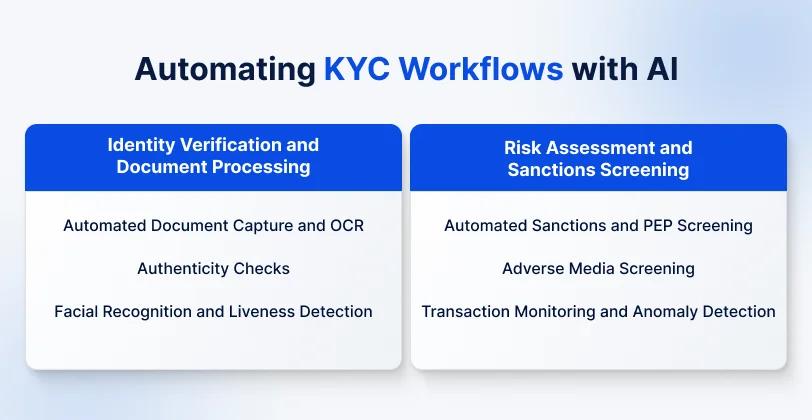
Identity Verification and Document Processing
The initial phase of KYC involves verifying a customer's identity and validating submitted documents. AI, particularly computer vision and ML, excels here:
Automated Document Capture and OCR: AI-powered systems can automatically capture images of identity documents (passports, driver's licenses), extract relevant data using Optical Character Recognition (OCR), and classify document types. This eliminates manual data entry errors and speeds up processing.
Authenticity Checks: ML algorithms can analyze security features on documents, detect signs of tampering, and cross-reference data against known fraud databases. This significantly enhances the accuracy of fraud detection compared to manual review.
Facial Recognition and Liveness Detection: Biometric verification using facial recognition matches a user's live selfie to their ID photo. Liveness detection ensures the user is a real person and not a spoof attempt (e.g., a photo or video playback), adding a critical layer of security.
Decision-makers must consider the trade-off between strict verification protocols and user experience. Overly complex or error-prone AI systems can lead to customer drop-off. Investing in robust, user-friendly AI solutions that provide clear feedback is paramount.
Risk Assessment and Sanctions Screening
Beyond initial identity verification, AI plays a crucial role in ongoing risk assessment and compliance:
Automated Sanctions and PEP Screening: AI systems can continuously screen customer databases against global sanctions lists (e.g., OFAC, UN, EU) and Politically Exposed Persons (PEP) databases. This process, traditionally manual and time-consuming, becomes instantaneous and highly accurate, reducing the risk of non-compliance.
Adverse Media Screening: NLP and ML can scan vast amounts of public data, news articles, and social media for any negative information associated with an individual or entity. This provides a holistic view of potential risks that might not be apparent from standard database checks.
Transaction Monitoring and Anomaly Detection: AI algorithms learn normal transaction patterns for each customer. Any deviation, such as unusually large transactions, frequent transfers to high-risk jurisdictions, or rapid account activity changes, can be flagged in real-time for human review, significantly improving anti-money laundering (AML) efforts.
The long-term implication is a shift from reactive to proactive compliance. AI enables continuous monitoring, adapting to new threats and regulatory changes faster than human teams. However, it requires careful calibration to minimize false positives, which can burden compliance teams and impact legitimate customer transactions.
Streamlining Customer Support with AI
Customer support in fintech demands speed, accuracy, and personalized interactions. AI-powered tools can handle a significant portion of inquiries, freeing human agents to focus on complex cases.
AI-Powered Chatbots and Virtual Assistants
Chatbots are often the first point of contact for customers, providing instant support for common queries:
24/7 Availability: Chatbots provide immediate assistance around the clock, improving customer satisfaction by reducing wait times.
Automated Query Resolution: Using NLP, chatbots can understand customer questions, access knowledge bases, and provide accurate answers to FAQs, account balance inquiries, transaction history requests, and basic troubleshooting.
Personalized Experiences: Advanced chatbots can integrate with CRM systems to access customer-specific data, offering personalized recommendations or tailored support based on past interactions or account status.
Ticket Routing and Escalation: When a query is too complex for the chatbot, it can intelligently route the customer to the most appropriate human agent, providing the agent with a summary of the interaction to ensure a seamless handoff.
The strategic decision here involves balancing automation with human intervention. While chatbots handle volume, human agents remain critical for empathy, complex problem-solving, and building customer loyalty. A hybrid model, where AI augments human capabilities, typically yields the best results.
Sentiment Analysis and Proactive Support
AI can move beyond reactive support to proactive engagement:
Sentiment Analysis: NLP can analyze customer interactions (chat, email, social media) to gauge sentiment. Negative sentiment can trigger alerts for human agents to intervene proactively, potentially preventing churn or escalating issues.
Predictive Analytics for Support Needs: By analyzing historical data, AI can predict when customers might encounter issues (e.g., approaching payment due dates, unusual account activity) and proactively offer assistance or information, reducing inbound support requests.
Automated Communication: AI can trigger personalized emails or in-app notifications for important updates, payment reminders, or security alerts, reducing the manual workload for marketing and support teams.
Implementing these capabilities requires robust data integration and a clear strategy for how AI-generated insights translate into actionable steps. Data privacy and ethical AI use are critical considerations when analyzing customer sentiment and behavior.


Hi, my name is Jaswinder, let's talk about your business needs.
I will do my best to find a reliable solution for you!
Implementing AI Automation: Strategic Considerations
Deploying AI in fintech is not merely a technical exercise; it requires a strategic approach that considers people, processes, and technology.
Data Quality and Governance
AI models are only as good as the data they are trained on. Poor data quality leads to inaccurate predictions and flawed automation. Fintech businesses must invest in:
Data Cleansing and Standardization: Ensuring data is accurate, consistent, and formatted correctly across all systems.
Data Security and Privacy: Implementing robust measures to protect sensitive customer data, adhering to regulations like GDPR, CCPA, and industry-specific financial data protection standards.
Data Lineage and Auditability: Maintaining clear records of how data is collected, processed, and used by AI systems, crucial for compliance and troubleshooting.
Decision-makers should prioritize data governance frameworks before embarking on large-scale AI initiatives. A significant risk is building AI systems on biased or incomplete data, leading to discriminatory outcomes or compliance failures.
Integration with Existing Systems
AI automation solutions must integrate seamlessly with core banking systems, CRM platforms, fraud detection tools, and existing compliance databases. A fragmented approach will undermine the benefits of automation.
API-First Architecture: Prioritize AI solutions that offer robust APIs for easy integration.
Modular Design: Opt for modular AI components that can be deployed incrementally and updated independently, reducing disruption.
Scalability: Ensure the chosen AI infrastructure can handle increasing data volumes and transaction loads as the business grows.
The trade-off here is often between off-the-shelf solutions that offer quick deployment but limited customization, versus custom-built AI that provides precise fit but requires significant development effort and time.
Human-in-the-Loop Strategy
While AI automates, human oversight remains essential, especially in high-stakes financial operations.
Exception Handling: AI systems should be designed to flag complex cases, edge scenarios, or high-risk transactions for human review.
Continuous Improvement: Human feedback on AI decisions helps retrain and refine models, improving their accuracy over time.
Ethical Oversight: Human teams are crucial for monitoring AI for bias, ensuring fairness, and making ethical judgments that AI cannot.
This hybrid approach ensures that the benefits of AI (speed, scale) are combined with human strengths (judgment, empathy, ethical reasoning).
Conclusion
The automation of support and KYC workflows using AI is no longer a futuristic concept but a strategic imperative for fintech businesses aiming for efficiency, compliance, and superior customer experience. By leveraging AI for identity verification, risk assessment, fraud detection, and intelligent customer support, fintech companies can significantly reduce operational costs, accelerate onboarding, and enhance security protocols.
Successful implementation hinges on a clear strategy for data governance, seamless integration, and a thoughtful human-in-the-loop approach. As the fintech landscape continues to evolve, AI-driven automation will be a key differentiator, enabling companies to scale responsibly and remain competitive in a highly regulated and rapidly changing environment.
RW Infotech specializes in developing robust AI automation solutions tailored for the fintech sector. Our expertise in full-stack development, AI integration, and performance optimization helps businesses build secure, scalable, and compliant platforms that leverage the full potential of artificial intelligence for critical workflows.
Frequently Asked Questions
Find answers to the most common questions about How Fintech Businesses Can Automate Support and KYC Workflows Using AI.
AI for KYC offers faster identity verification, reduced manual processing costs, enhanced fraud detection capabilities, improved compliance accuracy, and a more streamlined onboarding experience for customers.
AI improves customer support by providing 24/7 availability through chatbots, automating answers to common queries, intelligently routing complex issues to human agents, and enabling proactive communication based on sentiment analysis.
Key data considerations include ensuring high data quality, implementing robust data security and privacy measures, establishing clear data governance policies, and maintaining auditable data lineage for compliance.
No, AI is best utilized to augment human agents. While AI handles repetitive tasks and provides initial support, human agents remain crucial for complex problem-solving, empathetic interactions, and building customer trust.
RW Infotech can help your fintech business by designing and implementing custom AI automation solutions for support and KYC workflows, integrating AI with existing systems, and ensuring compliance and scalability through expert full-stack development and AI integration services.
News & Insights
We like to share our thoughts on topics we find inspiring. Explore our news and insights.

Which Headless CMS Is Best for Content-Heavy Websites in 2026?
Discover the best headless CMS platforms for content-heavy websites in 2026. Compare Sanity, Strapi, Contentful, Storyblok, Directus, and other leading options.
Headless CMS vs Traditional CMS: Which Is Better for Content-Heavy Websites?
Compare Headless CMS vs Traditional CMS for content-heavy websites and understand the differences in performance, scalability, SEO, security, content management, and omnichannel delivery.