
Select Your Region
Region-Based Optimized Content
Why Traditional Business Automation Is No Longer Enough in 2026
Discover why traditional business automation is no longer enough in 2026 and how agentic AI systems enable intelligent decision-making, adaptive workflows, and scalable business operations.


The landscape of business operations is evolving at an unprecedented pace. For years, traditional business automation, characterized by rule-based workflows and static scripts, has been a cornerstone for efficiency. These systems excelled at handling repetitive, predictable tasks, delivering significant gains in productivity and cost reduction. However, as businesses navigate increasingly complex environments, marked by dynamic market shifts, unstructured data, and the need for adaptive decision-making, the limitations of conventional automation are becoming starkly apparent.
In 2026, relying solely on traditional automation is no longer sufficient to maintain a competitive edge. This article explores why these established methods are struggling to meet modern demands and why the shift towards more intelligent, adaptive automation, particularly through agentic AI systems, is not merely an upgrade but a strategic imperative for sustained growth and operational resilience.
The Evolving Demands of Modern Business Operations
Today's business environment is characterized by volatility, uncertainty, complexity, and ambiguity (VUCA). This necessitates operational frameworks that can adapt, learn, and make informed decisions in real-time. Traditional automation, while effective for defined processes, often falters when confronted with these complexities.
Consider the proliferation of data. Businesses are awash in both structured and unstructured information from diverse sources customer interactions, social media, sensor data, and more. Traditional systems are typically designed to process structured data following predefined rules. They struggle to derive insights from nuanced, unstructured inputs or to handle exceptions that deviate from their programmed logic. This often leads to bottlenecks, manual interventions, and missed opportunities.
Furthermore, customer expectations have never been higher. Personalized experiences, instant gratification, and seamless omnichannel interactions are the norm. Static automation, which often leads to rigid customer journeys, can fail to deliver the dynamic, context-aware responses that build loyalty and satisfaction. Businesses need systems that can understand intent, adapt conversations, and resolve complex queries without constant human oversight.
Limitations of Traditional Rule-Based Automation
Traditional business automation relies heavily on if-then-else logic and predefined sequences. While powerful for well-understood, repetitive tasks, this approach has inherent limitations that hinder its effectiveness in modern contexts.
Rigidity and Lack of Adaptability: Rule-based systems are inherently static. Any change in business logic, market conditions, or regulatory requirements necessitates manual reprogramming. This makes them slow to adapt and expensive to maintain in dynamic environments.
Inability to Handle Exceptions: When a process deviates from its predefined path, traditional automation typically flags it for human intervention. While necessary for critical exceptions, a high volume of minor exceptions can negate efficiency gains and create significant operational overhead.
Struggles with Unstructured Data: Traditional systems are not designed to interpret natural language, images, or other forms of unstructured data. This limits their application in areas like customer support, content analysis, or market research, where such data is paramount.
Limited Decision-Making Capabilities: These systems execute instructions; they do not "think" or make judgments. They lack the capacity for contextual understanding, predictive analysis, or learning from past interactions, confining them to purely deterministic tasks.
Scalability Challenges with Complexity: As processes become more intricate, the number of rules required for traditional automation can explode, leading to unmanageable complexity, difficult debugging, and performance degradation.
These limitations explain why traditional business automation is no longer enough in 2026. Businesses are seeking solutions that can transcend these boundaries, offering greater flexibility, intelligence, and autonomy.
The Rise of Agentic AI Systems: A Paradigm Shift
The limitations of traditional automation have paved the way for a new paradigm: Agentic AI systems. These systems represent a significant leap forward, moving beyond simple task execution to intelligent decision-making and autonomous action. An agentic AI system is designed to perceive its environment, process information, reason about its goals, plan a sequence of actions, and execute those actions, often learning and adapting along the way.
Key characteristics of agentic AI systems include:
Contextual Understanding: Unlike rule-based systems, agentic AI can interpret context, intent, and nuance from various data sources, including unstructured text and speech. This allows for more intelligent and relevant responses.
Intelligent Decision-Making: Powered by machine learning models, these agents can analyze vast amounts of data, identify patterns, make predictions, and recommend or execute decisions that optimize for specific objectives, even in ambiguous situations.
Autonomous Workflow Execution: Agentic AI can orchestrate complex workflows across multiple systems and applications without constant human supervision. They can identify the next logical step, adapt to changing conditions, and even self-correct.
Learning and Adaptation: Through continuous interaction and feedback, agentic systems can learn from their experiences, refine their decision-making models, and improve their performance over time, making them inherently more resilient and future-proof.
Proactive Problem Solving: Rather than merely reacting to predefined triggers, agentic AI can proactively identify potential issues, anticipate needs, and initiate actions to prevent problems or seize opportunities.
This shift from prescriptive automation to adaptive intelligence fundamentally changes how businesses can operate, enabling higher levels of efficiency, personalization, and strategic agility.
Strategic Implications for Teams and Decision-Makers
Adopting agentic AI is not merely a technological upgrade; it's a strategic decision with profound implications for organizational structure, talent management, and competitive positioning. Decision-makers must consider several factors: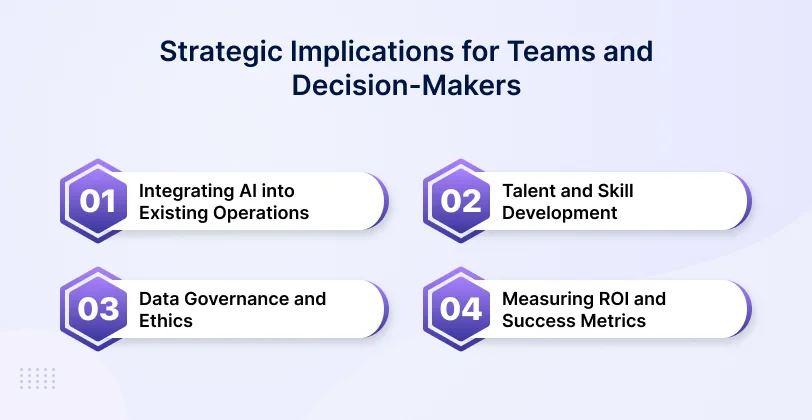
Integrating AI into Existing Operations
The transition from traditional to AI-driven automation requires careful planning. Businesses often have significant investments in legacy systems and established workflows. Agentic AI should be integrated incrementally, focusing on high-impact areas first. This might involve augmenting existing RPA (Robotic Process Automation) deployments with AI capabilities or deploying AI agents for specific, complex tasks that traditional systems cannot handle.
A phased approach allows teams to gain experience, build confidence, and demonstrate ROI before scaling. It also necessitates robust API strategies to ensure seamless communication between disparate systems.
Talent and Skill Development
The rise of agentic AI will reshape job roles. Repetitive tasks will be increasingly handled by AI, freeing human employees to focus on more strategic, creative, and empathetic work. This requires upskilling and reskilling initiatives. Employees will need to develop skills in AI oversight, data interpretation, prompt engineering, and complex problem-solving. Leaders must foster a culture of continuous learning and adaptability to prepare their workforce for this evolution.
Data Governance and Ethics
Agentic AI systems are data-hungry. The quality, integrity, and ethical use of data are paramount. Organizations must establish robust data governance frameworks, ensuring data privacy, security, and compliance with regulations. Ethical considerations, such as algorithmic bias and transparency, must be addressed proactively to build trust and ensure responsible AI deployment.
Measuring ROI and Success Metrics
Measuring the return on investment for agentic AI goes beyond simple cost savings. While efficiency gains are significant, the true value lies in improved customer experience, enhanced decision-making quality, accelerated innovation, and increased operational resilience. Decision-makers should define clear success metrics that encompass both quantitative (e.g., reduced processing time, error rates) and qualitative (e.g., customer satisfaction scores, employee engagement) outcomes.
Real-World Use Cases for Agentic AI
Agentic AI is transforming various business functions, offering practical solutions where traditional automation falls short.
Customer Support: AI-powered chatbots and virtual assistants can handle complex customer inquiries, understand sentiment, personalize interactions, and escalate only truly unique issues to human agents. They can access and synthesize information from multiple knowledge bases, providing comprehensive and consistent support 24/7.
Operations and Supply Chain: Agentic AI can optimize logistics, predict demand fluctuations, manage inventory autonomously, and identify potential disruptions in the supply chain before they occur. For example, an AI agent could monitor global shipping data, weather patterns, and geopolitical events to reroute shipments proactively.
Sales and Marketing: AI agents can analyze customer behavior across channels, personalize marketing campaigns in real-time, generate highly targeted content, and even qualify leads more effectively. They can adapt messaging based on user engagement and predict the next best action for sales teams.
Human Resources: From automating candidate screening and onboarding to personalizing employee development paths and answering HR policy questions, AI agents can streamline HR operations, allowing HR professionals to focus on strategic talent management and employee well-being.
Business Process Management (BPM): Agentic AI can observe and learn from human interactions within complex processes, identify inefficiencies, and suggest or implement optimizations autonomously. This moves beyond simply automating existing processes to intelligently redesigning them for optimal performance.
These examples illustrate how agentic decision-making, autonomous workflows, and AI-powered adaptability are helping organizations improve efficiency, reduce manual intervention, and build scalable operations that can evolve with business needs.


Hi, my name is Jaswinder, let's talk about your business needs.
I will do my best to find a reliable solution for you!
Conclusion
The era where traditional rule-based automation was sufficient for competitive advantage is drawing to a close. In 2026 and beyond, businesses must embrace intelligent, adaptive systems to navigate complexity, capitalize on data, and meet evolving customer demands. Agentic AI systems offer a powerful solution, moving beyond static execution to intelligent decision-making, contextual understanding, and continuous learning.
The transition requires a strategic approach, focusing on thoughtful integration, workforce development, robust data governance, and a clear understanding of success metrics. Organizations that proactively adopt agentic AI will not only gain significant operational efficiencies but also build a foundation for innovation, resilience, and sustainable growth in an increasingly dynamic world. Ignoring this shift means risking obsolescence. Embracing it means unlocking unprecedented potential.
At RW Infotech, we specialize in helping businesses integrate cutting-edge AI automation solutions, including agentic AI systems, into their operations. Our expertise in full stack development, AI automation, and performance optimization ensures that your transition to intelligent workflows is seamless, secure, and strategically aligned with your long-term business objectives.
Frequently Asked Questions
Find answers to the most common questions about Why Traditional Business Automation Is No Longer Enough in 2026
Traditional RPA automates repetitive, rule-based tasks with structured data. Agentic AI, conversely, can understand context, make intelligent decisions, learn from experience, and handle unstructured data, allowing it to manage complex, dynamic workflows autonomously.
Key challenges include ensuring data quality and governance, managing the integration with existing legacy systems, developing new skills within the workforce, and addressing ethical considerations such as bias and transparency in AI decision-making.
No, agentic AI is designed to augment human capabilities, not replace them entirely. It handles repetitive and complex analytical tasks, freeing human employees to focus on strategic thinking, creativity, complex problem-solving, and empathetic customer interactions.
RW Infotech specializes in AI automation and full stack development. We can assist your business by designing and implementing custom agentic AI solutions, integrating them with your existing systems, and optimizing them for performance and scalability to meet your specific operational needs.
News & Insights
We like to share our thoughts on topics we find inspiring. Explore our news and insights.