
Select Your Region
Region-Based Optimized Content
The Next SEO Is Product Data: Are Ecommerce Brands Ready for AI Shopping?
Discover why product data is becoming the next SEO for ecommerce and how brands can optimize product information for AI shopping and AI-powered search.


The landscape of ecommerce is undergoing a fundamental shift. Traditional SEO, focused on keywords, content marketing, and organic search rankings, remains important. However, a new paradigm is emerging, driven by artificial intelligence. As AI shopping assistants, conversational commerce platforms, and AI-powered search engines become integral to the buying journey, the optimization strategy for ecommerce brands must evolve. The next SEO is product data, and its quality, structure, and accuracy will determine an ecommerce brand's visibility and success.
This article explores why rich, structured product data is becoming the critical differentiator for ecommerce visibility. We will examine how AI systems interpret and leverage this data, the implications of poor data quality, and provide a framework for brands to prepare their product catalogs for the era of AI shopping.
The Evolution of Search: From Keywords to Context and Intent
For decades, SEO has revolved around matching user queries with relevant content through keywords. Search engines indexed web pages, analyzed text, and ranked results based on relevance and authority. While this model persists, AI is introducing a layer of semantic understanding and predictive intent. AI shopping assistants don't just match keywords; they interpret complex queries, understand nuances, compare attributes, and anticipate user needs across various touchpoints.
Consider a user asking an AI assistant, "Find me a durable, lightweight laptop for under $1200 with at least 16GB RAM and good battery life for travel." This isn't a simple keyword search. It requires the AI to:
- Understand "durable," "lightweight," and "good battery life" in the context of laptops.
- Filter by specific technical specifications (RAM, price).
- Infer usage patterns ("travel") to prioritize certain features (battery, weight, robustness).
- Compare multiple products based on a composite set of criteria.
For an ecommerce brand's products to be surfaced in such scenarios, their underlying product data must be meticulously detailed, accurately categorized, and easily consumable by AI.
Why Product Data is the New SEO for AI Shopping
AI systems, whether embedded in search engines, voice assistants, or dedicated shopping apps, rely on machine-readable information to understand and present products. This goes far beyond a simple product title and description. It encompasses a comprehensive set of attributes that describe every facet of a product.
Comprehensive Product Information
AI needs granular details to make intelligent recommendations. This includes:
- Product Names and Descriptions: Clear, concise, and feature-rich.
- Pricing and Availability: Real-time accuracy is paramount. Outdated pricing or stock information leads to poor user experiences and distrust.
- Variants and Attributes: Size, color, material, configuration options—each needs to be distinctly defined and linked.
- Technical Specifications: Detailed specs like dimensions, weight, power consumption, processor type, memory, storage, and connectivity options are crucial for comparison.
- Imagery and Media: High-quality images from multiple angles, videos, and 3D models provide visual context that AI can increasingly interpret.
- Customer Reviews and Ratings: AI systems leverage sentiment analysis from reviews to understand product strengths and weaknesses from a user perspective.
- Shipping Information: Delivery times, costs, and return policies influence purchasing decisions and must be transparent.
- Categorization and Taxonomy: Products must be accurately categorized within a logical hierarchy for AI to understand their context and relationship to other products.
Structured Data and Semantic Markup
For AI to effectively "read" and interpret product information, it needs to be structured. This is where technologies like Schema.org markup become indispensable. Schema.org provides a standardized vocabulary for describing entities on the web, including products, offers, reviews, and more. Implementing accurate Schema markup helps search engines and AI assistants understand the meaning and relationships within your product data, rather than just parsing raw text.
Loading...
This JSON-LD snippet clearly defines the product's name, description, brand, reviews, and offer details in a machine-readable format. Without such structured data, AI systems struggle to reliably extract and interpret product attributes, leading to diminished visibility.
Product Feeds and APIs
Beyond on-page Schema, robust product feeds and APIs are crucial for feeding product data to various AI platforms and aggregators. Google Merchant Center, for instance, relies on comprehensive product feeds to power Shopping Ads and product listings across Google's ecosystem. Similarly, marketplaces, comparison shopping engines, and emerging AI shopping platforms will require standardized, real-time access to product catalogs.
An API-first approach to product information management (PIM) ensures that product data is centrally managed, consistently updated, and accessible to any consuming application or AI agent. This eliminates data silos and ensures a single source of truth.
The Cost of Poor Product Data
In the era of AI shopping, incomplete, inaccurate, or unstructured product data carries significant risks:
- Reduced Visibility: AI systems cannot recommend or surface products they don't fully understand. If key attributes are missing, or data is inconsistent, products will simply not appear in relevant AI-driven queries.
- Inaccurate Recommendations: Poor data leads to irrelevant or incorrect product suggestions, frustrating users and damaging brand perception.
- Lost Sales and Conversions: When AI cannot confidently match a product to a user's needs, the opportunity for a sale is lost, often to a competitor with better data.
- Increased Returns: Misleading or incomplete product descriptions can lead to customers receiving products that don't meet their expectations, resulting in higher return rates.
- Negative Brand Perception: A brand that consistently provides poor product data will be perceived as unreliable and unprofessional by both AI systems and human shoppers.
Preparing Your Ecommerce Product Data for AI Shopping
Transitioning to an AI-ready product data strategy requires a multi-faceted approach. Here are the key steps for teams and decision-makers:
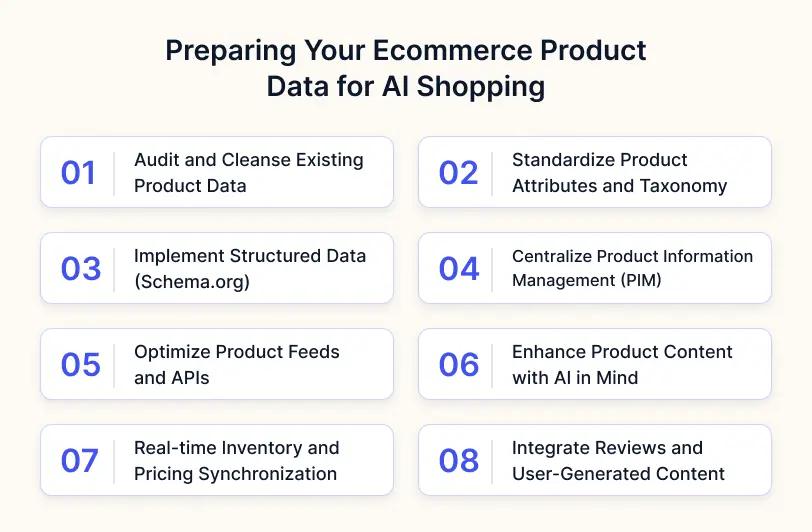
1. Audit and Cleanse Existing Product Data
Begin with a comprehensive audit of your current product catalog. Identify gaps, inconsistencies, duplicate entries, and outdated information. Establish clear data governance policies and processes for ongoing data cleansing and maintenance. This foundational step is critical before any other optimization can be effective.
2. Standardize Product Attributes and Taxonomy
Develop a robust, consistent taxonomy for your product categories and a standardized set of attributes for each product type. For example, all laptops should have attributes for "processor," "RAM," "storage," "screen size," and "battery life," defined with consistent units and formats. This ensures uniformity and machine readability.
3. Implement Structured Data (Schema.org)
Prioritize the implementation of comprehensive Schema.org markup for all product pages. Focus on Product, Offer, AggregateRating, and Review types. Validate your Schema implementation using tools like Google's Rich Results Test to ensure correctness and avoid errors.
4. Centralize Product Information Management (PIM)
Invest in a robust PIM system or enhance existing solutions to serve as the single source of truth for all product data. A PIM facilitates centralized data entry, validation, enrichment, and distribution to various channels, including your ecommerce site, marketplaces, and AI platforms. This is a strategic decision that impacts scalability and data consistency.
5. Optimize Product Feeds and APIs
Ensure your product feeds (e.g., for Google Merchant Center, social commerce platforms) are complete, accurate, and regularly updated. Explore developing APIs to expose your product catalog in a machine-readable format for potential integration with emerging AI shopping assistants or custom applications. This API-first approach provides flexibility and future-proofs your data distribution.
6. Enhance Product Content with AI in Mind
Beyond structured data, optimize your product descriptions and imagery for AI interpretation. Use descriptive language that highlights key features and benefits. Provide multiple high-quality images and consider 3D models or AR experiences where relevant. Ensure image alt text is descriptive, as AI can increasingly process visual information.
7. Real-time Inventory and Pricing Synchronization
AI systems require real-time accuracy for availability and pricing. Implement robust integrations between your inventory management system, ecommerce platform, and any external data feeds to ensure instant synchronization. This prevents frustrating "out of stock" or "price changed" scenarios for users interacting with AI.
8. Integrate Reviews and User-Generated Content
Actively solicit and integrate customer reviews and ratings. AI systems leverage this user-generated content for sentiment analysis and to provide social proof. Ensure your review data is also structured with Schema.org markup.


Hi, my name is Jaswinder, let's talk about your business needs.
I will do my best to find a reliable solution for you!
Synergy with Traditional SEO
Optimizing product data for AI does not negate the importance of traditional SEO. Instead, it complements and enhances it. High-quality product data improves crawlability, enriches rich snippets in search results, and ultimately contributes to better organic visibility. A well-structured product page with comprehensive data is inherently more valuable to both human users and search engine algorithms.
Traditional keyword research still informs product titles and descriptions, while content marketing builds brand authority and drives traffic. The difference is that AI-ready product data ensures that when users arrive, or when AI agents are making recommendations, the underlying product information is robust enough to convert intent into action.
Conclusion
The shift towards AI-powered shopping is not a distant future; it is happening now. Ecommerce brands that fail to prioritize the quality, structure, and accessibility of their product data risk becoming invisible in this evolving landscape. The next SEO is product data, and mastering it is no longer optional it is a strategic imperative for sustained growth and competitive advantage.
By investing in robust PIM solutions, meticulous data governance, comprehensive structured data implementation, and real-time synchronization, brands can ensure their products are understood, recommended, and purchased by the next generation of AI-driven shoppers. This requires a coordinated effort across marketing, product, and IT teams, guided by a clear vision for an AI-ready ecommerce future.
RW Infotech specializes in building robust, scalable ecommerce platforms with a strong emphasis on headless solutions, data integration, and performance optimization. Our expertise in Headless CMS migrations, Full Stack Development, and AI automation ensures that your product data is not only clean and structured but also efficiently managed and delivered across all channels, preparing your brand for the demands of AI shopping.
Frequently Asked Questions
Find answers to the most common questions about The Next SEO Is Product Data: Are Ecommerce Brands Ready for AI Shopping?
AI-powered shopping involves AI assistants or search engines interpreting complex natural language queries, comparing product attributes across multiple sources, and providing personalized recommendations, often conversationally, rather than users manually browsing categories or typing specific keywords into a search bar.
APIs (Application Programming Interfaces) enable different systems, including AI agents and shopping platforms, to programmatically access and exchange product data in real time. This ensures that AI systems always have the most current and comprehensive product information available, facilitating dynamic recommendations and comparisons.
Schema.org markup is a critical component for helping search engines and AI understand product data on your web pages. However, it's part of a larger strategy that also includes comprehensive product feeds, robust PIM systems, accurate attribute standardization, and real-time inventory synchronization for full AI shopping readiness.
Product data, especially pricing and availability, should be updated in real-time or as close to real-time as possible. For other attributes like descriptions, images, or specifications, updates should occur immediately whenever changes are made, ensuring consistency across all channels and AI platforms.
RW Infotech can assist by implementing headless solutions and robust PIM systems to centralize and manage your product data, ensuring it is structured and accessible via APIs. We also specialize in integrating real-time inventory and pricing synchronization, and optimizing your platform for performance, laying the technical foundation for AI-ready ecommerce.
News & Insights
We like to share our thoughts on topics we find inspiring. Explore our news and insights.
Headless CMS vs Traditional CMS: Which Is Better for Content-Heavy Websites?
Compare Headless CMS vs Traditional CMS for content-heavy websites and understand the differences in performance, scalability, SEO, security, content management, and omnichannel delivery.

5 Signs Your Website Is Already Outdated Even If It Looks Fine
Learn the 5 key signs your website is already outdated, including poor AI readability, weak mobile performance, slow loading speeds, confusing CTAs, and security risks.