
Select Your Region
Region-Based Optimized Content
Headless CMS vs Traditional CMS: Which Is Better for Content-Heavy Websites?
Compare Headless CMS vs Traditional CMS for content-heavy websites, including performance, scalability, SEO, security, flexibility, and omnichannel delivery.


Choosing the right Content Management System (CMS) is a critical strategic decision, especially for organizations managing substantial volumes of content. For content-heavy websites—such as large blogs, news portals, publishing platforms, educational sites, and enterprise documentation hubs—the CMS directly impacts performance, scalability, content delivery, and the efficiency of editorial and development teams. This article will dissect the merits of Headless CMS vs Traditional CMS, focusing on their suitability for environments where content is king.
Traditional CMS platforms, often monolithic in architecture, bundle content management and presentation layers. In contrast, headless CMS solutions decouple these functions, offering a content repository accessible via APIs. Understanding these fundamental differences is crucial for making an informed choice that aligns with your long-term digital strategy, particularly as omnichannel delivery and personalized experiences become standard expectations.
The Challenges of Content-Heavy Websites with Traditional CMS
Content-heavy websites inherently face specific challenges that can be exacerbated by a traditional CMS architecture. These platforms, while convenient for simpler sites, often struggle under the weight of extensive content portfolios and modern delivery demands.
Performance Bottlenecks: Traditional CMSs frequently couple the database, application logic, and frontend rendering. As content volume grows, database queries become more complex, and page generation times increase. This can lead to slow load times, poor user experience, and negative SEO impacts, especially during traffic spikes.
Tightly Coupled Frontend and Backend: The monolithic nature means the frontend presentation layer is intrinsically linked to the backend content management. Customizing the user experience or integrating new technologies often requires deep modifications to the core CMS, making updates cumbersome and innovation slow.
Complex Content Management Workflows: While traditional CMSs offer robust editorial tools, managing vast content libraries across different sections, categories, and author teams can become unwieldy. Version control, content reuse, and approval processes can be less flexible than required for dynamic, high-volume publishing.
Difficulty Delivering Content Across Multiple Platforms: Modern digital strategies demand content delivery beyond a single website. Traditional CMSs are primarily designed for web-centric delivery. Extending content to mobile apps, IoT devices, smart displays, or voice assistants often requires duplicating content or developing complex, custom integrations that are difficult to maintain.
Scalability Limitations: Scaling a traditional CMS often means scaling the entire stack—database, application server, and web server. This can be resource-intensive and complex, particularly when different components have varying scaling needs. Performance can degrade significantly under high concurrent user loads or extensive content updates.
Understanding Headless CMS and Traditional CMS Architectures
To evaluate which approach is better, it's essential to understand their core architectural differences and how these impact content-heavy environments.
Traditional CMS: Monolithic and Integrated
A traditional CMS (e.g., WordPress, Drupal, Joomla) combines the content repository, content management interface, and the frontend presentation layer into a single, integrated system. When a user requests a page, the CMS fetches content from the database, applies templates, and renders the HTML directly. This "what you see is what you get" (WYSIWYG) experience is intuitive for content creators.
Content Management: Provides a comprehensive admin panel for content creation, editing, publishing, and media management.
Templating and Presentation: Offers built-in themes and templates to define the website's look and feel, directly generating the final webpage.
Ease of Use: Often favored for smaller teams or less complex websites due to its integrated nature and lower initial development overhead for a standard website.
Headless CMS: Decoupled and API-First
A headless CMS (e.g., Strapi, Contentful, Sanity) separates the content management backend (the "body" of the CMS) from the frontend presentation layer (the "head"). Content is stored, managed, and delivered purely as data via APIs (Application Programming Interfaces). Developers then use these APIs to pull content into any frontend application or "head"—be it a website built with React, a mobile app, a smart device, or any other digital experience.
Content Repository: Focuses solely on content creation, storage, and organization, providing a clean, structured content model.
API-Driven Delivery: Content is accessed programmatically via RESTful or GraphQL APIs, allowing for flexible integration with any frontend framework or device.
Developer Flexibility: Empowers developers to choose their preferred tools and frameworks for the frontend, optimizing for performance and user experience.
Detailed Comparison: Headless CMS vs Traditional CMS for Content-Heavy Websites
Here’s a comparative analysis across key criteria relevant to managing extensive content portfolios:
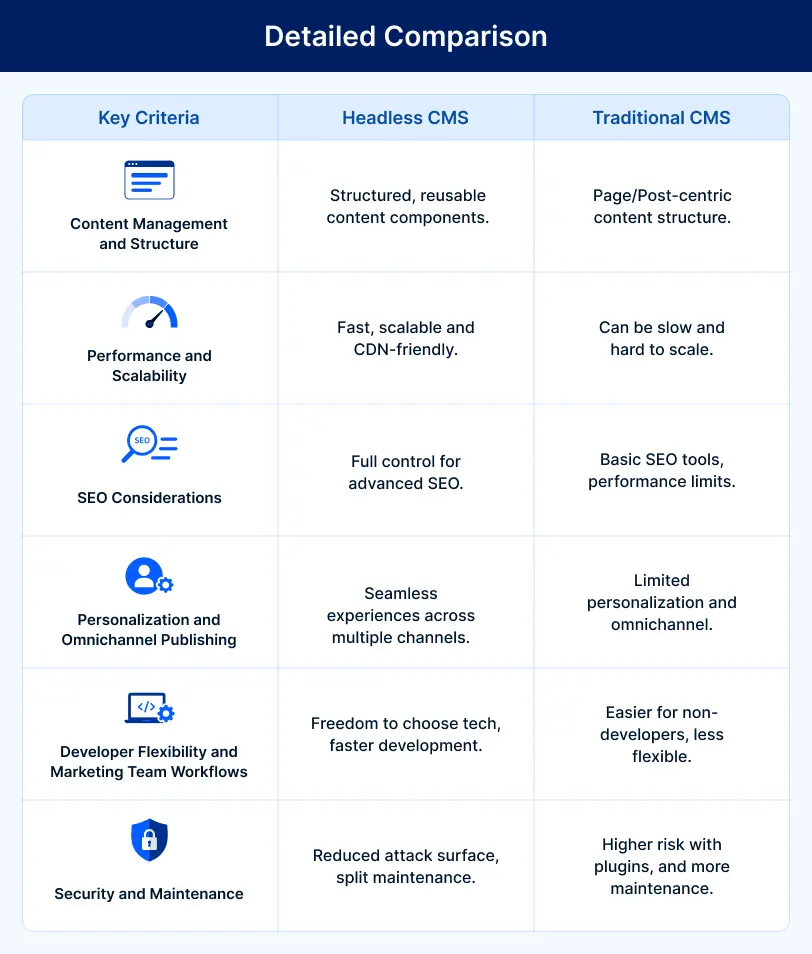
Content Management and Structure
Traditional CMS: Content is often stored in a page-centric or post-centric manner. While custom post types exist, structuring content for reuse across diverse contexts can be challenging. Editors manage content directly within the context of how it will appear on the web page.
Headless CMS: Emphasizes content modeling, where content is structured into reusable components (e.g., author, article body, image gallery) independent of presentation. This atomic approach allows for highly organized, consistent, and reusable content, crucial for managing vast libraries and delivering across multiple channels.
Performance and Scalability
Traditional CMS: Can suffer from performance issues due to database queries, server-side rendering, and plugin overhead. Scaling often means replicating the entire stack, which can be inefficient for high traffic or dynamic content needs. Caching helps but has limitations.
Headless CMS: Excels in performance. By decoupling, the frontend can be built with modern frameworks (e.g., React, Next.js, Gatsby) and deployed to CDNs, enabling lightning-fast load times through static site generation (SSG) or server-side rendering (SSR) that is optimized for specific needs. The backend scales independently, making it highly resilient to traffic spikes. This architecture is ideal for high-performance publishing platforms and enterprise documentation sites.
SEO Considerations
Traditional CMS: Often comes with built-in SEO plugins and tools that simplify meta tag management, sitemaps, and basic optimizations. However, poor performance (slow load times) can negatively impact SEO rankings.
Headless CMS: Provides complete control over the frontend, allowing developers to implement advanced SEO strategies, including granular control over rendering (SSG for static content, SSR for dynamic content), semantic HTML, and optimized image delivery. While it requires more initial setup for SEO, the control and performance benefits often lead to superior long-term SEO outcomes.
Personalization and Omnichannel Publishing
Traditional CMS: Personalization is typically limited to the website context and often requires complex plugins or custom development. Omnichannel delivery is difficult, requiring significant custom work to extract and reformat content for different endpoints.
Headless CMS: Designed for omnichannel. Content is pure data, easily consumed by any application. This makes it ideal for delivering personalized experiences across websites, mobile apps, email campaigns, digital signage, and IoT devices from a single source of truth. It's a strategic advantage for brands aiming for consistent user experiences everywhere.
Developer Flexibility and Marketing Team Workflows
Traditional CMS: Offers a relatively low barrier to entry for developers familiar with its ecosystem. Marketing teams often appreciate the WYSIWYG editor and integrated page builders. However, developers can be constrained by the CMS's architecture and templating language, making advanced customizations or integrations challenging.
Headless CMS: Grants unparalleled developer flexibility. Developers can use any frontend technology, programming language, or framework, leading to faster development cycles and more innovative user experiences. Marketing teams gain a clean content interface but might initially miss the direct visual feedback of a traditional editor, though modern headless CMSs are addressing this with visual editing layers. The emphasis shifts to structured content entry.
Security and Maintenance
Traditional CMS: Security is a constant concern, especially with numerous plugins and themes that can introduce vulnerabilities. Maintenance involves managing core updates, plugin updates, and server infrastructure.
Headless CMS: By separating the frontend, the attack surface is reduced. The content API is the primary exposure point, which can be secured more rigorously. Frontend applications can be deployed as static assets, further enhancing security. Maintenance is often split, with the headless provider managing the content backend and the organization managing its frontend deployments.
Comparison Table: Headless CMS vs Traditional CMS
| Feature | Traditional CMS | Headless CMS |
|---|---|---|
| Architecture | Monolithic (coupled frontend & backend) | Decoupled (API-first, separate frontend & backend) |
| Content Structure | Page/post-centric, less flexible for reuse | Component-based, highly structured & reusable |
| Performance | Can be slower due to server-side rendering & database load | Excellent (static generation, CDN deployment, optimized frontend) |
| Scalability | Scales monolithically, can be complex & resource-intensive | Scales components independently, highly efficient |
| Omnichannel Delivery | Difficult, requires custom work per channel | Native, content delivered as data to any channel |
| Developer Flexibility | Limited by CMS ecosystem, templating language | High, freedom to choose any frontend technology |
| Marketing Workflow | WYSIWYG editing, integrated page builders | Structured content entry, visual previews may require integration |
| Security | Larger attack surface (core, plugins, themes) | Reduced attack surface, API-centric security |
| Initial Setup Cost | Potentially lower for simple websites | Higher initial development for custom frontend |
| Long-term Cost/ROI | Can increase with complexity, maintenance, and scaling | Higher ROI for complex, omnichannel, and high-performance needs |
When a Traditional CMS is Still the Right Choice
Despite the advantages of headless, a traditional CMS can still be the optimal choice in specific scenarios:
Simple Websites with Limited Scope: For basic blogs, small business websites, or portfolios where content delivery is solely to a single web frontend and future omnichannel needs are unlikely.
Budget Constraints for Initial Development: If the budget for initial development is very limited and a quick launch is paramount, a traditional CMS with off-the-shelf themes can be more cost-effective upfront.
Teams Without Frontend Development Expertise: Organizations lacking dedicated frontend developers or preferring an all-in-one solution where content creators have full visual control without developer intervention.
Low Content Volume and Complexity: When content volume is low, content structure is simple, and there's no immediate need for complex content reuse or personalization.
When a Headless CMS Becomes the Better Option for Content-Heavy Websites
For content-heavy websites, a headless CMS often emerges as the superior strategic choice due to its inherent flexibility, scalability, and performance benefits.
Omnichannel Content Delivery: If your strategy involves delivering content to multiple platforms—websites, mobile apps, IoT devices, smart displays, voice interfaces—a headless CMS provides a single source of truth for all content.
High Performance and Scalability Requirements: For news sites, publishing platforms, or high-traffic enterprise portals where speed, resilience, and the ability to handle massive user loads are critical.
Complex Content Structures and Reuse: When content needs to be highly structured, modular, and reused across various contexts and channels without duplication.
Future-Proofing and Innovation: If you anticipate evolving your frontend technologies, integrating with new digital experiences, or leveraging AI for content personalization and automation, headless offers the necessary architectural flexibility.
Developer Empowerment: For organizations with dedicated frontend development teams who want the freedom to choose the best frameworks and tools for optimal performance and user experience.
Advanced Personalization and Dynamic Experiences: When delivering highly personalized content based on user behavior, location, or other data points across different touchpoints.


Hi, my name is Jaswinder, let's talk about your business needs.
I will do my best to find a reliable solution for you!
A Practical Decision Framework
Choosing between a headless CMS vs traditional CMS requires a holistic evaluation of your current needs and future aspirations. Consider the following factors:
Content Volume and Complexity: How much content do you manage? Is it highly structured and interconnected? The higher the volume and complexity, the more a headless CMS's content modeling capabilities become advantageous.
Team Requirements and Expertise: Do you have dedicated frontend developers capable of building and maintaining custom interfaces? Or does your team prefer a simpler, integrated editing experience without deep technical involvement?
Growth Plans and Future-Proofing: Do you foresee expanding to mobile apps, new digital channels, or integrating advanced AI/ML capabilities for content? A headless architecture is inherently more adaptable to future technological shifts.
Performance Needs: Is lightning-fast load time and high availability critical for your user experience and SEO? Headless solutions, especially when paired with modern frontend frameworks and CDNs, offer superior performance.
Omnichannel and Personalization Strategy: Is delivering consistent, personalized content across multiple touchpoints a core business objective? If so, headless provides the foundational architecture.
Budget and Time-to-Market: While traditional CMS can offer a quicker initial launch for simple sites, consider the total cost of ownership, including maintenance, scaling, and future development for complex requirements. Headless might have a higher upfront development cost but can offer greater long-term ROI for ambitious projects.
For content-heavy websites, the trend towards decoupled architectures is driven by a clear need for agility, performance, and omnichannel reach. While a traditional CMS can serve simpler needs, a headless CMS provides the robust foundation necessary for scalable, future-proof digital experiences in a content-rich environment.
How RW Infotech Can Help
At RW Infotech, we specialize in guiding organizations through this critical decision and implementing the right CMS solution. Our expertise in headless solutions, Jamstack website development, and headless CMS migrations ensures that your content-heavy website is built for performance, scalability, and future innovation. We work with teams to design optimal content architectures, integrate modern frontends, and develop robust APIs that empower your digital strategy, from initial consultation to full-scale deployment and ongoing optimization.
Frequently Asked Questions
Find answers to the most common questions about Headless CMS vs Traditional CMS: Which Is Better for Content-Heavy Websites.
A traditional CMS bundles content management and presentation into one system, while a headless CMS separates content management from the presentation layer, delivering content via APIs to any frontend.
While a traditional CMS offers built-in SEO tools, a headless CMS provides greater control over the frontend, allowing for advanced SEO optimizations, faster load times, and superior performance that can lead to better long-term SEO results.
Yes, modern headless CMS platforms offer intuitive content editing interfaces. While the visual editing experience might differ from a traditional WYSIWYG, the focus on structured content streamlines content reuse and omnichannel publishing.
Headless CMS is ideal for omnichannel experiences, high-performance websites, mobile applications, IoT devices, e-commerce platforms, and large-scale enterprise content management requiring flexible content delivery.
RW Infotech provides end-to-end services for headless CMS migrations, including strategy, content modeling, custom frontend development, API integration, and performance optimization, ensuring a smooth transition and a future-ready digital platform.
News & Insights
We like to share our thoughts on topics we find inspiring. Explore our news and insights.