
Select Your Region
Region-Based Optimized Content
Why Marketing Teams Prefer Headless CMS for Modern Websites
Discover why marketing teams choose headless CMS: faster campaign launches, content autonomy, easier A/B testing, personalization, and multi-channel delivery.

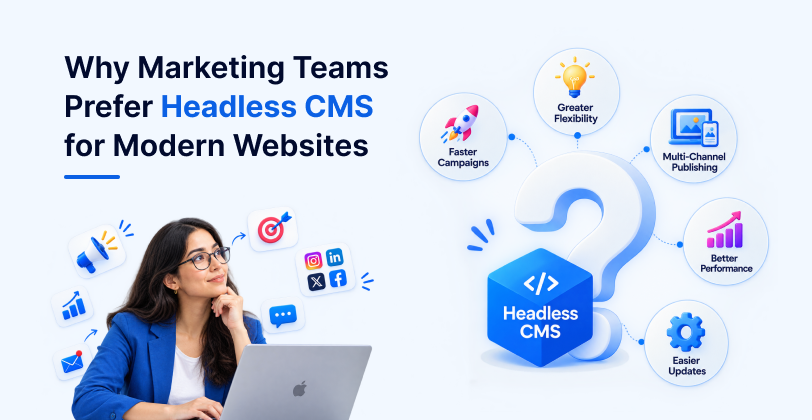
Modern marketing demands agility, speed, and the ability to adapt campaigns rapidly. Traditional content management systems (CMS) often introduce bottlenecks, requiring developers for even minor content updates. This friction slows down campaign launches, impedes A/B testing, and limits personalization efforts. As a result, marketing teams are increasingly turning to headless CMS architectures to gain the autonomy and flexibility needed to succeed in a fast-paced digital landscape.
A headless CMS decouples the content repository (the "body") from the presentation layer (the "head"). This separation empowers marketers to manage content independently, while developers can build front-ends using any framework or technology. This strategic shift streamlines content operations, accelerates time-to-market for campaigns, and fosters better collaboration between marketing and development teams. For organizations aiming to optimize their digital presence and enhance marketing effectiveness, understanding the benefits of a headless CMS is crucial.
Empowering Marketers: Autonomy and Agility with Headless CMS
The core appeal of a headless CMS for marketing teams lies in its ability to grant greater autonomy over content. In traditional CMS environments, content changes, new landing page deployments, or even minor CTA adjustments often necessitate developer involvement. This dependency creates delays and limits the marketing team's responsiveness to market trends or campaign performance data.
With a headless CMS, marketers can directly manage a wide array of content-related tasks without waiting for development cycles:
Creating and Updating Landing Pages: Marketers can design, populate, and launch new landing pages quickly, often using visual editors or pre-built components, directly from the CMS interface. This accelerates lead generation efforts and campaign-specific promotions.
Changing Website Content: From product descriptions to service explanations, content updates across the website become self-service. This ensures information remains current and accurate without taxing development resources.
Managing Campaign Pages: Seasonal promotions, event registrations, or specific marketing initiatives often require dedicated campaign pages. A headless CMS allows marketers to spin up and iterate on these pages rapidly, optimizing for conversion.
Updating Calls-to-Action (CTAs): CTAs are critical for guiding user journeys. Marketers can test and deploy different CTAs across various pages and campaigns, responding to performance data in real-time.
Publishing Blogs and Articles: Content marketing is a cornerstone of digital strategy. Headless CMS platforms provide intuitive interfaces for drafting, scheduling, and publishing blog posts, supporting robust content calendars.
Running Promotions and Offers: Implementing time-sensitive promotions, discounts, or special offers becomes a straightforward content management task, enabling marketers to react swiftly to market opportunities.
Supporting Multiple Regions or Languages: For global brands, managing localized content is complex. Headless CMS platforms often provide robust internationalization (i18n) and localization (l10n) features, allowing marketers to manage content for different regions and languages centrally, then deliver it to specific front-ends.
This increased operational efficiency directly translates into faster campaign launches, shorter time-to-market for new initiatives, and the ability to respond dynamically to market changes. Marketers can focus on strategy and content creation rather than technical dependencies.
Key Features Driving Marketing Efficiency in Headless CMS
Beyond basic content management, modern headless CMS platforms offer specific features designed to enhance marketing workflows and drive better results. These capabilities bridge the gap between content creation and strategic marketing objectives:
Visual Editors and Reusable Components: While headless CMS separates content from presentation, many platforms now offer visual editing experiences or "content previews" that allow marketers to see how their structured content will render on various front-ends. Reusable content components (e.g., hero sections, testimonials, product cards) enable consistent branding and faster page assembly.
Structured Content and Content Models: Headless CMS enforces structured content through content models. This means content is stored based on its purpose (e.g., "product name," "product description," "product image") rather than its presentation. This structure makes content highly reusable across different channels (web, mobile app, IoT device) and ensures consistency. For marketers, this simplifies content creation and ensures all necessary fields are completed.
Content Workflows and Collaboration Tools: Robust workflow features allow marketers to define content creation, review, and approval processes. This ensures brand consistency, legal compliance, and quality control. Features like versioning, commenting, and role-based access control streamline collaboration within marketing teams and with other departments.
Scheduling and Publishing: The ability to schedule content publication and unpublication is fundamental for campaign planning and timely content delivery. This feature is crucial for product launches, seasonal campaigns, and news announcements.
Personalization and A/B Testing Capabilities: By delivering content via APIs, headless CMS platforms easily integrate with personalization engines and A/B testing tools. This allows marketers to serve tailored content to specific audience segments and test different content variations to optimize engagement and conversion rates, without requiring front-end code changes for each test.
APIs and Integrations with Analytics and Marketing Tools: The API-first nature of headless CMS is a significant advantage. It enables seamless integration with a wide ecosystem of marketing tools:
Analytics Platforms: Connect content performance directly to Google Analytics, Adobe Analytics, or similar tools to track engagement.
Marketing Automation: Integrate with platforms like HubSpot, Marketo, or Salesforce Marketing Cloud to power email campaigns, lead nurturing, and customer journeys with up-to-date content.
CRM Systems: Sync content data with CRM for a unified view of customer interactions.
SEO Tools: Optimize content for search engines by integrating with SEO auditing and keyword research tools.
These integrations create a cohesive marketing technology stack, allowing data to flow freely and providing marketers with a comprehensive view of campaign performance.
Strategic Advantages for Teams and Decision-Makers
Adopting a headless CMS is not merely a technical choice; it's a strategic decision that impacts team dynamics, operational efficiency, and long-term business agility. For product leaders and decision-makers, the benefits extend beyond day-to-day marketing tasks:
Developer Focus on Complex Technical Work: By offloading routine content management to marketing, development teams can concentrate on higher-value tasks such as building innovative features, optimizing site performance, enhancing security, or integrating complex third-party systems. This specialization leads to more efficient resource allocation and faster development cycles for critical functionalities.
Faster Campaign Launches and Time-to-Market: The reduced dependency on developers for content changes directly translates to significantly faster campaign deployment. Marketing teams can react to market opportunities, competitor actions, or internal product launches with unprecedented speed, gaining a competitive edge.
Improved Collaboration and Productivity: Headless CMS fosters a clearer division of labor. Marketers become content owners, and developers become platform builders. This clarity minimizes bottlenecks, reduces inter-departmental friction, and boosts overall team productivity. Content workflows ensure smooth hand-offs and approvals.
Future-Proofing and Channel Agnosticism: A headless architecture ensures that content is prepared for any future digital channel—be it a new social platform, a voice assistant, an IoT device, or an augmented reality application. Content is stored once and can be delivered anywhere, future-proofing the organization's content strategy against evolving technological landscapes. This channel agnosticism is a critical long-term advantage for digital growth.
Enhanced Personalization and Customer Experience: With structured content and API-driven delivery, headless CMS makes it easier to implement sophisticated personalization strategies. Marketers can deliver highly relevant content to individual users based on their behavior, demographics, or preferences, leading to improved customer experiences and higher conversion rates.
Scalability and Performance: Decoupling the front-end from the back-end often leads to better performance and scalability. Front-ends can be built with modern frameworks and optimized for speed, while content delivery networks (CDNs) can efficiently serve content globally. This is crucial for handling traffic spikes during campaigns and ensuring a smooth user experience.
Traditional CMS vs. Headless CMS: A Marketing Perspective
To illustrate the tangible differences, consider this comparison from a marketing team's viewpoint:
| Feature/Aspect | Traditional CMS (e.g., WordPress, Drupal) | Headless CMS (e.g., Contentful, Strapi) |
|---|---|---|
| Content Management | Content and presentation are tightly coupled, with WYSIWYG editors built for specific web pages. | Content is structured and stored independently. Marketers manage raw content, which is delivered via APIs to any "head." |
| Developer Dependency | High dependency for design changes, new page templates, complex integrations, or multi-channel delivery. | Low dependency for content updates and new campaign pages. Developers focus on front-ends and integrations. |
| Campaign Launch Speed | Often slower due to development cycles for new pages or content structures. | Significantly faster. Marketers can launch and iterate on content independently. |
| Multi-Channel Delivery | Hard to reuse content across web, app, and IoT without heavy customization or separate content entry. | Native multi-channel support. Content is API-first and easily consumed by any front-end. |
| Personalization & A/B Testing | Complex to implement without custom development or plugins tied to the front-end. | Easier to integrate with dedicated personalization and A/B testing tools thanks to API-driven delivery. |
| Integrations | Often relies on plugins or modules tightly coupled to the CMS, which can cause conflicts. | API-first approach allows flexible, robust integrations with any marketing tool (CRM, analytics, automation). |
| Marketing Team Empowerment | Limited autonomy, constrained by front-end templates and developer availability. | High autonomy. Marketers manage content, campaigns, and updates independently. |
| Future-Proofing | Can become a legacy system if front-end technology evolves, requiring re-platforming. | Highly future-proof. Front-end technologies can be swapped without touching content. |
The shift to a headless CMS represents a strategic move from a monolithic, web-centric content approach to a flexible, API-driven content hub that serves as the foundation for modern digital experiences.
Conclusion
For marketing teams navigating the complexities of modern digital engagement, a headless CMS is no longer a niche solution but a strategic imperative. It addresses critical pain points by granting autonomy over content, accelerating campaign launches, and fostering seamless collaboration with development teams. By leveraging features like structured content, visual editors, robust workflows, and powerful API integrations, marketers can focus on strategy, personalization, and driving measurable results.
The decision to adopt a headless CMS is an investment in agility, scalability, and future-proofing your digital presence. It empowers marketers to be more responsive, innovative, and effective in a rapidly evolving digital landscape, ultimately contributing to a stronger brand presence and better customer experiences.
RW Infotech specializes in guiding organizations through the adoption and implementation of headless solutions. Our expertise in Headless CMS migrations, Jamstack website development, and full-stack development ensures that your marketing team gets the tools it needs to thrive, while your technical infrastructure remains robust, scalable, and future-ready.
Frequently Asked Questions
Find answers to the most common questions about headless CMS for marketing teams.
The biggest advantage is increased autonomy and agility. Marketers can create, update, and publish content for various campaigns and channels without constant developer intervention, significantly accelerating time-to-market.
Yes. Many modern headless CMS platforms offer visual editors or preview capabilities that let marketers see how their structured content will appear on different front-ends before publication, balancing flexibility with user-friendliness.
A headless CMS stores content in a structured, channel-agnostic format. The same content can be delivered via APIs to a website, mobile app, smart device, or any other digital touchpoint, ensuring consistency and reusability across all channels.
No. Headless CMS solutions are scalable and beneficial for businesses of all sizes. Large enterprises benefit from complex multi-channel needs, but small and medium businesses can also gain significant advantages in agility, developer efficiency, and future-proofing their content strategy.
RW Infotech provides end-to-end services for headless CMS adoption, including strategic consulting, platform selection, seamless migration from traditional systems, Jamstack website development, and custom API integrations that connect your headless CMS with your existing marketing tools and platforms.