
Select Your Region
Region-Based Optimized Content
Storyblok + AI Automates Blog Scheduling for Marketing Teams in 2026
Discover how Storyblok + AI helps marketing teams automate blog scheduling, improve content workflows, optimize SEO, and publish consistently at scale.


Modern marketing demands consistent, high-quality content at scale. For many teams, managing a blog schedule manually becomes a significant bottleneck, consuming valuable time and resources. This often leads to missed deadlines, inconsistent publishing, and a reactive content strategy. The solution lies in integrating intelligent automation with robust content management. This article explores how combining Storyblok, a leading headless CMS, with AI-powered automation can fundamentally transform and automate blog scheduling for marketing teams, enabling greater efficiency, strategic focus, and consistent content delivery.
By leveraging AI for predictive insights, content generation assistance, and workflow orchestration, alongside Storyblok's flexible content structure and visual editing capabilities, marketing teams can move beyond manual coordination. This synergy reduces the operational overhead of content planning, production, and publishing, allowing marketers to concentrate on strategy and audience engagement rather than administrative tasks.
The Strategic Imperative for Automated Blog Scheduling
In a competitive digital landscape, a consistent and well-orchestrated blog strategy is crucial for SEO, audience engagement, and thought leadership. However, the complexities involved topic ideation, keyword research, content creation, review cycles, localization, and publishing often overwhelm marketing operations. Manual processes introduce friction, errors, and delays, making it difficult to maintain momentum.
Automated blog scheduling addresses these challenges by streamlining repetitive tasks and providing data-driven insights. It shifts the marketing team's focus from tactical execution to strategic content planning and performance analysis. For decision-makers, investing in such a system is about enabling faster time-to-market for content, improving content quality, and achieving a higher return on content marketing efforts.
Understanding Storyblok's Role in Content Orchestration
Storyblok operates as a headless CMS, separating the content repository from the presentation layer. This architecture provides unparalleled flexibility, allowing content to be created once and published across multiple channels websites, mobile apps, social media, and more without redevelopment. For blog scheduling, Storyblok offers several key advantages:
Visual Editor: Marketers can see content in context as they create it, simplifying the editing and review process and reducing reliance on developers for content previews.
Flexible Content Models: Custom content types and components ensure that blog posts, author profiles, categories, and tags are structured consistently and optimized for various outputs.
Workflow Management: Storyblok's built-in workflows can define content stages (draft, review, approved, published), providing a basic framework for collaboration.
API-First Approach: Its robust API is critical for integration with external tools, including AI services, enabling seamless data exchange and automation.
Version Control and Localization: Ensures content integrity and facilitates multi-language blog strategies.
While Storyblok excels at managing content, its native capabilities for advanced scheduling, topic generation, or SEO analysis are limited. This is where AI integration becomes indispensable, augmenting Storyblok's strengths to create a truly automated content pipeline.
Leveraging AI for Enhanced Blog Scheduling and Content Strategy
Integrating AI with Storyblok elevates blog scheduling from a manual chore to a strategic advantage. AI agents can perform tasks that are time-consuming or require extensive data analysis, providing insights and automation at every stage of the content lifecycle. Here’s how AI can be applied:
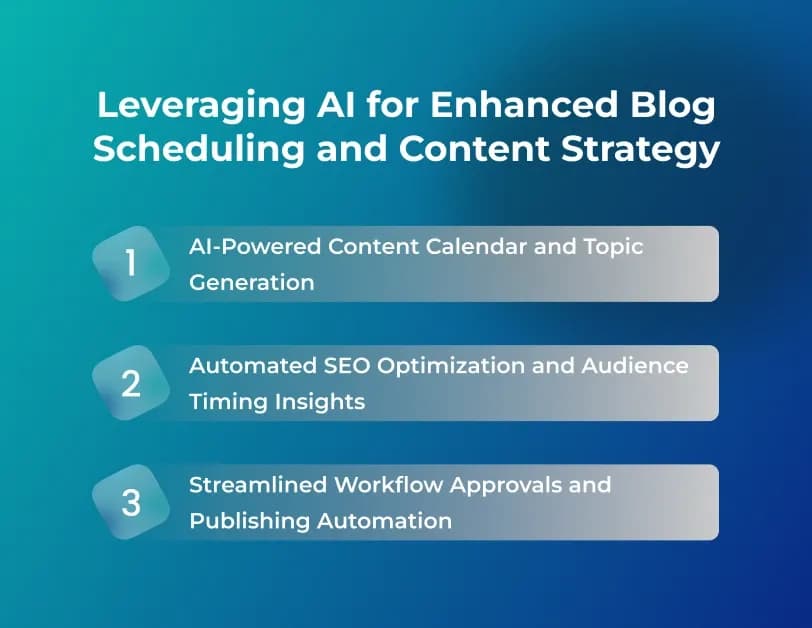
AI-Powered Content Calendar and Topic Generation
One of the most significant challenges in blog scheduling is consistently generating relevant and engaging topics. AI can analyze vast datasets, including industry trends, competitor content, search engine queries, and audience engagement metrics, to suggest high-potential blog topics. This moves topic generation from guesswork to data-driven insights.
Trend Analysis: AI can identify emerging trends and keywords that are gaining traction, suggesting topics that resonate with current audience interests.
Competitor Analysis: By analyzing competitor content performance, AI can identify gaps or opportunities for unique content angles.
Audience Persona Mapping: AI can suggest topics tailored to specific audience segments based on their historical interaction data and preferences.
Content Gaps: AI can highlight areas where existing content is lacking or outdated, recommending updates or new articles to maintain relevance and SEO performance.
These AI-generated topic suggestions, complete with potential keywords and content briefs, can be directly fed into Storyblok as new content entries, pre-populating fields and kickstarting the content creation process. This reduces the initial ideation phase from days to hours.
Automated SEO Optimization and Audience Timing Insights
Effective blog content requires more than just good writing; it needs to be discoverable. AI can significantly enhance the SEO performance of blog posts and optimize their publishing schedule.
Keyword Integration: AI can analyze content drafts within Storyblok and suggest optimal keyword placements, variations, and long-tail keywords to improve search rankings. It can also assess keyword density and readability.
Meta Description and Title Generation: AI can automatically generate compelling meta descriptions and SEO-friendly titles based on the blog post's content, improving click-through rates from search results.
Content Structure Optimization: AI can recommend structural improvements, such as heading hierarchies and internal linking strategies, to enhance readability and SEO.
Optimal Publishing Times: By analyzing historical engagement data (website traffic, social media shares, conversion rates) and audience behavior patterns, AI can predict the best times to publish blog posts for maximum reach and impact. This ensures content is released when the target audience is most active and receptive.
This level of optimization, often requiring specialized SEO expertise, can be largely automated, ensuring that every blog post is launched with its best foot forward, directly impacting organic traffic and content performance.
Streamlined Workflow Approvals and Publishing Automation
The journey from content draft to published article often involves multiple stakeholders and approval stages. AI, combined with Storyblok's workflow capabilities, can automate and accelerate this process.
Automated Routing: Based on content type, author, or topic, AI can automatically route blog posts to the appropriate reviewers (e.g., legal, brand, subject matter experts) within Storyblok's workflow.
Pre-Approval Checks: AI can perform initial checks for brand consistency, grammatical errors, plagiarism, and factual accuracy, flagging potential issues before human review. This reduces the burden on human editors.
Scheduled Publishing: Once approved, AI can trigger the publishing process directly from Storyblok to the desired frontend(s) at the optimal time determined by its audience timing insights. This eliminates manual scheduling errors and ensures consistent delivery.
Post-Publishing Monitoring: AI can monitor content performance post-publication, tracking key metrics like views, engagement, and conversions, and providing alerts or reports to the marketing team.
This automation minimizes manual coordination, reduces approval bottlenecks, and ensures that content goes live precisely when it should, maintaining a consistent blog schedule and improving overall operational efficiency.
Implementation Considerations and Strategic Decision Points
Adopting an AI-powered Storyblok setup for blog scheduling requires strategic planning and careful implementation. Teams must consider several factors to ensure a successful integration and maximize value.
Integration Strategy and Tool Selection
The core of this solution lies in connecting Storyblok with AI services. This typically involves:
Choosing AI Services: Identify specific AI tools or platforms that offer the desired capabilities (e.g., natural language processing for content generation, predictive analytics for scheduling, SEO analysis tools). These could be standalone SaaS products or custom-developed AI agents.
API Integration: Develop or configure connectors to enable seamless data flow between Storyblok's API and the chosen AI services. This might involve webhooks, custom scripts, or integration platforms (iPaaS).
Workflow Orchestration: Define how AI actions integrate into Storyblok's content workflow. For example, after a draft is created in Storyblok, an AI service could automatically perform an SEO audit and update fields, then trigger the next review stage.
Decision Point: Build vs. Buy. Teams must decide whether to build custom AI models and integrations or leverage existing AI-powered content marketing platforms that offer Storyblok connectors. Building custom solutions offers greater control and specificity but requires significant development resources. Buying off-the-shelf solutions can accelerate deployment but may require adapting workflows to the tool's capabilities.
Data Management and Quality
AI's effectiveness is directly tied to the quality and volume of data it processes. Marketing teams must ensure:
Clean Data in Storyblok: Consistent content structuring and tagging within Storyblok are crucial for AI to understand and process content effectively.
Access to Performance Data: AI needs access to analytics data (Google Analytics, social media insights, CRM data) to provide accurate insights for topic generation, SEO optimization, and optimal scheduling.
Data Governance: Establish clear policies for data collection, storage, and usage, especially when dealing with sensitive audience data.
Risk: Garbage In, Garbage Out. Poor data quality or insufficient data will lead to inaccurate AI recommendations and suboptimal automation. Investing in data hygiene and robust analytics infrastructure is paramount.
Team Adaptation and Skill Development
Automating blog scheduling with AI transforms roles and responsibilities within a marketing team.
Shift in Focus: Marketers will spend less time on manual tasks and more time on strategic thinking, content refinement, and performance analysis.
New Skill Sets: Teams may need to develop skills in prompt engineering (for AI content generation), data interpretation, and understanding AI recommendations.
Collaboration: Developers and marketers must collaborate closely to implement and refine the integration, ensuring the AI system meets marketing objectives.
Trade-off: Initial Learning Curve vs. Long-term Efficiency. There will be an initial investment in training and adapting to new workflows. However, the long-term gains in efficiency, productivity, and strategic impact outweigh this initial effort.


Hi, my name is Jaswinder, let's talk about your business needs.
I will do my best to find a reliable solution for you!
The Long-Term Benefits for Marketing Teams
Implementing Storyblok with AI for automated blog scheduling delivers tangible, long-term benefits:
Increased Productivity: Automation frees up marketing teams from repetitive, administrative tasks, allowing them to focus on high-value activities like strategy, creativity, and audience engagement.
Consistent Publishing Schedule: AI-driven scheduling ensures a steady stream of content, maintaining audience interest and improving SEO rankings through regular updates.
Improved Content Quality and Performance: AI-assisted content generation, SEO optimization, and performance monitoring lead to higher-quality, more relevant content that performs better against key metrics.
Faster Time-to-Market: Streamlined workflows and automated approvals significantly reduce the time from content ideation to publication.
Data-Driven Decisions: AI provides actionable insights into content performance, audience behavior, and market trends, enabling more informed strategic decisions.
Scalability: The automated system can easily scale to accommodate increased content volume without a proportional increase in manual effort, supporting ambitious content strategies.
Conclusion
The combination of Storyblok's robust content management capabilities and AI-powered automation offers a transformative approach to blog scheduling for marketing teams. It moves beyond simple content storage to an intelligent, proactive system that optimizes every stage of the content lifecycle from ideation and SEO to scheduling and performance analysis. For modern marketing teams striving for efficiency, consistency, and strategic impact, this integrated solution represents a significant competitive advantage.
By automating the mundane and empowering strategic decision-making with data, teams can achieve unprecedented levels of productivity and content effectiveness. This synergy not only streamlines operations but also elevates the entire content marketing function, enabling organizations to deliver valuable content consistently and at scale.
Frequently Asked Questions
Find answers to the most common questions about How Storyblok + AI Automates Blog Scheduling for Marketing Teams.
RW Infotech specializes in Headless Solutions, including Storyblok implementation and migration, and AI automation for digital workflows. We can assist your team in designing, integrating, and deploying a customized Storyblok + AI solution to automate blog scheduling, optimize content workflows, and enhance your overall content strategy.
AI can be integrated for topic ideation, keyword research, SEO optimization (meta descriptions, titles), content brief generation, content quality checks, optimal publishing time analysis, and automated routing for workflow approvals within Storyblok.
While not strictly mandatory, a headless CMS like Storyblok greatly facilitates AI integration due to its API-first architecture and flexible content models. It provides a structured content repository that AI can easily access, process, and update, making the automation more robust and scalable.
The timeline varies based on complexity, existing infrastructure, and desired features. A basic integration for topic generation and SEO optimization might take 4-8 weeks, while a comprehensive solution involving custom AI models and complex workflow automation could extend to 3-6 months.
Key risks include reliance on data quality ("garbage in, garbage out"), potential for AI-generated content lacking human nuance or brand voice, over-automation leading to a loss of human oversight, and the initial investment in integration and training. Careful oversight and iterative refinement are crucial.
News & Insights
We like to share our thoughts on topics we find inspiring. Explore our news and insights.

Legacy PHP Website to Sanity and Next.js: A Step-by-Step Migration Guide
Learn how to migrate a legacy PHP website to Sanity and Next.js step by step, from content modeling and data import to redirects, SEO protection, and launch.

Why Marketing Teams Prefer Headless CMS for Modern Websites
Learn how headless CMS helps marketing teams manage content independently, launch campaigns faster, improve collaboration, personalize customer experiences, and deliver content across multiple channels.