
Select Your Region
Region-Based Optimized Content
How to Connect AI Shopping Agents to Your Ecommerce Store Using MCP
Learn how to connect AI shopping agents to your ecommerce store using MCP for personalized shopping, real-time data access, automation, and secure AI integration.


The landscape of online retail is rapidly evolving, driven by consumer demand for highly personalized and efficient shopping experiences. Traditional e-commerce platforms, while robust, often struggle to deliver the dynamic, conversational interactions that modern AI agents promise. This is where the Model Context Protocol (MCP) emerges as a critical enabler. MCP provides a standardized, secure method for AI shopping agents to interact directly with e-commerce systems, facilitating real-time access to product data, inventory, pricing, and customer information. Understanding how to connect AI shopping agents to your e-commerce store using MCP is becoming essential for businesses aiming to leverage AI for a competitive advantage in 2026 and beyond.
This article will explore MCP, detailing its role in enabling intelligent, personalized shopping experiences. We will cover the strategic implications of adopting MCP, discuss its integration with various e-commerce architectures, and outline the benefits and considerations for product leaders and development teams. The goal is to provide a clear framework for decision-makers looking to implement sophisticated AI-powered customer engagement in their digital commerce strategies.
Understanding the Model Context Protocol (MCP)
The Model Context Protocol (MCP) is a specification designed to standardize the communication between AI models (agents) and external applications or data sources. It defines a structured way for AI agents to request and receive context-rich information, perform actions, and maintain state across interactions. Unlike traditional APIs, which often require custom integrations for each specific function or data type, MCP aims to provide a unified language that AI agents can understand and use to interact with a broad range of applications.
For e-commerce, MCP allows an AI shopping agent to query a product catalog, check real-time inventory levels, retrieve customer-specific pricing, access past order history, and even initiate actions like adding items to a cart or processing a return. This is achieved through a defined schema for data exchange and a protocol for handling requests and responses, ensuring that the AI agent receives accurate, up-to-date information in a format it can readily interpret and act upon. The protocol emphasizes security, data integrity, and efficient data retrieval, which are paramount in transactional environments.
Strategic Imperatives for AI Shopping Agent Integration
Integrating AI shopping agents via MCP is not merely a technical upgrade; it represents a strategic shift in how e-commerce businesses engage with customers. Decision-makers must evaluate several key imperatives to ensure a successful and impactful implementation.
Enhancing Customer Experience and Personalization
The primary driver for AI shopping agents is the ability to deliver hyper-personalized customer experiences at scale. Traditional e-commerce often relies on rule-based recommendations or broad segmentation. AI agents, powered by MCP, can access individual customer preferences, browsing history, purchase patterns, and real-time context to offer highly relevant product suggestions, answer complex queries, and guide users through their buying journey. This level of personalization fosters loyalty and can significantly improve conversion rates.
For teams, this means moving beyond static content delivery to dynamic, conversational interfaces. It requires an investment in data infrastructure that can feed rich, real-time customer data to the AI. Product leaders must define clear use cases where AI can add distinct value, such as personalized product discovery, intelligent cross-selling, or proactive customer support.
Operational Efficiency and Scalability
AI shopping agents can automate a significant portion of customer interactions, reducing the load on human customer service teams. By accurately answering common questions, assisting with order tracking, and even recovering abandoned carts, these agents free up human resources to handle more complex issues. MCP enables this efficiency by providing direct, programmatic access to the necessary e-commerce data without manual intervention or brittle integrations.
Scalability is another critical factor. As customer traffic grows, an MCP-enabled AI agent can handle an increasing volume of interactions without proportional increases in operational costs. This is particularly important for businesses experiencing rapid growth or those operating in peak seasons. The decision to adopt MCP should consider the long-term operational cost savings and the ability to scale customer support and sales efforts without compromising service quality.
Competitive Differentiation and Market Positioning
In a crowded e-commerce market, delivering a superior customer experience is a key differentiator. Businesses that successfully implement sophisticated AI shopping agents will gain a competitive edge by offering a more engaging, efficient, and personalized shopping journey. This can translate into higher customer satisfaction, increased market share, and stronger brand perception.
For product strategists, this means identifying areas where AI can create unique value propositions that competitors cannot easily replicate. It involves understanding the evolving expectations of the target audience and positioning the brand as an innovator in customer engagement. Early adoption and effective implementation of MCP-powered AI agents can solidify a brand's position as a leader in digital commerce.
Architectural Considerations for MCP Integration
Integrating MCP with existing e-commerce infrastructure requires careful architectural planning. The choice of e-commerce platform, the existing data landscape, and the desired level of AI autonomy will all influence the implementation strategy.
Integrating with Headless Commerce Platforms
Headless commerce architectures are inherently well-suited for MCP integration. By decoupling the front-end presentation layer from the back-end commerce engine, headless platforms expose APIs that AI agents can leverage directly. MCP can sit as an abstraction layer on top of these APIs, standardizing the data format and interaction patterns for the AI.
In a headless setup, the AI shopping agent becomes another "head" consuming data and services from the commerce API layer. This allows for maximum flexibility, enabling the AI to retrieve product details from the product information management (PIM) system, inventory status from the order management system (OMS), and customer data from the customer relationship management (CRM) system, all orchestrated through the headless commerce platform's API gateway. This approach minimizes tightly coupled integrations and promotes a modular, scalable architecture.
Integrating with Traditional Ecommerce Platforms (e.g., Shopify)
While traditional platforms like Shopify offer extensive app ecosystems, direct MCP integration might require a different approach. Shopify provides robust APIs for accessing product data, orders, and customer information. An MCP implementation would typically involve building a custom middleware layer that translates MCP requests into Shopify API calls and formats Shopify responses back into the MCP standard.
This middleware acts as a bridge, abstracting the specifics of the Shopify API from the AI agent. It ensures that the AI can communicate consistently regardless of the underlying platform. For decision-makers, this means evaluating the effort required to build and maintain such a layer versus the benefits of standardized AI communication. While more complex than a native headless integration, it still provides significant advantages over custom, point-to-point integrations for each AI capability.
Leveraging Headless CMS Solutions
Headless CMS solutions play a crucial role in providing rich, structured content to AI shopping agents. Beyond basic product data, AI agents often need access to marketing copy, detailed product descriptions, rich media, FAQs, and editorial content to provide comprehensive and engaging responses. A headless CMS can serve this content via APIs, making it readily available to the MCP layer.
For example, when a customer asks a complex question about product features or comparisons, the AI agent can query the headless CMS through MCP to retrieve detailed, editorially curated information that goes beyond simple product attributes. This enhances the quality and depth of AI interactions, enabling agents to provide more human-like and informative responses. Teams should consider how their content strategy aligns with the data needs of AI agents and how a headless CMS can streamline content delivery.
Implementation Workflow and Key Considerations
Implementing MCP-powered AI shopping agents involves a structured workflow and careful consideration of several factors.
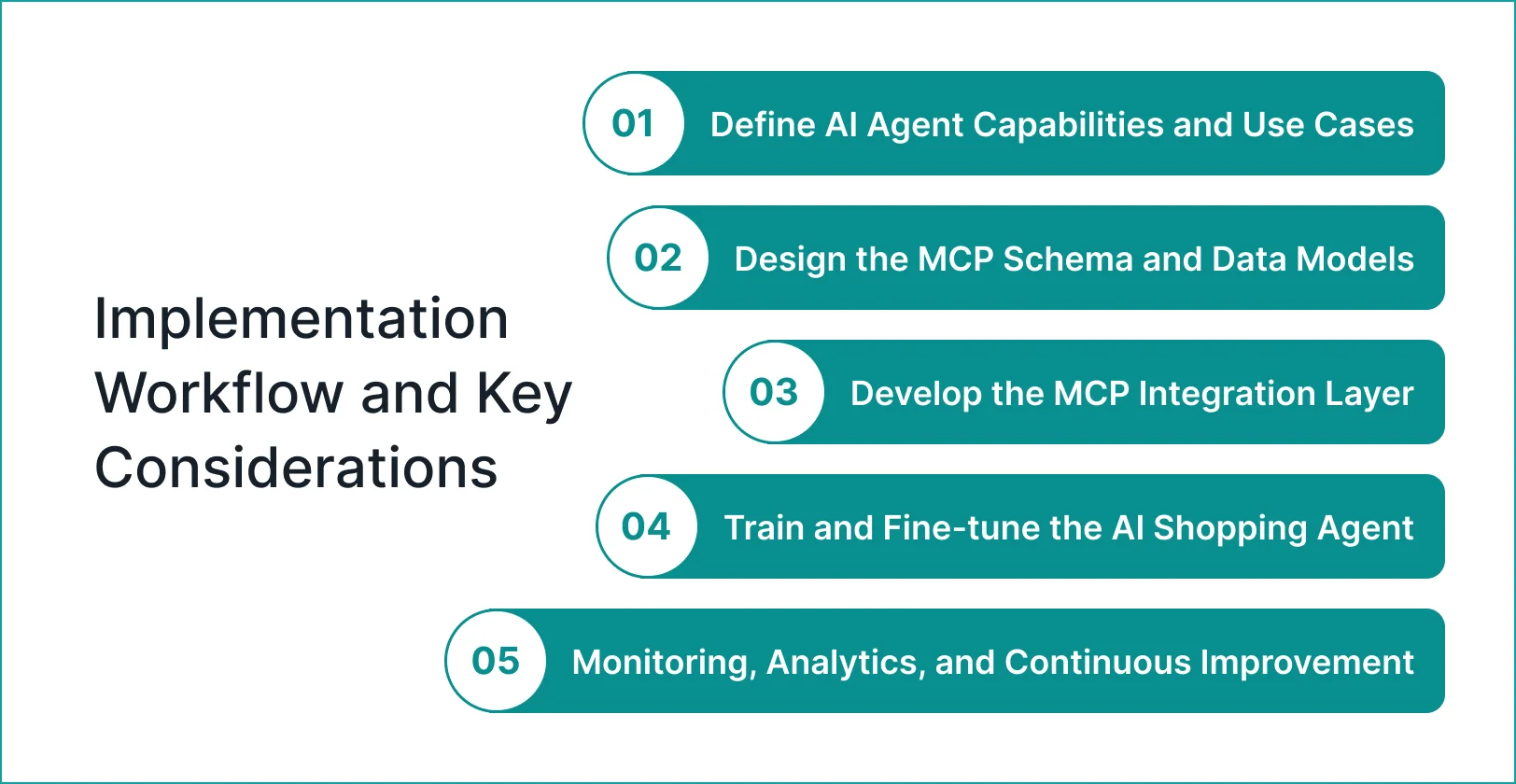
1. Define AI Agent Capabilities and Use Cases
Before any technical implementation, clearly define what the AI shopping agent will do. Will it handle product recommendations, answer FAQs, assist with order tracking, or manage returns? Each use case dictates the type of data the AI agent needs and the actions it must be able to perform via MCP. Prioritize use cases that offer the highest immediate value and are technically feasible.
For product managers, this involves mapping customer journeys and identifying pain points where an AI agent can provide significant relief or enhancement. This initial phase drives the requirements for the MCP schema and the underlying e-commerce integrations.
2. Design the MCP Schema and Data Models
The core of MCP implementation is defining the data schema that the AI agent will use to communicate. This includes specifying how products, customers, orders, inventory, and other relevant e-commerce entities are represented. The schema must be robust enough to support all defined AI capabilities and extensible for future enhancements.
This phase requires close collaboration between AI developers and e-commerce architects. It's crucial to align on data definitions, ensure data consistency, and establish clear protocols for data access and modification. Security considerations, such as authentication and authorization for data access, must be baked into the schema design.
3. Develop the MCP Integration Layer
This involves building the actual software layer that translates MCP requests into calls to your e-commerce platform's APIs (whether headless or traditional) and formats the responses back into MCP-compliant data. This layer will handle:
Request Routing: Directing AI requests to the appropriate e-commerce service (PIM, OMS, CRM).
Data Transformation: Converting data formats between MCP and the e-commerce platform's native APIs.
Authentication and Authorization: Ensuring secure access to e-commerce data based on defined permissions.
Error Handling: Gracefully managing API errors and communicating them back to the AI agent.
Caching: Implementing caching strategies to improve performance and reduce load on backend systems.
For development teams, this is where the bulk of the engineering effort lies. Choosing the right technology stack for this integration layer (e.g., Node.js, Python, Go) and ensuring its scalability and reliability are critical.
4. Train and Fine-tune the AI Shopping Agent
Once the MCP integration layer is in place, the AI agent can begin to interact with real e-commerce data. This phase involves training the AI model on relevant datasets and fine-tuning its ability to understand user queries, retrieve accurate information via MCP, and generate appropriate responses. Iterative testing and feedback loops are essential to refine the agent's performance.
Data quality is paramount here. The AI agent's effectiveness is directly tied to the quality and relevance of the data it can access through MCP. Teams should invest in data governance and ensure that product information, customer profiles, and inventory data are accurate and up-to-date.
5. Monitoring, Analytics, and Continuous Improvement
Post-deployment, continuous monitoring of the AI agent's performance and the MCP integration layer is crucial. Track key metrics such as response times, accuracy of recommendations, conversion rates attributed to the AI, and customer satisfaction scores. Use analytics to identify areas for improvement, refine the AI model, and optimize the MCP integration for better efficiency and user experience.
This ongoing process ensures that the AI shopping agent remains a valuable asset and adapts to changing customer needs and business requirements. It also provides insights into potential bottlenecks or security vulnerabilities within the integration.
Benefits and Security Considerations
Adopting MCP for AI shopping agents brings significant benefits, but also requires careful attention to security.
Key Benefits
Standardized Communication: Simplifies AI integration across diverse e-commerce systems, reducing development time and complexity.
Enhanced Personalization: Enables AI agents to access real-time, context-rich data for highly relevant recommendations and interactions.
Operational Efficiency: Automates routine customer inquiries and tasks, freeing human agents for complex issues.
Scalability: Supports growing customer interactions without proportional increases in manual effort.
Faster Innovation: Allows for quicker deployment of new AI capabilities by providing a consistent data access layer.
Improved Data Quality: Encourages structured data management and consistent data exposure for AI consumption.
Security Considerations
Connecting AI shopping agents to your e-commerce store using MCP involves sensitive customer and business data, making security a top priority.
Authentication and Authorization: Implement robust authentication mechanisms (e.g., OAuth 2.0) for AI agents accessing the MCP layer. Granular authorization controls should dictate precisely which data an AI agent can access and which actions it can perform.
Data Encryption: All data in transit between the AI agent, MCP layer, and e-commerce systems must be encrypted using TLS/SSL. Sensitive data at rest should also be encrypted.
Input Validation and Sanitization: AI agents might process user inputs that could contain malicious data. Implement thorough input validation and sanitization at the MCP layer to prevent injection attacks or data corruption.
Rate Limiting and Throttling: Protect backend e-commerce systems from excessive requests by implementing rate limiting and throttling mechanisms on the MCP integration layer.
Auditing and Logging: Maintain comprehensive logs of all AI agent interactions and data access requests. This is crucial for security monitoring, incident response, and compliance.
Data Minimization: Adhere to the principle of least privilege. AI agents should only be granted access to the minimum amount of data necessary to perform their functions.
Compliance: Ensure that all data handling practices comply with relevant regulations such as GDPR, CCPA, and PCI DSS, especially when dealing with customer personal information and payment data.
Teams must conduct regular security audits and penetration testing of the MCP integration layer to identify and address vulnerabilities proactively. A robust security posture is non-negotiable for AI-powered e-commerce applications.


Hi, my name is Jaswinder, let's talk about your business needs.
I will do my best to find a reliable solution for you!
Conclusion
The integration of AI shopping agents into e-commerce operations, facilitated by the Model Context Protocol (MCP), represents a significant leap forward in customer engagement and operational efficiency. By providing a standardized and secure way for AI agents to interact with complex e-commerce ecosystems, MCP empowers businesses to deliver highly personalized, real-time shopping experiences that drive conversions and build lasting customer loyalty. The strategic decision to connect AI shopping agents to your e-commerce store using MCP requires careful planning, architectural foresight, and a strong focus on security and data governance.
For product leaders and development teams, embracing MCP means preparing for a future where AI is not just an add-on but an integral part of the digital commerce strategy. It offers a clear path to competitive differentiation, scalable customer service, and a more intelligent retail environment. As the e-commerce landscape continues to evolve, businesses that proactively adopt and master such advanced integration protocols will be best positioned to thrive in the years to come.
Frequently Asked Questions
Find answers to the most common questions about How to Connect AI Shopping Agents to Your Ecommerce Store Using MCP
RW Infotech specializes in headless solutions, full stack development, and AI automation. We can assist your team in designing and implementing robust MCP integration layers, migrating to headless commerce platforms, and developing custom AI agents tailored to your e-commerce needs, ensuring secure and scalable solutions for enhanced customer experiences.
MCP offers a standardized protocol specifically designed for AI-to-application communication, simplifying data exchange and action execution for AI agents across diverse systems, reducing the need for custom, brittle integrations for each AI capability.
Yes, MCP can be integrated with existing platforms by building a middleware layer that translates MCP requests into the platform's native API calls and vice versa. This layer abstracts the platform specifics from the AI agent.
Key security considerations include robust authentication and authorization, data encryption (in transit and at rest), input validation, rate limiting, comprehensive auditing and logging, data minimization, and adherence to compliance regulations like GDPR and PCI DSS.
A Headless CMS provides structured, rich content (e.g., detailed product descriptions, marketing copy, FAQs) via APIs. An MCP-powered AI agent can access this content to provide more comprehensive, informative, and human-like responses beyond basic product attributes, enhancing the overall customer experience.
News & Insights
We like to share our thoughts on topics we find inspiring. Explore our news and insights.