
Select Your Region
Region-Based Optimized Content
Which Headless CMS Is Best for Content-Heavy Websites in 2026?
Compare the best headless CMS platforms for content-heavy websites in 2026, including Sanity, Strapi, Contentful, Storyblok, Directus, and more.

Choosing the right Headless CMS for a content-heavy website in 2026 is a strategic decision that impacts development velocity, content management efficiency, scalability, and long-term operational costs. With the headless market maturing, platforms like Sanity, Builder.io, Strapi, Prismic, Storyblok, Contentful, and Directus offer distinct advantages. This article provides a practical comparison, focusing on how each platform aligns with specific business needs rather than declaring a single "best" option. We will evaluate them across critical dimensions to help teams, product leaders, and decision-makers identify the optimal solution for their content volume, traffic, team size, technical resources, performance requirements, budget, and future growth plans.
Strategic Considerations for Content-Heavy Websites
For websites with substantial content requirements—whether due to high publication frequency, diverse content types, extensive localization needs, or large media libraries—the underlying CMS must offer robust capabilities. Key factors extend beyond basic content storage to encompass the entire content lifecycle, from creation and management to delivery and optimization. Decision-makers must weigh developer flexibility against editor experience, raw performance against cost, and immediate needs against future scalability.
Understanding Your Content Strategy and Business Needs
Before evaluating specific platforms, define your content strategy. Consider the types of content you publish (articles, product data, documentation, marketing pages), the frequency of updates, the number of content contributors, and your global reach. A publisher with daily articles has different needs than an e-commerce platform managing product SKUs or an enterprise providing localized documentation.
- Startups & SMBs: Often prioritize ease of use, quick time-to-market, and cost-effectiveness. Flexibility to iterate is crucial.
- Marketing-Heavy Websites: Require strong visual editing, A/B testing capabilities, SEO features, and robust integration with marketing automation tools.
- Publishers & Media: Need efficient editorial workflows, rich text editing, digital asset management, and performance for high traffic.
- Enterprise Organizations: Demand scalability, advanced security, granular permissions, multi-site management, and extensive integration ecosystems.
- E-commerce Businesses: Focus on structured content for products, promotions, and customer data, often requiring deep integration with PIM/ERP systems.
- Documentation Platforms: Benefit from versioning, structured content, search capabilities, and collaborative features.
- Businesses Needing Self-Hosting/Database Control: Prioritize open-source solutions for complete control over infrastructure and data.
Key Evaluation Criteria for Headless CMS Platforms
When comparing headless CMS options, several technical and operational criteria are paramount:
- Performance & Scalability: How well does the CMS handle high traffic, large content volumes, and concurrent API requests? This includes CDN integration, caching strategies, and API response times.
- Content Modeling: The flexibility to define complex content structures, relationships between content types, and custom fields. This is critical for managing diverse content.
- Editor Experience: Ease of use for non-technical content creators. Features like visual editing (WYSIWYG or visual builders), real-time collaboration, preview functionality, and intuitive dashboards.
- Developer Flexibility & API Capabilities: The quality and completeness of APIs (REST, GraphQL), SDKs, webhooks, and the extensibility of the platform for custom development.
- SEO & Localization: Built-in features for managing meta tags, structured data, URL slugs, and robust support for multi-language and multi-region content.
- Integrations: The breadth of pre-built integrations with third-party services (e-commerce, analytics, marketing automation) and the ease of custom integrations.
- AI Readiness: Support for AI-driven content generation, translation, personalization, or search, either natively or through integrations.
- Security & Compliance: Data protection, user access control, audit trails, and adherence to industry standards.
- Cost: Total cost of ownership, including licensing, infrastructure, development, and maintenance. This varies significantly based on usage.
Comparative Analysis of Leading Headless CMS Platforms for 2026
Below is a detailed comparison of prominent Headless CMS platforms, considering their strengths and ideal use cases for content-heavy websites.
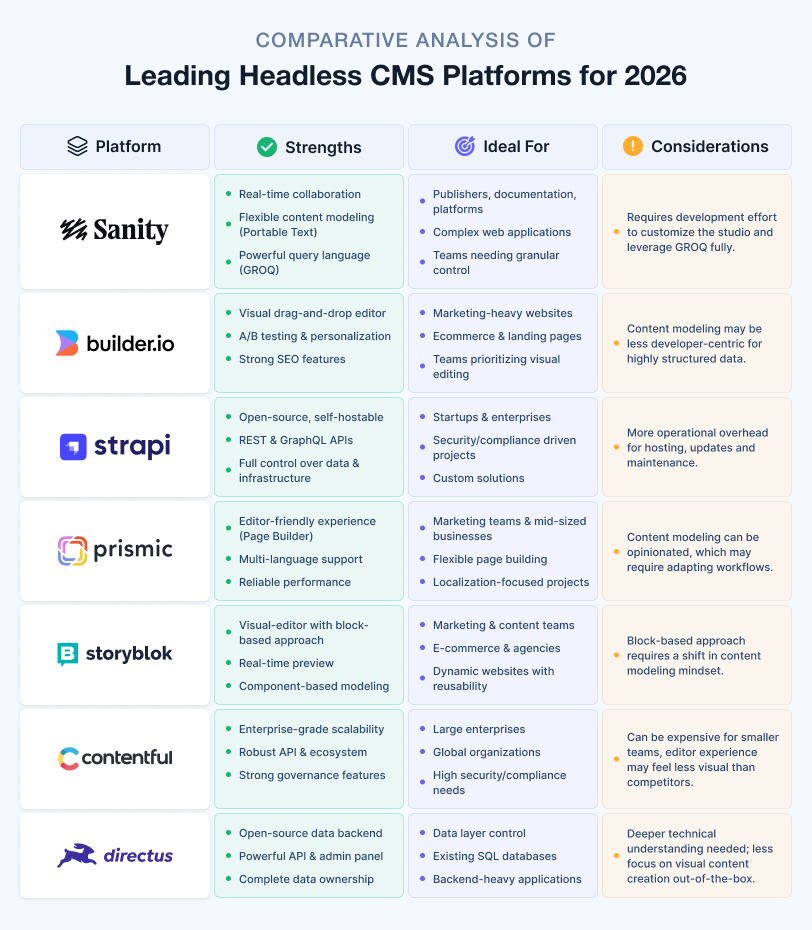
Sanity
- Strengths: Real-time collaboration, highly flexible content modeling with Portable Text for rich text, powerful query language (GROQ), and a customizable open-source editor (Sanity Studio). Excellent for structured content and developer-centric workflows.
- Ideal For: Publishers, documentation platforms, complex web applications, and teams needing granular control over content structure and presentation. Its real-time capabilities are great for collaborative environments.
- Considerations: Requires development effort to customize the studio and leverage GROQ fully.
Builder.io
- Strengths: Visual drag-and-drop editor (visual CMS), A/B testing, personalization, and powerful SEO features. Focuses on marketing and growth teams, allowing non-developers to create and publish pages. Integrates well with existing tech stacks.
- Ideal For: Marketing-heavy websites, e-commerce, landing page creation, and teams prioritizing visual content editing and rapid experimentation without developer intervention.
- Considerations: While powerful for visual content, its core content modeling might be less developer-centric than Sanity or Directus for highly structured, non-visual data.
Strapi
- Strengths: Open-source, self-hostable, highly customizable, and developer-friendly. Offers both REST and GraphQL APIs. Gives full control over data and infrastructure, making it a strong choice for bespoke solutions and data-sensitive projects.
- Ideal For: Startups, developers, enterprises requiring self-hosting, businesses needing database-level control, and projects with specific security or compliance needs that necessitate owning the infrastructure.
- Considerations: Requires more operational overhead for hosting, updates, and maintenance compared to SaaS solutions.
Prismic
- Strengths: Strong emphasis on editor experience with the "Page Builder" Slice Machine for modular content, excellent multi-language support, and reliable performance. Good for content teams that need flexibility in page layout without coding.
- Ideal For: Marketing teams, mid-sized businesses, and enterprises that prioritize a user-friendly content editor, flexible page building, and robust localization capabilities.
- Considerations: Content modeling can be opinionated, which might require adapting workflows.
Storyblok
- Strengths: Visual editor with a unique "block-based" approach, real-time visual preview, excellent component-based content modeling, and strong internationalization features. A good balance between developer flexibility and editor ease of use.
- Ideal For: Marketing and content teams, e-commerce, and agencies building dynamic websites where visual editing and component reusability are key.
- Considerations: The block-based approach, while powerful, requires a shift in content modeling mindset for some teams.
Contentful
- Strengths: Enterprise-grade scalability, robust API, extensive ecosystem of integrations, and strong governance features. A mature platform suitable for large organizations with complex content needs and diverse teams.
- Ideal For: Large enterprises, global organizations, and businesses with significant content volume, multiple brands/sites, and strict security/compliance requirements.
- Considerations: Can be more expensive for smaller teams, and the editor experience, while functional, might be less visually intuitive than Storyblok or Builder.io for certain use cases.
Directus
- Strengths: Open-source data backend that wraps any SQL database with a powerful API and an intuitive admin panel. Offers complete data ownership and flexibility, acting as a "headless data platform."
- Ideal For: Developers and enterprises needing ultimate control over their data layer, those with existing SQL databases, or projects requiring a highly customized data model with a powerful API. Excellent for backend-heavy applications beyond just websites.
- Considerations: Requires a deeper technical understanding for setup and management; less focused on visual content creation out-of-the-box compared to some competitors.
Indicative Cost Ranges for Headless CMS Platforms (2026 Estimates)
Pricing for Headless CMS platforms is highly variable, depending on content items, API calls, users, assets, and specific features. The figures below are indicative estimates for 2026, designed to provide a sense of scale. Actual costs will require direct consultation with vendors.
| Platform | Free/Entry-Level | Growing Business | Enterprise (Custom) |
|---|---|---|---|
| Sanity | Free (generous usage) | $100 - $500+/month | Custom pricing (>$1,000/month) |
| Builder.io | Free (limited features) | $400 - $1,500+/month | Custom pricing (>$2,500/month) |
| Strapi | Free (self-hosted) | $9 - $129/month (Cloud) | Custom pricing (Cloud/Enterprise features) |
| Prismic | Free (basic usage) | $50 - $500+/month | Custom pricing (>$1,000/month) |
| Storyblok | Free (developer plan) | $100 - $1,000+/month | Custom pricing (>$1,500/month) |
| Contentful | Free (developer plan) | $500 - $2,500+/month | Custom pricing (>$3,000/month) |
| Directus | Free (self-hosted) | $50 - $500+/month (Cloud) | Custom pricing (Cloud/Enterprise features) |
Disclaimer: These cost ranges are approximate and based on typical usage patterns and publicly available information as of late 2024, projected to 2026. Headless CMS pricing models are dynamic and subject to change by vendors. Always consult the official pricing pages and sales teams for current and accurate quotes tailored to your specific needs.
Making the Right Decision for Your Business
The "best" Headless CMS for content-heavy websites is not a universal truth but a contextual fit. The decision hinges on a thorough understanding of your organization's specific requirements, team capabilities, and long-term vision. For rapid marketing iteration, Builder.io or Storyblok might excel. For deep content structure and developer control, Sanity or Directus could be superior. Enterprises often gravitate towards Contentful for its maturity and scalability, while Strapi offers an open-source alternative for full ownership.
Consider piloting a few options with a small project or a proof-of-concept. Engage both content creators and developers in the evaluation process to ensure the chosen platform meets the needs of all stakeholders. Prioritize platforms that offer flexibility for future growth, integration with your existing tech stack, and a clear path for content migration and scalability. The right choice will empower your teams, streamline content operations, and support your digital strategy for years to come.


Hi, my name is Jaswinder, let's talk about your business needs.
I will do my best to find a reliable solution for you!
Conclusion: Navigating the Headless CMS Landscape for Content-Heavy Websites
Selecting the optimal Headless CMS in 2026 for a content-heavy website demands a nuanced approach, balancing technical capabilities with business objectives. Each platform—Sanity, Builder.io, Strapi, Prismic, Storyblok, Contentful, and Directus—presents a compelling set of features tailored to different organizational priorities. By meticulously evaluating factors such as content modeling, editor experience, developer flexibility, scalability, and cost, businesses can make an informed decision that drives efficiency and supports their strategic goals.
RW Infotech specializes in guiding businesses through this complex landscape. Our expertise in Headless Solutions, Jamstack website development, and Headless CMS migrations ensures that your content infrastructure is robust, scalable, and perfectly aligned with your digital strategy. We help you choose and implement the Headless CMS that best fits your content volume, team dynamics, and performance requirements, ensuring a future-proof foundation for your digital presence.
Frequently Asked Questions
Find answers to the most common questions about Which Headless CMS Is Best for Content-Heavy Websites in 2026.
The primary advantage is the decoupling of content from presentation, allowing content to be delivered via API to any frontend (web, mobile, IoT). This provides unparalleled flexibility, scalability, and performance, crucial for managing and distributing large volumes of diverse content efficiently across multiple channels.
Yes, a Headless CMS can significantly improve SEO. By separating content, it allows developers to build highly optimized, fast-loading frontends (often with Jamstack) that Google favors. It also provides structured content and flexible metadata management, giving greater control over SEO elements than traditional monolithic systems.
Self-hosting a Headless CMS like Strapi or Directus is viable for enterprises requiring full control over data, infrastructure, and compliance. It offers maximum customization and security but demands internal technical resources for setup, maintenance, and scaling. Cloud-hosted solutions reduce this operational overhead.
AI readiness means the CMS can integrate with or natively support AI tools for content generation, translation, personalization, or advanced search. For content-heavy sites, this is increasingly important for efficiency and delivering tailored user experiences. Look for robust APIs and integration ecosystems that facilitate AI tool adoption.
RW Infotech provides strategic consulting for Headless CMS selection, considering your specific content needs, team capabilities, and budget. We specialize in Headless CMS migrations and Jamstack development, offering end-to-end implementation services to ensure your chosen platform is integrated seamlessly and optimized for performance and scalability.