
Select Your Region
Region-Based Optimized Content
How to Optimize Your Product Catalog for AI Shopping
Learn how to optimize your product catalog for AI shopping with structured data, better product attributes, real-time inventory, and PIM.


The rise of AI-powered shopping assistants, intelligent search, and personalized recommendation engines is reshaping e-commerce. These AI systems promise unprecedented product discovery and conversion rates, yet many businesses are finding their existing product catalogs are not equipped to leverage this potential. The underlying issue is often a lack of structured, consistent, and machine-readable product data.
Traditional e-commerce platforms were built for human browsing and keyword matching. AI, however, requires a deeper, semantic understanding of products to accurately compare, categorize, and recommend. When your product catalog is too complex or inconsistent, AI struggles to interpret product attributes, differentiate variants, or understand product relationships, leading to suboptimal recommendations, frustrated customers, and lost sales. This article will explore the critical changes needed to prepare your product data for the era of AI shopping.
The Structural Deficiencies Hindering AI Shopping
For AI to effectively understand and process your product catalog, the data must be clean, consistent, and semantically rich. Many legacy or poorly maintained catalogs present significant hurdles. Here are common deficiencies:
Inconsistent Product Naming and Terminology: Varied spellings, abbreviations, or synonyms for the same attribute (e.g., "color," "colour," "shade"; "size," "dimension," "fit") confuse AI. It struggles to recognize these as equivalent, leading to fragmented data and inaccurate filtering.
Missing or Incomplete Attributes: Products often lack essential descriptive attributes like material, compatibility, use case, or specific features. AI cannot recommend a product effectively if it doesn't have sufficient data points to understand its purpose or differentiation.
Ambiguous Product Variants: AI needs clear, distinct definitions for product variants (e.g., a specific "red" shirt in "large" size). If variants are poorly defined, bundled inconsistently, or lack unique identifiers, AI cannot accurately present choices or manage inventory.
Unstructured Product Descriptions: Long, free-form text descriptions, while useful for humans, are challenging for AI to parse for specific facts. AI benefits from structured data points embedded within or alongside descriptive text.
Outdated or Inaccurate Data: Real-time accuracy of pricing, inventory levels, and product availability is paramount. AI recommendations based on stale data lead to customer dissatisfaction and operational inefficiencies.
Poorly Defined Product Categories and Relationships: Hierarchical categories that are too broad, too deep, or inconsistent across the catalog prevent AI from understanding product context. Lack of clear relationships (e.g., "customers who bought this also bought...") limits cross-selling and up-selling capabilities.
Duplicate Products and Data Redundancy: Multiple entries for the same product, or redundant information spread across different fields, create noise and inefficiency for AI processing, potentially leading to conflicting recommendations.
These issues collectively diminish AI's ability to perform tasks like intelligent search, personalized recommendations, automated merchandising, and predictive analytics. Addressing them is not just a technical task; it's a strategic imperative for future-proofing your e-commerce operations.
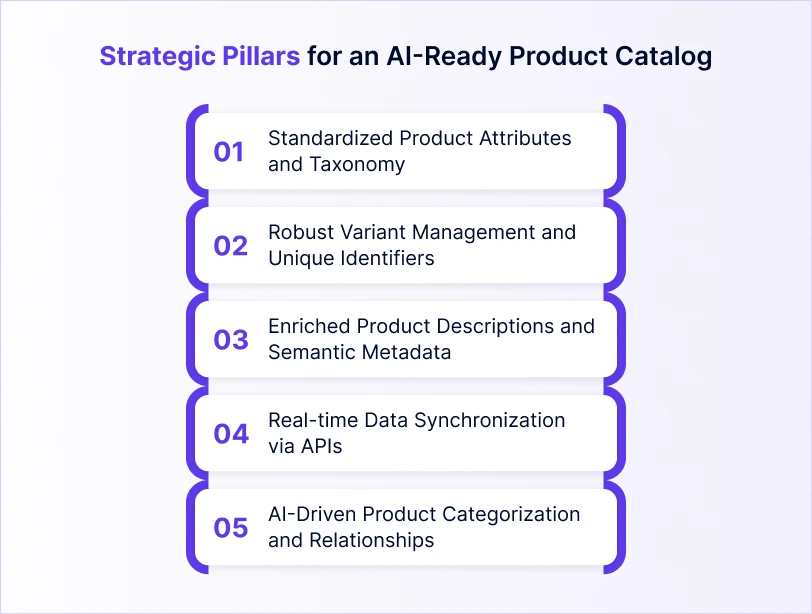
Strategic Pillars for an AI-Ready Product Catalog
Transforming a complex product catalog into an AI-friendly asset requires a multi-faceted approach focusing on standardization, enrichment, and real-time data management. Decision-makers must prioritize these areas to ensure their investment in AI yields tangible returns.
1. Standardized Product Attributes and Taxonomy
The foundation of an AI-ready catalog is a rigorously standardized attribute set and a well-defined taxonomy. This involves establishing canonical names for all product characteristics and ensuring consistent data types and formats. For instance, if "color" is an attribute, define acceptable values (e.g., "Red," "Blue," "Green" rather than "Crimson," "Azure," "Emerald") and ensure all products use this standard.
Decision Criteria: Evaluate current catalog size, product diversity, and the level of inconsistency. Prioritize attributes critical for search, filtering, and core product differentiation.
Trade-offs: Initial investment in data cleansing and governance tools can be substantial. Requires cross-functional alignment between product, marketing, and IT teams.
Long-term Implications: Enables more precise AI understanding, improved search relevance, easier product comparisons, and better data quality for analytics. Reduces manual data entry errors.
Implementing a Product Information Management (PIM) system is often a strategic choice here. A PIM acts as a central repository for all product data, enforcing consistency, managing attributes, and facilitating data enrichment across various channels. It provides the structured backbone that AI demands.
2. Robust Variant Management and Unique Identifiers
AI needs to clearly distinguish between a base product and its specific variants. Each variant (e.g., a specific size, color, or material combination) must have a unique identifier and clearly defined attributes that differentiate it from other variants of the same product. This allows AI to present precise options to customers and manage inventory accurately.
Decision Criteria: Assess the complexity of your product lines and the number of variants per product. Consider the impact on inventory management and order fulfillment.
Trade-offs: Requires careful data modeling and potentially adjustments to existing SKU structures. Can be complex for highly configurable products.
Long-term Implications: Improves inventory accuracy, streamlines order processing, enhances personalization by allowing AI to recommend specific variants, and reduces customer confusion.
For example, instead of a generic "T-shirt," AI needs to understand "Men's Crew Neck T-shirt, 100% Cotton, Size L, Color Blue, SKU: ABC-L-BLU." This level of granularity is crucial for AI to match user intent precisely.
3. Enriched Product Descriptions and Semantic Metadata
While structured attributes are vital, rich product descriptions still play a role. The key is to make them semantically digestible for AI. This involves using clear, concise language and incorporating relevant keywords and phrases that align with your standardized attributes. Furthermore, embedding semantic metadata (e.g., Schema.org markup) directly into your product pages provides explicit signals to AI systems and search engines about product type, price, availability, and reviews.
Decision Criteria: Evaluate existing content strategy. Prioritize products with high traffic or conversion potential for initial enrichment efforts.
Trade-offs: Requires content creation resources and potentially technical implementation for schema markup. Ongoing maintenance to ensure accuracy.
Long-term Implications: Boosts product visibility in AI-powered search results, improves product discovery, enhances SEO, and provides richer context for AI recommendations.
Loading...
This snippet demonstrates how Schema.org markup provides structured data directly on the page, making it instantly understandable by AI and search engines.
4. Real-time Data Synchronization via APIs
AI's value diminishes rapidly with outdated information. For dynamic elements like pricing, inventory, and promotions, real-time synchronization is non-negotiable. This is achieved through robust API integrations that connect your product catalog, PIM, ERP, and inventory systems. APIs allow AI agents to query the most current data, ensuring recommendations and availability statements are always accurate.
Decision Criteria: Assess the volatility of your pricing and inventory. Consider the volume of products and transactions. Prioritize critical data points for real-time updates.
Trade-offs: Requires development resources for API integration and maintenance. Performance considerations for high-volume data requests.
Long-term Implications: Eliminates customer frustration from out-of-stock items or incorrect pricing, improves operational efficiency, and builds trust in AI-driven commerce experiences.
Modern e-commerce architectures often leverage headless solutions, where the front-end experience is decoupled from the back-end commerce logic and data. This approach inherently relies on APIs to fetch product data, making it highly adaptable for AI integration and real-time updates.
5. AI-Driven Product Categorization and Relationships
Beyond manual categorization, AI can assist in optimizing product taxonomy and identifying implicit relationships. Machine learning algorithms can analyze product attributes, descriptions, and customer behavior to suggest better category placements or discover "customers also bought" relationships that might not be immediately obvious. This can lead to more intuitive browsing paths and more effective cross-selling strategies.
Decision Criteria: Evaluate the current effectiveness of your category structure. Consider the volume of new products introduced regularly.
Trade-offs: Requires data science expertise or AI tools for implementation. Initial training and fine-tuning of models are necessary.
Long-term Implications: Improves product discoverability, enhances personalization, optimizes site navigation, and unlocks new merchandising opportunities.
This approach transforms catalog management from a purely manual task to a hybrid model where human oversight guides AI-powered optimization, leading to a continuously improving product data ecosystem.


Hi, my name is Jaswinder, let's talk about your business needs.
I will do my best to find a reliable solution for you!
Conclusion: The Imperative of an AI-Ready Product Catalog
The complexity of your product catalog directly impacts your ability to compete in an increasingly AI-driven e-commerce landscape. Businesses that fail to address inconsistencies, enrich data, and ensure real-time accuracy will find their AI shopping initiatives underperforming. Optimizing product data is no longer a backend chore; it is a strategic investment that directly influences product discovery, personalization, conversion rates, and ultimately, market share.
By focusing on standardized attributes, robust variant management, enriched metadata, real-time data synchronization, and leveraging AI for categorization, organizations can transform their product catalogs into powerful assets. This prepares them not just for current AI assistants but for the evolving capabilities of intelligent commerce, ensuring their products are always understood, recommended, and discovered by the right customers at the right time.
At RW Infotech, we understand the critical link between structured data and AI success. Our expertise in headless solutions, PIM integrations, and custom API development helps businesses re-architect their product data infrastructure, ensuring it is clean, consistent, and ready for the demands of modern AI-powered commerce. We guide teams through the strategic decisions and technical implementations required to future-proof their digital presence.
Frequently Asked Questions
ind answers to the most common questions about AI-ready product catalogs and AI shopping.
A PIM system centralizes and standardizes all product data, enforcing consistent attributes, managing variants, and enabling rich content creation. This structured, clean data is precisely what AI needs for accurate understanding, recommendations, and search.
Immediate benefits include improved search relevance, more accurate product recommendations, reduced customer support inquiries related to product information, and a stronger foundation for personalization efforts.
While not always strictly "necessary" for internal AI, Schema.org markup explicitly tells external AI systems (like search engines and shopping assistants) what your product data means, significantly improving visibility and interpretation in broader AI-driven contexts.
Real-time inventory ensures AI only recommends products that are actually available. Recommending out-of-stock items leads to poor customer experience and lost sales, undermining the trust and effectiveness of AI shopping assistants.
RW Infotech specializes in implementing PIM solutions, developing custom APIs for data synchronization, and migrating to headless commerce architectures that provide the structured, real-time data foundation essential for AI-driven e-commerce.
News & Insights
We like to share our thoughts on topics we find inspiring. Explore our news and insights.