
Select Your Region
Region-Based Optimized Content
Why Every Headless CMS Will Need an MCP Server in 2026
Learn why every headless CMS will need an MCP server in 2026. Discover how MCP enables secure AI integration, workflow automation, and intelligent content management.


The evolution of content management has consistently mirrored advancements in technology. From monolithic systems to API-first headless architectures, the industry adapts to new demands for flexibility, performance, and scalability. As AI agents and intelligent automation become integral to digital operations, a new foundational technology is emerging to bridge the gap between AI and content platforms: the Model Context Protocol (MCP) server.
By 2026, we anticipate that an MCP server will transition from an innovative concept to an essential component for any headless CMS aiming to leverage AI effectively. This shift is driven by the limitations of traditional APIs in providing the rich, real-time contextual understanding that sophisticated AI models require for tasks like content creation, optimization, and personalized delivery. This article will explore why MCP is becoming critical, how it functions, and the strategic implications for teams adopting headless CMS platforms like Sanity, Strapi, Storyblok, Builder io, Contentful, and Prismic.
The Evolution Beyond Traditional APIs for AI Integration
Traditional APIs have been the bedrock of headless architectures, enabling content delivery and basic programmatic interaction. They provide structured endpoints for fetching, creating, updating, and deleting content. For simple integrations, this model remains effective. However, the paradigm shifts when introducing advanced AI agents that need to understand content contextually, infer relationships, and perform complex, multi-step operations.
AI agents require more than just data access; they need a dynamic understanding of the content model, editorial workflows, user permissions, version history, and even the semantic meaning of content elements. Relying solely on REST or GraphQL APIs for this level of interaction often leads to:
Contextual Gaps: APIs typically return raw data, leaving AI models to infer context, which can lead to misinterpretations or inefficient processing.
Security Complexities: Granting AI agents broad API access can pose significant security risks, especially when dealing with sensitive content or system-level operations. Granular control for AI is challenging to implement with standard API keys.
Integration Overhead: Each AI capability often requires custom API calls and logic, increasing development time and maintenance for every new AI feature.
Performance Bottlenecks: Multiple API calls to gather sufficient context can introduce latency, impacting real-time AI performance.
These limitations highlight the need for a more sophisticated communication layer designed specifically for the nuanced demands of AI-driven content operations. This is where the Model Context Protocol (MCP) server becomes indispensable.
What is an MCP Server and How Does It Function?
An MCP server acts as a secure, intelligent intermediary between AI agents and a headless CMS. Unlike a traditional API gateway, an MCP server doesn't just route data; it understands, processes, and enriches the context around that data before presenting it to an AI model. It provides a standardized protocol for AI agents to query, understand, and interact with the content model, its instances, and associated business logic.
Key functionalities of an MCP server include:
Semantic Layer: It translates raw CMS data into a semantically rich representation that AI models can readily comprehend. This includes understanding content types, fields, relationships, and taxonomies in a way that goes beyond simple data structures.
Contextual Awareness: An MCP server maintains a real-time understanding of the content environment. This includes editorial state (draft, published, pending review), version history, user roles, workflow stages, and even performance metrics linked to content.
Secure AI Access: It enforces granular access control policies specifically tailored for AI agents. This means an AI agent might have permission to draft content but not publish it, or access analytics data without modifying content directly. This enhances security by limiting the scope of AI operations.
Standardized Interaction Protocol: MCP defines a common language for AI agents to communicate with any compliant headless CMS. This reduces the need for custom integrations for each AI tool, fostering interoperability.
Event-Driven Architecture: It can subscribe to CMS events (e.g., content updated, new asset uploaded) and proactively notify AI agents, enabling real-time automation and reactive intelligence.
Business Logic Abstraction: An MCP server can encapsulate complex business rules or content guidelines, presenting them to AI agents as actionable constraints or recommendations, rather than raw data points.
For headless CMS platforms like Sanity, Strapi, Storyblok, Builder.io, Contentful, and Prismic, integrating an MCP server means unlocking a new dimension of AI capabilities without re-architecting their core content storage and delivery mechanisms. It acts as an intelligent facade, optimizing the interaction for AI.
Strategic Benefits of Adopting an MCP Server
The adoption of an MCP server is not merely a technical upgrade; it represents a strategic decision to future-proof content operations and gain a competitive edge through advanced AI automation. The benefits extend across various organizational functions:
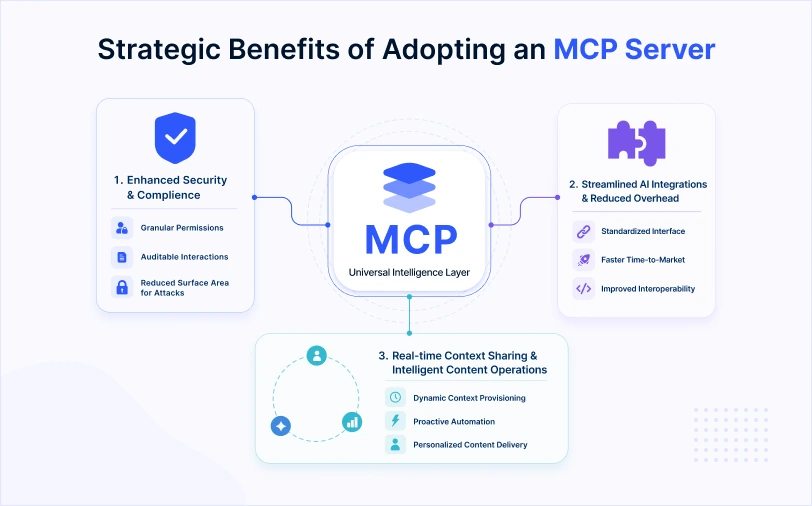
1. Enhanced Security and Compliance for AI Operations
One of the primary concerns with AI integration is security. Granting AI agents broad access to content and system APIs can introduce significant vulnerabilities. An MCP server addresses this by:
Granular Permissions: It allows administrators to define precise permissions for each AI agent, specifying what content types, fields, or actions an agent can access or perform. For example, an SEO AI might only read published content and suggest metadata changes, while a content generation AI might only create drafts in specific content models.
Auditable Interactions: All AI interactions through the MCP server are logged, providing a clear audit trail of AI-driven changes and queries, which is crucial for compliance and debugging.
Reduced Surface Area for Attacks: By mediating AI access, the MCP server acts as a single, hardened entry point for AI, reducing the direct exposure of the core CMS APIs.
This level of control and transparency is critical for organizations dealing with sensitive data, regulatory compliance, or large-scale content operations.
2. Streamlined AI Integrations and Reduced Development Overhead
Without MCP, integrating multiple AI tools often means developing custom API wrappers and context-gathering logic for each. This leads to integration sprawl and maintenance headaches. An MCP server simplifies this by:
Standardized Interface: Providing a unified, context-rich interface for all AI agents, regardless of their underlying models or specific tasks. This significantly reduces the development effort for integrating new AI capabilities.
Accelerated Time-to-Market: Teams can deploy new AI features faster, as the complexity of CMS interaction is abstracted by the MCP server. This allows developers to focus on AI logic rather than data plumbing.
Improved Interoperability: Different AI agents from various vendors can seamlessly interact with the same content platform via the MCP server, fostering a more robust AI ecosystem.
This accelerates innovation and allows teams to experiment with and adopt new AI technologies more efficiently.
3. Real-time Context Sharing and Intelligent Content Operations
AI's effectiveness is directly proportional to the quality and richness of the context it receives. An MCP server excels here by:
Dynamic Context Provisioning: It doesn't just provide static data; it delivers dynamic context including content relationships, editorial status, user activity, and even historical performance data. This enables AI to make more informed decisions.
Proactive Automation: By subscribing to CMS events, AI agents can be triggered in real-time. For instance, an AI might automatically generate alternative headlines when a new article is drafted, or suggest related content upon publishing.
Personalized Content Delivery: An MCP server can feed AI models with user behavior data alongside content context, enabling sophisticated personalization engines to recommend or adapt content in real-time.
This capability transforms content operations from reactive to proactive, automating repetitive tasks and enabling truly intelligent content workflows.
Real-World Use Cases for MCP-Powered Headless CMS
The practical applications of an MCP server in conjunction with a headless CMS are vast, touching every aspect of the content lifecycle. Here are a few examples:
Automated Content Generation and Editing: An AI agent connected via MCP can access content models, understand brand guidelines, and generate drafts for product descriptions, social media posts, or blog outlines. It can also review existing content for tone, grammar, and style compliance, suggesting edits directly within the CMS environment.
SEO Optimization and Content Audit: An SEO AI can query published content, analyze its structure and keywords against current SEO best practices, and suggest metadata improvements, internal linking opportunities, or even identify content gaps based on competitor analysis. The MCP server provides the necessary context on content type, category, and target audience.
Multi-language Content Management and Translation: AI agents can leverage MCP to access content in one language, understand its semantic meaning and context, and then generate high-quality translations for multiple locales, adhering to specific cultural nuances and terminology stored within the CMS.
Workflow Automation and Publishing: An AI agent can monitor content approval workflows via MCP, automatically flagging content for review, escalating issues, or even triggering publication once all checks are passed and approvals are secured.
Personalized Content Delivery and Recommendations: By combining content context from the MCP server with user behavior data, an AI can dynamically assemble personalized content feeds, recommend relevant articles, or adapt website layouts for individual users, all managed and delivered through the headless CMS.
Content Performance Analytics and Optimization: An AI can analyze content performance data (views, engagement, conversions) linked to specific content pieces via MCP, identify underperforming content, and suggest optimization strategies or A/B test variations.
These scenarios demonstrate how an MCP server elevates AI from a mere augmentation tool to a core operational component, driving efficiency and innovation across the content supply chain.


Hi, my name is Jaswinder, let's talk about your business needs.
I will do my best to find a reliable solution for you!
Comparing Traditional API Integrations vs. MCP Architecture
To fully grasp the strategic shift, it's useful to compare the two approaches:
Traditional API-Based Integration
Interaction Model: Request/response for specific data endpoints.
Context Provisioning: AI must infer context from raw data or make multiple API calls to gather related information.
Security: Typically relies on API keys or OAuth for broad access; granular AI-specific permissions are complex to implement.
Integration Effort: High custom development for each AI tool to parse data and understand CMS structure.
Scalability for AI: Can lead to API call limits and performance bottlenecks for complex AI tasks requiring extensive context.
Interoperability: Limited; each AI integration is often bespoke.
Use Case Fit: Best for simple data retrieval, content delivery, or basic CRUD operations by AI.
MCP-Based Architecture
Interaction Model: Semantic queries and event-driven communication, understanding content models and relationships.
Context Provisioning: MCP server provides pre-processed, semantically rich, and real-time contextual understanding to AI.
Security: Granular, AI-specific permission sets and auditable interactions.
Integration Effort: Lower custom development due to standardized protocol and abstracted CMS complexity.
Scalability for AI: Designed to handle complex, context-rich AI tasks efficiently, reducing direct CMS load.
Interoperability: High; fosters a standardized ecosystem for various AI tools.
Use Case Fit: Ideal for advanced AI agents performing content creation, optimization, personalization, and complex workflow automation.
The choice between these two architectures hinges on the ambition for AI integration. For organizations aiming for deep, intelligent automation and personalized experiences, an MCP server provides the necessary foundation.
Conclusion: The Inevitable Rise of the MCP Server
The trajectory of digital content management is clear: AI is no longer an optional add-on but a fundamental driver of efficiency, personalization, and innovation. As AI agents become more sophisticated, their reliance on rich, real-time context and secure, standardized interaction protocols will only grow. Traditional API architectures, while foundational for content delivery, are inherently limited in providing this depth of interaction for advanced AI.
By 2026, the Model Context Protocol (MCP) server will be a prerequisite for any headless CMS aspiring to be truly AI-operated. It offers the critical bridge between the content layer and the intelligence layer, enabling secure, scalable, and context-aware AI interactions. For teams, product leaders, and decision-makers building future-ready digital platforms, understanding and planning for MCP integration is no longer a luxury but a strategic imperative.
RW Infotech specializes in headless solutions, headless CMS migrations, and AI automation. Our expertise ensures that your content platforms are not only robust and scalable but also equipped to seamlessly integrate the next generation of AI capabilities, including the strategic implementation of an MCP server to unlock your content's full potential.
Frequently Asked Questions
Find answers to the most common questions about Why Every Headless CMS Will Need an MCP Server in 2026
An MCP server is an intelligent intermediary between AI agents and a headless CMS. It translates raw CMS data into a semantically rich, contextual representation, providing AI models with the necessary understanding to perform complex content-related tasks securely and efficiently.
It enhances security with granular AI-specific permissions, reduces integration complexity through a standardized protocol, and provides real-time, rich context to AI agents, enabling more intelligent and automated content operations than traditional APIs alone.
Content teams can leverage MCP for AI-driven tasks such as automated content generation and editing, SEO optimization, multi-language content translation, intelligent workflow automation, and personalized content delivery, significantly boosting efficiency and content quality.
No, an MCP server complements traditional headless CMS APIs. While APIs handle content delivery and basic CRUD operations, the MCP server provides a specialized, context-rich layer for advanced AI agents to interact with the CMS more intelligently and securely.
RW Infotech offers expertise in headless CMS development, AI automation, and secure system integrations. We can help design and implement an MCP server architecture that integrates seamlessly with your existing headless CMS, enabling advanced AI capabilities for your content operations.
News & Insights
We like to share our thoughts on topics we find inspiring. Explore our news and insights.