
Select Your Region
Region-Based Optimized Content
Open Source AI vs Closed AI Models: Which Is Better for Enterprise Applications?
Compare Open Source AI and Closed AI models for enterprise applications. Learn about security, customization, scalability, cost, compliance, and how to choose the right AI strategy for your business.

The landscape of Artificial Intelligence is rapidly evolving, presenting enterprises with a critical decision: whether to adopt open source AI models or leverage closed, proprietary solutions. This choice has profound implications for data security, cost structures, customization capabilities, and long-term strategic flexibility. For business leaders and technical decision-makers, understanding the nuances between these two approaches is paramount to selecting the right AI strategy for enterprise applications.
This article will provide a strategic comparison of open source AI models (such as Llama, Mistral, DeepSeek, and Qwen) and closed AI models (like OpenAI GPT, Anthropic Claude, and Google Gemini). We will move beyond feature comparisons to focus on practical business decisions, evaluating the advantages and trade-offs in terms of security, compliance, scalability, maintenance, total cost of ownership, and integration complexity. Our goal is to equip you with a decision framework to determine which approach best aligns with your organization’s specific needs, budget, data sensitivity, and technical capabilities.
Understanding the Core Distinctions
At its heart, the distinction between open source and closed AI models lies in access to the model’s underlying architecture, weights, and training data. This access dictates control, flexibility, and dependency.
Open Source AI Models: These models make their weights, architecture, and often their training methodologies publicly available. This transparency allows organizations to download, inspect, modify, and deploy the models on their own infrastructure. Examples include Meta's Llama series, Mistral AI's models, DeepSeek, and Qwen.
Closed AI Models: Also known as proprietary or managed AI services, these models are developed and maintained by specific companies. Access is typically provided through APIs, and the underlying model architecture and training data remain proprietary. Users interact with the model as a service, without direct access to its internal workings. Prominent examples include OpenAI's GPT series, Anthropic's Claude, and Google's Gemini.
The choice between these paradigms is not merely technical; it is a strategic business decision that impacts an organization's operational autonomy, innovation potential, and risk profile.
Strategic Advantages of Open Source AI for Enterprise Applications
Open source AI models offer compelling advantages, particularly for enterprises with stringent requirements around data control, customization, and long-term cost management. These benefits often outweigh the initial effort required for self-management.
Enhanced Data Privacy and Security
One of the most significant advantages of open source models is the ability to self-host. Deploying models on your own private cloud or on-premises infrastructure ensures that sensitive enterprise data never leaves your controlled environment. This is crucial for industries handling confidential information, such as healthcare, finance, and legal sectors. With closed models, data processing typically occurs on the vendor's servers, raising concerns about data residency, access, and potential exposure, even with robust privacy agreements.
Unparalleled Customization and Fine-tuning
Open source models provide full access to their weights, enabling deep customization. Enterprises can fine-tune these models with proprietary datasets to achieve highly specific performance for niche tasks. This level of control allows for the development of bespoke AI solutions that are perfectly aligned with unique business processes or industry-specific terminology. For example, a legal firm could fine-tune a Llama model on its extensive case law database to create a highly specialized legal research assistant, achieving accuracy unattainable with a generic closed model.
Vendor Independence and Reduced Lock-in
Relying on a single proprietary AI vendor introduces significant vendor lock-in risks. Changes in pricing, service terms, or even the discontinuation of a specific model can disrupt enterprise operations. Open source AI mitigates this by allowing organizations to switch models or providers more easily, or even maintain their own fork of a model. This independence fosters greater control over the AI roadmap and protects against unforeseen business changes from external providers. It also enables more competitive sourcing for infrastructure and support.
Lower Long-Term Total Cost of Ownership (TCO)
While open source models may require an initial investment in infrastructure and skilled personnel for deployment and maintenance, their long-term TCO can be significantly lower. Organizations avoid recurring API usage fees, which can escalate rapidly with high-volume enterprise applications. The cost shifts from transactional API calls to infrastructure, which can often be optimized and scaled efficiently, especially for internal business applications where usage patterns are predictable. This is particularly attractive for large-scale deployments or applications with continuous, high-frequency AI interactions.
Community Support and Transparency
The open source community provides a vast ecosystem of developers, researchers, and users who contribute to model improvement, bug fixes, and knowledge sharing. This collective intelligence often leads to rapid innovation and robust solutions. The transparency of open source models also allows for thorough auditing and understanding of their behavior, which is critical for compliance and explainability in regulated industries.
Strengths of Closed AI Models and Managed Services
Despite the compelling arguments for open source, closed AI models and managed services offer distinct advantages, particularly for organizations seeking rapid deployment, minimal operational overhead, and access to cutting-edge performance without deep technical investment.
Higher Model Performance and State of the Art Capabilities
Leading closed AI models often represent the bleeding edge of AI research and development. Companies like OpenAI, Anthropic, and Google invest heavily in large-scale training, leveraging vast computational resources and proprietary datasets. This often results in superior general-purpose performance, broader capabilities, and faster innovation cycles for their flagship models. For applications requiring the absolute best in natural language understanding, generation, or complex reasoning, closed models frequently offer an immediate advantage.
Faster Deployment and Reduced Operational Overhead
Accessing AI capabilities via an API significantly accelerates deployment. Enterprises can integrate powerful AI functionalities into their applications with minimal setup, bypassing the complexities of infrastructure provisioning, model deployment, and ongoing maintenance. This "AI as a Service" model reduces the need for specialized in-house AI engineering teams for core model management, allowing internal teams to focus on application development and business logic. This is ideal for proof-of-concept projects or applications where time-to-market is critical.
Enterprise-Grade Support and Reliability
Proprietary AI vendors typically offer comprehensive enterprise support, service level agreements (SLAs), and robust infrastructure. This includes guaranteed uptime, performance monitoring, security patches, and direct access to technical experts. For mission-critical applications where downtime or performance degradation is unacceptable, the reliability and support provided by managed AI services can be a decisive factor.
Regular Updates and Continuous Improvement
Closed models are continuously updated and improved by their developers, often incorporating the latest research and user feedback. These enhancements, including performance optimizations, new features, and security fixes, are typically rolled out seamlessly to users via API updates. This ensures that enterprises are always leveraging an up-to-date and improving AI system without requiring internal development efforts to integrate new versions or apply patches.
Simplified AI Governance and Compliance
For organizations navigating complex AI governance and compliance landscapes, managed AI services can offer a more straightforward path. Vendors often provide documentation and assurances regarding data handling, model biases, and ethical AI practices. While enterprises still bear responsibility for their usage, the foundational compliance and security aspects are managed by the service provider, simplifying internal audit processes.
Comparative Analysis: Key Decision Criteria
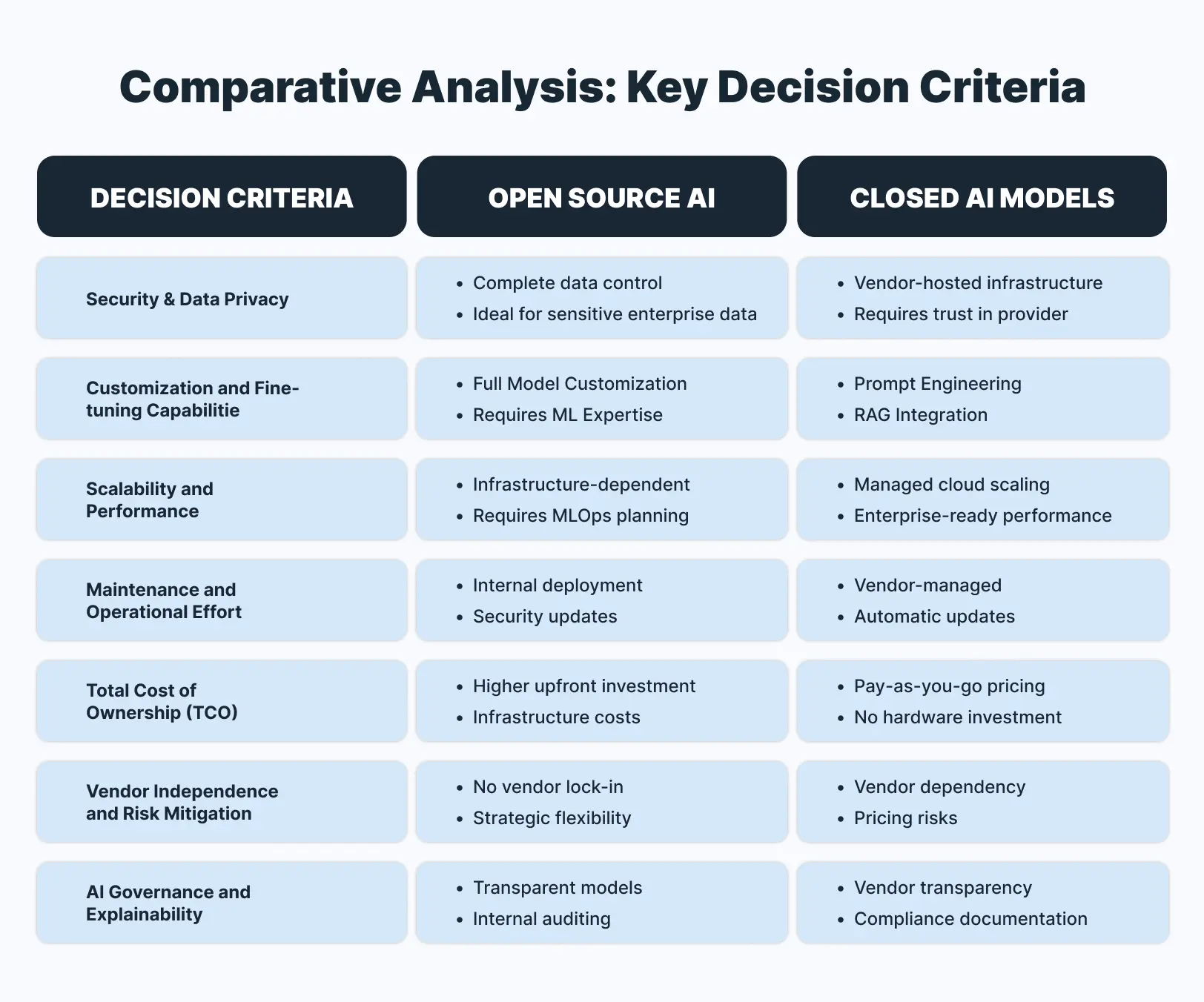
Choosing between open source and closed AI models requires a structured evaluation across several critical dimensions. The optimal path depends heavily on an organization's specific context, risk tolerance, and strategic objectives.
Security and Data Privacy
Open Source: Offers maximum control. Data stays within your environment. Responsibility for securing the model, infrastructure, and data is entirely internal. Ideal for highly sensitive data (e.g., healthcare patient records, financial transactions, classified information).
Closed: Data is processed on the vendor's infrastructure. Relies on vendor's security protocols and compliance certifications (e.g., SOC 2, ISO 27001). Requires careful review of data processing agreements and understanding of data residency. Suitable for less sensitive data or when vendor's compliance meets requirements.
Customization and Fine-tuning Capabilities
Open Source: Full access for deep customization, fine-tuning with proprietary data, and even architectural modifications. Enables highly specialized applications. Requires internal ML expertise.
Closed: Customization typically limited to prompt engineering, retrieval-augmented generation (RAG), or vendor-provided fine-tuning APIs. Less control over core model behavior. Simpler to implement.
Scalability and Performance
Open Source: Scalability depends on internal infrastructure and MLOps capabilities. Requires careful planning and resource management. Performance can be optimized for specific hardware.
Closed: Highly scalable by design, managed by the vendor. Performance is typically robust and optimized by the provider. Pay-as-you-go model adapts to fluctuating demand without internal infrastructure concerns.
Maintenance and Operational Effort
Open Source: Requires significant internal effort for deployment, monitoring, updates, security patching, and troubleshooting. Demands skilled MLOps and AI engineering teams.
Closed: Minimal operational effort for the enterprise. Vendor handles infrastructure, updates, and maintenance. Focus shifts to API integration and application logic.
Total Cost of Ownership (TCO)
Open Source: Initial capital expenditure for hardware/cloud infrastructure, ongoing operational costs (electricity, cooling, network), and significant personnel costs (AI engineers, MLOps). Long-term TCO can be lower for high-volume, continuous use.
Closed: Primarily operational expenditure (API usage fees). Costs scale directly with usage. No capital expenditure for hardware. Lower personnel costs for AI infrastructure management. Can become very expensive for high-volume, consistent usage.
Vendor Independence and Risk Mitigation
Open Source: High vendor independence. Reduced risk of lock-in. Greater control over AI strategy and long-term evolution.
Closed: Higher vendor dependence. Risks associated with pricing changes, service modifications, or vendor solvency. Requires robust vendor management strategies.
AI Governance and Explainability
Open Source: Full transparency allows for internal auditing, bias detection, and explainability efforts. Requires internal expertise to implement governance frameworks.
Closed: Transparency is limited by the vendor's disclosures. Relies on vendor's ethical AI principles and compliance certifications. Governance focuses on responsible use of the API.


Hi, my name is Jaswinder, let's talk about your business needs.
I will do my best to find a reliable solution for you!
Enterprise Scenarios: When to Choose Which
The decision framework becomes clearer when considering specific enterprise use cases.
Healthcare and Fintech
Scenario: Developing an AI assistant for processing sensitive patient medical records or analyzing proprietary financial data for fraud detection.
Recommendation: Open Source AI. The absolute necessity for data privacy, regulatory compliance (HIPAA, GDPR, PCI DSS), and the ability to train models on highly specialized, confidential datasets makes self-hosted open source models the preferred choice. Organizations can maintain full control over data residency and security protocols, and fine-tune models to understand complex medical terminology or intricate financial patterns without exposing sensitive information to external parties.
Customer Support Automation (Internal Knowledge Base)
Scenario: Building an internal knowledge assistant for employees to quickly find answers to HR policies, IT issues, or product specifications using proprietary company documents.
Recommendation: Hybrid or Open Source AI. While general customer-facing chatbots might leverage closed APIs for quick deployment, internal knowledge assistants often deal with proprietary company data that should not leave the enterprise perimeter. An open source model fine-tuned on internal documentation, potentially combined with RAG (Retrieval-Augmented Generation), offers superior data privacy and accuracy for internal use cases. This approach ensures that internal strategies and sensitive operational details remain confidential.
Marketing Content Generation and General Productivity Tools
Scenario: Generating marketing copy, drafting internal communications, or summarizing public reports.
Recommendation: Closed AI Models. For tasks where data sensitivity is lower and rapid deployment with state-of-the-art language capabilities is paramount, closed models like GPT or Claude excel. The ease of integration via APIs and the high quality of output for general-purpose text generation provide significant productivity gains without the overhead of managing a model internally. The cost scales with usage, which is often manageable for these types of applications.
AI Agents for Complex Business Process Automation
Scenario: Developing an AI agent to automate complex, multi-step business processes that involve interacting with various internal systems and proprietary data, such as supply chain optimization or complex financial modeling.
Recommendation: Open Source AI. The need for deep integration with internal systems, the handling of critical business logic, and often the processing of sensitive operational data make open source models more suitable. The ability to customize the model's behavior, ensure data privacy, and maintain full control over the agent's actions within the enterprise ecosystem is crucial for robust and compliant automation. This also allows for greater auditability and explainability of the agent's decisions.
Conclusion
The decision between open source AI and closed AI models is a strategic one, without a universally correct answer. It hinges on a careful evaluation of an organization's specific data privacy requirements, customization needs, budget constraints, technical capabilities, and long-term strategic goals. While closed models offer immediate access to cutting-edge performance and reduced operational overhead, open source models provide unparalleled control, data privacy, and cost efficiency for enterprises willing to invest in their own AI infrastructure and expertise.
For organizations prioritizing data sovereignty, deep customization, and long-term cost optimization for mission-critical applications, open source models present a powerful and strategic advantage. Conversely, for rapid prototyping, general-purpose tasks, and situations where speed-to-market and minimal operational burden are key, closed AI services offer a compelling solution. The most effective strategy for many enterprises might involve a hybrid approach, leveraging the strengths of both paradigms across different applications within their ecosystem. Understanding these trade-offs is crucial for making an informed decision that drives sustainable innovation and competitive advantage in the AI era.
RW Infotech specializes in helping enterprises navigate these complex decisions. With expertise in full-stack development, AI automation, and performance optimization, we assist organizations in architecting, developing, and integrating both open source and proprietary AI solutions tailored to their unique business needs and strategic objectives.
Frequently Asked Questions
Find answers to the most common questions about Open Source AI vs Closed AI Models: Which Is Better for Enterprise Applications?
The main advantages include enhanced data privacy (self-hosting), deep customization capabilities, vendor independence, and potentially lower long-term total cost of ownership, especially for high-volume, sensitive applications. They offer full control over the model and its deployment environment.
Enterprises should consider closed AI models when rapid deployment is critical, they require state-of-the-art general-purpose performance, have limited in-house AI engineering resources, and data sensitivity allows for external processing. These models offer enterprise-grade support and continuous updates with minimal operational overhead.
Yes, many closed AI models offer fine-tuning capabilities through their APIs, allowing users to adapt the model to specific tasks using their own data. However, the level of customization and control is generally more limited compared to open source models where the entire architecture can be modified.
For open source, security is entirely the enterprise's responsibility, requiring robust internal controls and expertise. For closed models, security relies on the vendor's infrastructure and compliance, necessitating careful review of their security protocols, data processing agreements, and certifications.
RW Infotech provides strategic consulting, development, and integration services for both open source and proprietary AI solutions. We help organizations evaluate their specific needs, architect custom AI applications, fine-tune models, and integrate them seamlessly into existing enterprise systems, ensuring optimal performance and security.
News & Insights
We like to share our thoughts on topics we find inspiring. Explore our news and insights.