
Select Your Region
Region-Based Optimized Content
How MCP Servers Are Turning Headless CMS Platforms into AI-Operated Content Systems
Learn how MCP servers connect AI with headless CMS platforms to automate content creation, workflow management, personalization, and content operations at scale.


The landscape of content management is undergoing a significant transformation, driven by the convergence of headless CMS architectures and advanced artificial intelligence. Traditional content workflows, often manual and resource-intensive, are evolving into intelligent, automated systems. At the forefront of this evolution are Model Context Protocol (MCP) servers, acting as a crucial bridge that enables AI models to securely and effectively interact with content data.
This shift is not merely about integrating AI tools; it's about establishing a robust, secure, and standardized communication layer that allows AI agents to become active participants in the content lifecycle. For product leaders, development teams, and marketing strategists, understanding MCP is essential for building future ready content ecosystems that are efficient, scalable, and capable of operating with minimal human intervention. This article explores how MCP servers are fundamentally changing how headless CMS platforms function, enabling them to become truly AI operated content systems.
The Role of Model Context Protocol (MCP) in AI-Driven Content
Model Context Protocol (MCP) defines a standardized method for AI models to access, interpret, and interact with external data sources, including headless CMS platforms. Unlike simple API integrations, MCP provides a structured framework that ensures secure authentication, data context preservation, and controlled data manipulation. It acts as a specialized middleware, enabling AI agents to understand the schema and relationships within a CMS, rather than just raw data.
This protocol is critical because AI models require not just data, but context to perform meaningful tasks. A headless CMS stores content as structured data, but without a protocol like MCP, an AI model might struggle to differentiate between a blog post title, a product description, or an author's bio. MCP provides the necessary semantic understanding, allowing AI to query, retrieve, and update content with precision and adherence to predefined rules.
For organizations, implementing MCP means establishing a secure conduit for AI. It mitigates risks associated with direct database access and ensures that AI operations are governed by specific permissions and data integrity checks. This architectural decision is pivotal for scalability and compliance, especially when dealing with sensitive content or regulated industries.
Enabling AI to Interact with Headless CMS Data Securely
The core challenge in integrating AI with enterprise content systems is ensuring secure and context-aware interaction. MCP servers address this by providing a controlled environment. When an AI agent needs to perform an action such as generating a new blog post, updating product details, or localizing content it communicates with the MCP server, not directly with the headless CMS API.
The MCP server then translates the AI's intent into specific CMS operations, using predefined schemas and access policies. This layered approach offers several advantages:
Granular Access Control: MCP allows administrators to define exactly what data an AI model can access, read, modify, or delete. This prevents unauthorized operations and ensures data integrity.
Contextual Understanding: The protocol helps AI models interpret the content structure, metadata, and relationships within the CMS. For instance, an AI can understand that a "featured image" field is distinct from a "body content" field.
Security Auditing: All interactions through the MCP server can be logged and monitored, providing a clear audit trail of AI-driven content modifications. This is crucial for compliance and debugging.
Abstraction Layer: MCP abstracts the underlying CMS specifics from the AI model. This means that even if the headless CMS platform changes, the AI integration can remain stable with minimal adjustments to the MCP configuration.
Decision makers should view MCP as an investment in a secure, scalable, and maintainable AI integration strategy. It moves beyond brittle, custom API scripts to a standardized, robust framework that can support complex AI workflows across diverse content types and channels.
Transforming Headless CMS Platforms into AI-Operated Content Systems
The integration of MCP servers with headless CMS platforms is fundamentally reshaping content operations. This transformation enables a new paradigm where AI agents perform a wide array of tasks that traditionally required significant human effort. The result is a more agile, efficient, and scalable content ecosystem.
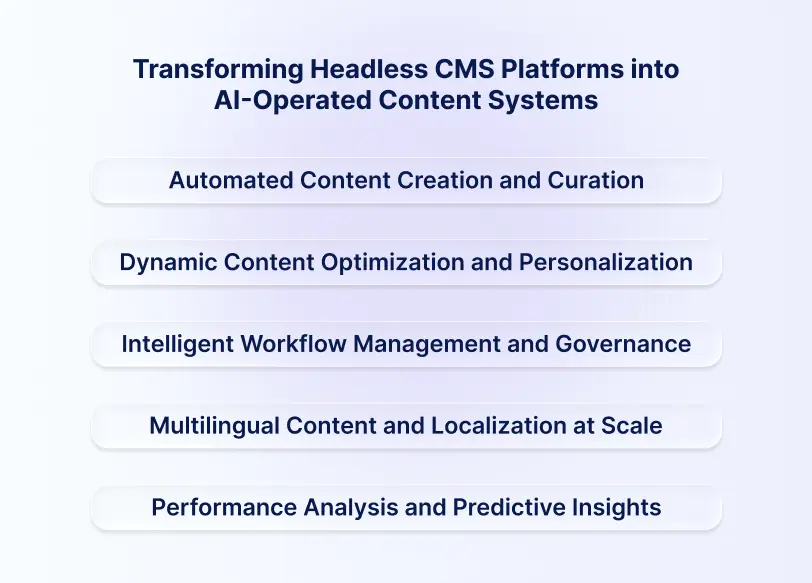
Here’s how AI, powered by MCP, is revolutionizing content management:
Automated Content Creation and Curation
AI models can leverage MCP to access existing content, analyze trends, and generate new content drafts directly within the CMS. This includes blog posts, product descriptions, marketing copy, and social media updates. AI can also curate content by identifying relevant articles, summarizing lengthy reports, or suggesting related content based on user behavior data stored in the CMS.
Dynamic Content Optimization and Personalization
With MCP, AI can analyze real time performance data (e.g., SEO rankings, user engagement metrics) and dynamically update content within the headless CMS. This could involve optimizing headlines, adjusting keywords, or personalizing content variants for different audience segments. AI can A/B test different content versions and automatically deploy the best performing ones.
Intelligent Workflow Management and Governance
AI operated content systems can automate content workflows, from initial draft generation to review, approval, and publishing. AI can route content to relevant human editors, flag compliance issues, or ensure brand consistency across all content pieces. MCP provides the necessary interface for AI to interact with workflow states and metadata within the CMS.
Multilingual Content and Localization at Scale
For global enterprises, managing multilingual content is a significant challenge. AI, connected via MCP, can automate content translation, ensuring cultural relevance and consistency across different languages. It can also manage localization workflows, identifying content that needs translation and pushing translated versions back into the CMS for specific locales.
Performance Analysis and Predictive Insights
Beyond content creation, AI can analyze vast amounts of content performance data stored in the CMS and integrated analytics platforms. MCP allows AI to retrieve this data, identify patterns, predict future trends, and recommend strategic content adjustments. This enables data driven content strategies and proactive optimization.
The strategic implication is profound: teams can shift from repetitive manual tasks to higher value activities like strategy, creativity, and critical review. This model reduces time to market for content, enhances content quality, and significantly lowers operational costs.


Hi, my name is Jaswinder, let's talk about your business needs.
I will do my best to find a reliable solution for you!
Strategic Considerations for Adopting MCP in Your Headless Architecture
Implementing MCP servers to enable AI-operated content systems requires careful strategic planning. It's not merely a technical integration but a shift in how content teams operate and how content is managed at an enterprise level.
Decision Criteria and Trade-offs
Scalability Needs: For organizations with large content volumes, frequent updates, or multiple content channels, MCP-enabled AI offers unparalleled scalability. Smaller operations might find the initial setup overhead outweighs immediate benefits.
Content Complexity: If content is highly structured, rich in metadata, and follows strict schemas, AI can leverage MCP effectively. Highly unstructured or subjective content may still require significant human oversight.
Resource Investment: Adopting MCP and building AI integrations requires investment in technical expertise for setup, configuration, and ongoing maintenance. Organizations need to assess their internal capabilities or partner with specialized agencies.
Data Security and Governance: MCP provides a strong framework for security. Organizations must define clear data access policies and ensure compliance with relevant regulations (e.g., GDPR, HIPAA) when AI interacts with content.
Potential Risks and Mitigation
AI Hallucinations and Inaccuracies: AI models can generate incorrect or nonsensical content. Mitigation involves robust human review processes, fine-tuning AI models with domain-specific data, and implementing validation steps.
Over-Automation: Relying solely on AI without human oversight can lead to a loss of brand voice or creative uniqueness. The goal should be augmentation, not full replacement, of human creativity.
Integration Complexity: While MCP standardizes interaction, integrating AI models, the MCP server, and the headless CMS still requires careful planning and execution. Phased rollouts and robust testing are crucial.
Ethical Considerations: AI-generated content raises questions about authorship and bias. Organizations must establish clear guidelines for AI content attribution and ensure fairness in content generation.
Long-Term Implications
Embracing MCP and AI in content management positions an organization for future growth and agility. It builds a foundation for advanced content intelligence, predictive analytics, and hyper-personalized user experiences. This strategic move fosters a culture of innovation and enables teams to focus on higher-value tasks, ultimately driving greater ROI from content investments.
For businesses aiming to stay competitive, integrating AI into their content strategy via MCP is becoming less of an option and more of a necessity. It represents a commitment to efficiency, innovation, and a truly dynamic content ecosystem.
Conclusion: The Future is AI-Operated Content Systems
The emergence of Model Context Protocol (MCP) servers marks a pivotal moment in the evolution of content management. By providing a secure, standardized, and context-aware communication layer, MCP is enabling headless CMS platforms to transcend their traditional roles and become intelligent, AI-operated content systems. This transformation empowers organizations to automate content creation, optimize delivery, manage complex workflows, and gain deeper insights, all with unprecedented efficiency and scale.
For decision-makers and technical teams, embracing MCP is a strategic investment in the future of digital experiences. It’s about building a resilient, adaptable content infrastructure that can leverage the full potential of artificial intelligence, reducing manual effort, accelerating content velocity, and ensuring consistent, high-quality output across all digital channels. The shift towards AI-driven content is not just an incremental improvement; it's a fundamental reimagining of how content is managed, delivering significant competitive advantages for those who adopt it effectively.
At RW Infotech, we specialize in building modern, scalable digital platforms, including headless solutions and AI automation. Our expertise in integrating advanced AI capabilities with headless CMS architectures, leveraging protocols like MCP, helps businesses create intelligent content ecosystems that drive efficiency and innovation. We guide teams through the strategic decisions, technical implementations, and long-term optimizations required to transform their content operations into future-ready, AI-powered systems.
Frequently Asked Questions
Find answers to the most common questions about MCP Servers Are Turning Headless CMS Platforms into AI-Operated Content Systems.
RW Infotech specializes in integrating AI automation with headless CMS platforms. We provide strategic consulting, architecture design, and development services to implement MCP servers, enabling secure and intelligent AI interaction with your content. Our expertise ensures your content systems are efficient, scalable, and future-ready.
The primary benefits include enhanced security for AI interactions, granular access control for content data, improved contextual understanding for AI models, and a standardized framework for integrating AI into content workflows. This leads to more efficient and reliable AI-driven content operations.
No, MCP is not a replacement for traditional CMS APIs. Instead, it acts as a specialized layer on top of existing APIs. MCP provides a structured protocol for AI models to interact with the CMS data via its APIs, adding context, security, and governance that raw API calls typically lack for AI agents.
AI tasks that can be automated include content generation (drafting articles, product descriptions), content optimization (SEO, personalization), workflow management (approvals, publishing), content translation, performance analysis, and content summarization. These tasks leverage AI's ability to process and act on content data programmatically.
MCP significantly enhances security by providing granular access control, ensuring AI models only interact with authorized data. It establishes an auditable layer for all AI operations, reducing the risk of unauthorized data access or manipulation, and helping maintain data integrity and compliance standards.
News & Insights
We like to share our thoughts on topics we find inspiring. Explore our news and insights.