
Select Your Region
Region-Based Optimized Content
What Does AI Integration Cost for a Business Website? (2026)
Discover the cost of AI integration for business websites in 2026. Compare AI models, pricing, implementation costs, ROI, and strategies to reduce expenses.


Integrating Artificial Intelligence (AI) into a business website is no longer a niche endeavor but a strategic imperative for enhancing user experience, streamlining operations, and driving growth. However, understanding the true cost of AI integration extends beyond initial setup fees. It encompasses a complex interplay of business goals, choice of AI models, implementation complexity, and ongoing operational expenditures.
This article provides a comprehensive breakdown of the factors influencing AI integration costs for business websites. We will explore various AI applications, compare leading AI models, detail critical cost components, and offer practical strategies for managing expenses. Our aim is to equip business owners, product leaders, and technical teams with the insights needed to make informed decisions and build a sustainable AI strategy.
Understanding AI Integration Types and Their Value
The scope and complexity of AI integration directly correlate with its cost. Different AI applications serve distinct business objectives, each requiring specific models, data, and development efforts.
AI Chatbots and Virtual Assistants: These enhance customer service by providing instant support, answering FAQs, and guiding users. Costs vary based on conversational complexity, integration with backend systems, and multi-language support.
Personalized Product Recommendations: Leveraging user behavior data, AI algorithms suggest relevant products or content, improving conversion rates and user engagement. This often involves machine learning model training and robust data pipelines.
AI Search and Discovery: Advanced search functionalities powered by AI can understand natural language queries, delivering more accurate and relevant results than traditional keyword-based search. This requires sophisticated natural language processing (NLP) capabilities.
Content Generation and Curation: AI tools can assist in generating blog posts, product descriptions, or social media content, and curating relevant information. This reduces manual effort and accelerates content production, but demands careful oversight for quality and brand voice.
Workflow Automation: AI can automate repetitive tasks such as lead qualification, data entry, or report generation, freeing up human resources for more strategic work. Integration with existing business systems is a key cost driver here.
Lead Qualification and Scoring: AI models analyze visitor data and behavior to identify high-potential leads, allowing sales teams to prioritize effectively. This often involves predictive analytics and CRM integration.
Document Processing and Analysis: AI can extract, classify, and analyze information from unstructured documents, automating tasks like invoice processing or contract review. Optical Character Recognition (OCR) and NLP are central to these solutions.
Voice Assistants and Interfaces: Enabling voice commands for website navigation or specific functionalities can improve accessibility and user experience, but requires sophisticated speech-to-text and text-to-speech capabilities.
Each of these applications offers a unique return on investment, but their implementation requires careful consideration of data availability, integration points, and the desired level of autonomy.
Evaluating AI Models: Capabilities, Pricing, and Use Cases
The choice of AI model significantly impacts both performance and cost. Businesses can opt for managed AI APIs from leading providers or deploy self-hosted open-source models. Each approach has distinct trade-offs.
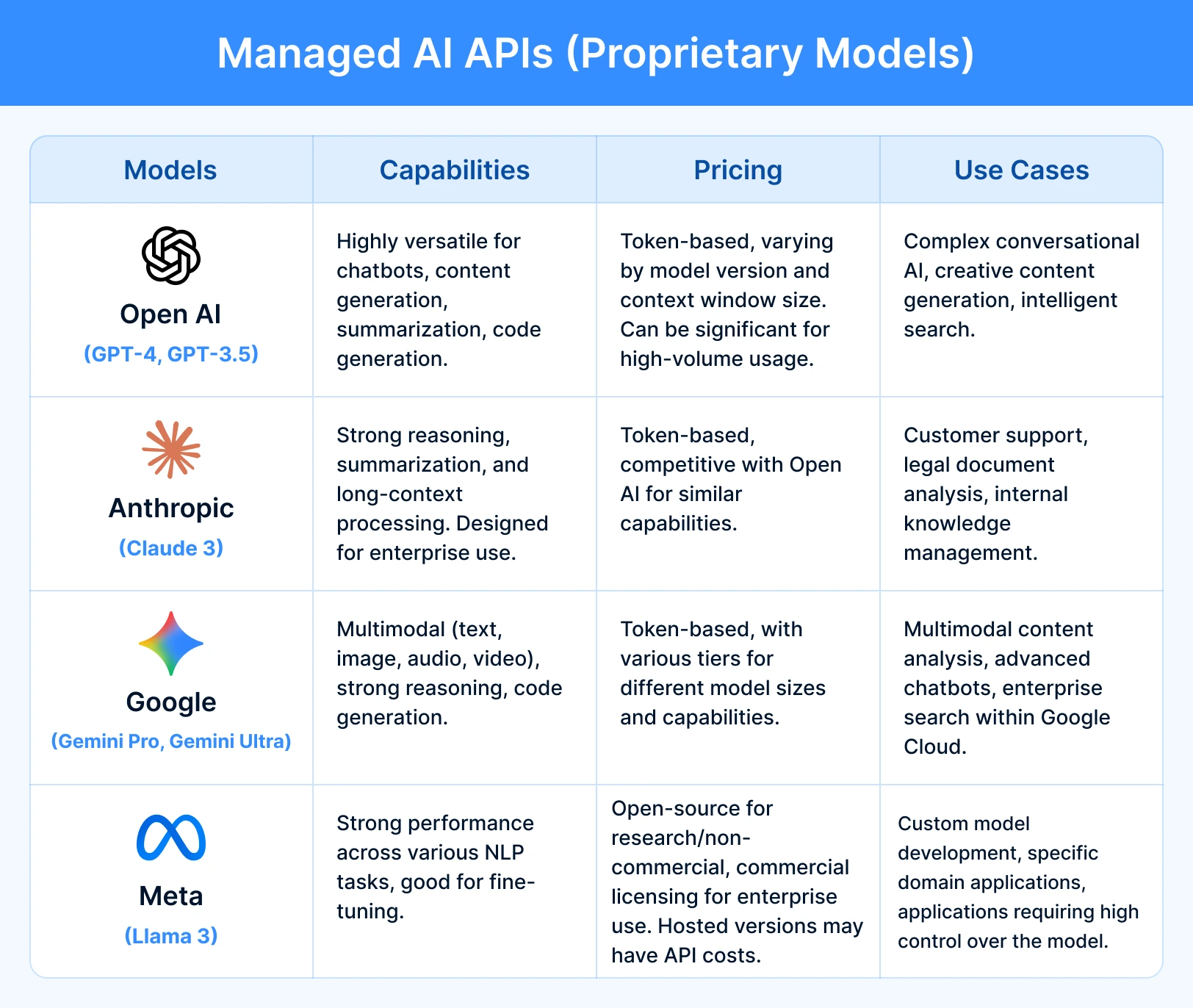
Managed AI APIs (Proprietary Models)
These services offer pre-trained, highly capable models accessible via APIs. They abstract away the complexities of model hosting, infrastructure management, and continuous optimization. Key players include:
OpenAI (GPT-4, GPT-3.5):
Capabilities: Highly versatile for chatbots, content generation, summarization, code generation.
Pricing: Token-based, varying by model version and context window size. Can be significant for high-volume usage.
Use Cases: Complex conversational AI, creative content generation, intelligent search.
Anthropic (Claude 3):
Capabilities: Strong reasoning, summarization, and long-context processing. Designed for enterprise use.
Pricing: Token-based, competitive with OpenAI for similar capabilities.
Use Cases: Customer support, legal document analysis, internal knowledge management.
Google (Gemini Pro, Gemini Ultra):
Capabilities: Multimodal (text, image, audio, video), strong reasoning, code generation.
Pricing: Token-based, with various tiers for different model sizes and capabilities.
Use Cases: Multimodal content analysis, advanced chatbots, enterprise search within Google Cloud.
Meta (Llama 3):
Capabilities: Strong performance across various NLP tasks, good for fine-tuning.
Pricing: Open-source for research/non-commercial, commercial licensing for enterprise use. Hosted versions may have API costs.
Use Cases: Custom model development, specific domain applications, applications requiring high control over the model.
Advantages of Managed APIs: Faster deployment, less infrastructure overhead, continuous model improvements, access to cutting-edge research.
Disadvantages: Recurring API costs can scale significantly with usage, vendor lock-in, potential data privacy concerns (though most offer robust data handling policies), less control over model architecture.
Self-Hosted Open-Source Models
Models like Meta Llama, Mistral, DeepSeek, and Qwen can be downloaded and run on your own infrastructure. This offers greater control and potentially lower long-term operational costs for high-volume use, but demands significant technical expertise.
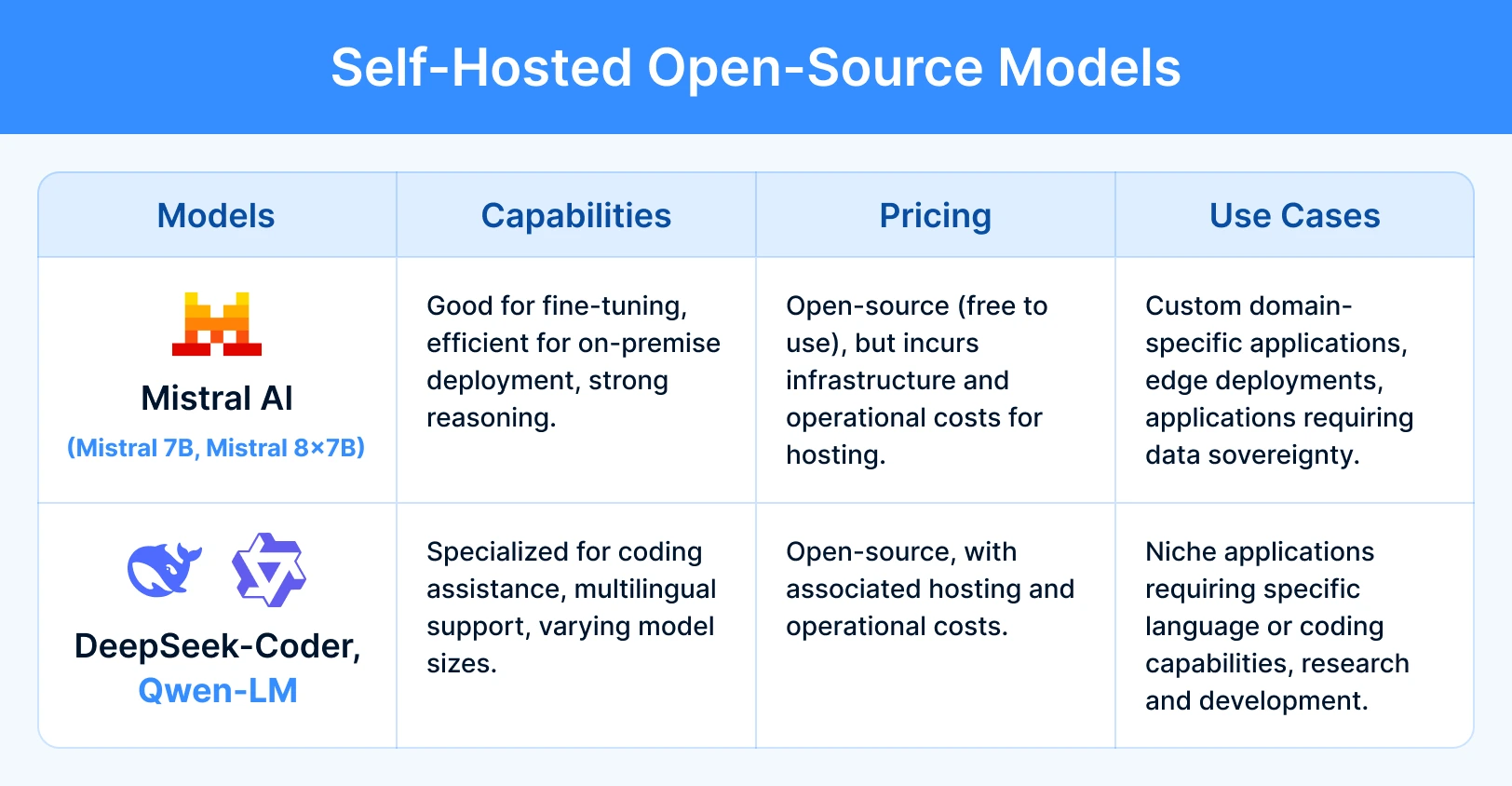
Mistral AI (Mistral 7B, Mixtral 8x7B):
Capabilities: Good for fine-tuning, efficient for on-premise deployment, strong reasoning.
Pricing: Open-source (free to use), but incurs infrastructure and operational costs for hosting.
Use Cases: Custom domain-specific applications, edge deployments, applications requiring data sovereignty.
DeepSeek-Coder, Qwen-LM:
Capabilities: Specialized for coding assistance, multilingual support, varying model sizes.
Pricing: Open-source, with associated hosting and operational costs.
Use Cases: Niche applications requiring specific language or coding capabilities, research and development.
Advantages of Self-Hosted: Full control over data and model, no recurring API costs (only infrastructure), better data privacy, ability to fine-tune extensively.
Disadvantages: High initial setup cost, significant infrastructure investment (GPUs), requires specialized MLOps and engineering talent, ongoing maintenance and optimization burden.
The decision between managed APIs and self-hosted models hinges on factors like budget, technical capabilities, data sensitivity, and anticipated usage volume. For many businesses, a hybrid approach, using managed APIs for general tasks and self-hosted models for highly specific or sensitive functions, can be optimal.
Major Cost Factors for AI Integration
Understanding the breakdown of costs is crucial for accurate budgeting and strategic planning.
1. AI API Usage / Model Licensing
For managed services, this is a direct variable cost, typically billed per token, per call, or per unit of compute. High-volume applications will incur substantial API costs. For proprietary models, there might also be licensing fees for specific features or enterprise-level support.
2. Model Hosting and Infrastructure
If self-hosting open-source models, this includes the cost of cloud computing resources (GPUs, CPUs, memory), storage for models and data, and networking. These are significant fixed and variable costs, often requiring specialized hardware for efficient inference.
3. Development and Integration
This is often the largest upfront cost. It includes:
Solution Design and Architecture: Planning the AI solution, selecting models, and designing the integration points.
Data Preparation and Engineering: Collecting, cleaning, labeling, and transforming data for AI model training or inference. This can be highly labor-intensive.
Model Training and Fine-tuning: If using custom models or fine-tuning open-source ones, this requires significant computational resources and expert data scientists.
API Integration: Connecting the website's frontend and backend systems to the chosen AI APIs or self-hosted models.
User Interface (UI) Development: Designing and implementing the website components that interact with the AI (e.g., chatbot widgets, recommendation displays).
Testing and Quality Assurance: Ensuring the AI performs as expected, handling edge cases, and delivering accurate results.
4. Data Storage and Management
AI models thrive on data. Storing large datasets, managing data pipelines, ensuring data security, and complying with regulations (e.g., GDPR, CCPA) add to the overall cost. This includes databases, data lakes, and data warehousing solutions.
5. Maintenance and Ongoing Operational Costs
AI solutions are not "set it and forget it." Ongoing costs include:
Monitoring and Performance Tuning: Continuously monitoring model performance, API usage, and system health.
Model Updates and Retraining: AI models need to be updated and retrained periodically with new data to maintain relevance and accuracy.
Security Updates and Patching: Ensuring the AI infrastructure and integrations remain secure against evolving threats.
Software Licenses: For any additional tools or platforms used in the AI stack.
Team Salaries: The cost of data scientists, MLOps engineers, and developers required for ongoing support and evolution.
6. Compliance and Governance
Depending on the industry and data handled, ensuring AI systems comply with ethical guidelines, privacy regulations, and industry standards can involve additional development, auditing, and legal consultation costs.
Estimated Cost Ranges for AI Integration
These ranges are illustrative and can vary significantly based on specific requirements, regional labor costs, and chosen technologies.
Small Businesses (Basic AI Chatbot, Simple Recommendations):
Initial Development: $5,000 - $25,000
Monthly Operational (API usage, basic maintenance): $50 - $500
Typical Solutions: Off-the-shelf chatbot platforms, basic recommendation engines using managed APIs.
Growing Companies (Advanced AI Search, Workflow Automation, Personalized Content):
Initial Development: $25,000 - $150,000+
Monthly Operational (API usage, infrastructure, maintenance): $500 - $5,000+
Typical Solutions: Custom-integrated AI search, AI-powered lead scoring, content generation using fine-tuned managed APIs or smaller self-hosted models.
Enterprise Websites (Complex Multimodal AI, Custom Models, Extensive Automation):
Initial Development: $150,000 - $1,000,000+
Monthly Operational (High API usage, dedicated infrastructure, MLOps team): $5,000 - $50,000+
Typical Solutions: Enterprise-grade virtual assistants, real-time personalization at scale, document intelligence, advanced predictive analytics, often leveraging self-hosted open-source models or highly customized proprietary solutions.
These estimates underscore the importance of a clear strategy and phased implementation to manage costs effectively.
Strategies for Reducing AI Costs
While AI integration involves investment, several strategies can help optimize costs without compromising performance or strategic objectives.
Start Small and Iterate: Begin with a minimal viable product (MVP) focusing on one high-impact AI feature. Gather feedback, measure ROI, and then expand. This limits initial investment and allows for course correction.
Leverage Managed AI Services: For many common use cases, managed AI APIs are more cost-effective than building and maintaining custom models from scratch, especially for businesses without dedicated MLOps teams.
Optimize API Usage: Implement caching mechanisms, batch requests, and use efficient prompting techniques to reduce token consumption for managed APIs. Monitor usage patterns to identify and eliminate wasteful calls.
Choose the Right Model Size: Not every task requires the largest, most expensive model. For simpler tasks, smaller, more efficient models (e.g., GPT-3.5 over GPT-4, smaller open-source models) can deliver comparable performance at a fraction of the cost.
Fine-tune Smartly: Instead of training a large model from scratch, fine-tuning a smaller pre-trained open-source model with your specific data can yield highly relevant results at a lower cost than using large proprietary models for every task.
Automate MLOps: For self-hosted solutions, invest in MLOps tools and practices to automate model deployment, monitoring, and retraining. This reduces manual labor and improves operational efficiency.
Cloud Cost Optimization: If hosting models on the cloud, employ strategies like reserved instances, spot instances, and serverless functions where appropriate to reduce infrastructure costs.
Data Governance and Quality: High-quality, well-managed data reduces the need for extensive data cleaning and improves model accuracy, thereby reducing retraining costs and improving efficiency.


Hi, my name is Jaswinder, let's talk about your business needs.
I will do my best to find a reliable solution for you!
Decision Framework for AI Solution Selection
Choosing the right AI solution requires balancing various factors. Use the following framework to guide your decision-making:
Define Business Goal & ROI: What specific problem will AI solve? What measurable business value will it deliver? This clarifies the scope and justifies the investment.
Assess Technical Capabilities: Does your team have the expertise in AI, data science, and MLOps to build and maintain a custom solution, or is a managed service more appropriate?
Data Availability & Privacy: Do you have sufficient, high-quality data for training? Are there strict data privacy or regulatory requirements that necessitate self-hosting or specific data handling policies?
Scalability Requirements: How will usage grow? Can the chosen solution scale efficiently to meet future demand without prohibitive cost increases?
Budget Constraints: What is the realistic budget for initial development and ongoing operational costs?
Time to Market: How quickly do you need the AI feature deployed? Managed APIs generally offer faster deployment.
Here's a simplified comparison table to aid in decision-making:
| Feature | Managed AI APIs | Self-Hosted Open-Source Models |
|---|---|---|
| Initial Cost | Lower (development effort) | Higher (infrastructure, MLOps, development) |
| Ongoing Cost | Variable (API usage, can scale high) | Fixed (infrastructure) + Variable (talent) |
| Time to Market | Faster | Slower |
| Technical Expertise Required | Lower (integration focus) | Higher (data science, MLOps, infrastructure) |
| Data Control/Privacy | Less control (vendor policies) | Full control (on-premise) |
| Flexibility/Customization | Limited (via prompts, fine-tuning) | High (full model control, extensive fine-tuning) |
| Maintenance Burden | Lower (vendor handles) | Higher (internal team) |
Conclusion
The cost of AI integration for a business website is a multifaceted equation, influenced by the chosen AI application, model selection, development complexity, and ongoing operational needs. While the investment can be substantial, the strategic advantages in customer experience, operational efficiency, and competitive differentiation are often compelling.
By carefully defining objectives, evaluating AI models, understanding cost factors, and implementing smart cost-reduction strategies, businesses can integrate AI effectively and sustainably. The key is to approach AI integration not as a one-time project, but as an evolving component of your digital strategy, continuously optimizing for value and efficiency.
RW Infotech specializes in helping businesses navigate the complexities of AI integration. From strategic consulting and solution architecture to custom development, model integration, and ongoing MLOps, we empower teams to build intelligent web experiences and automate workflows efficiently, ensuring your AI investment delivers tangible business results.
Frequently Asked Questions
Find answers to the most common questions about What Does AI Integration Cost for a Business Website?
ROI varies widely but typically stems from increased conversion rates, improved customer satisfaction (leading to retention), reduced operational costs (e.g., customer support), and enhanced lead generation. Quantifying these metrics before and after integration is crucial for assessing success.
Prioritize AI models and platforms with robust data security and privacy policies. For sensitive data, consider self-hosting open-source models on your own infrastructure or utilizing managed services that offer strong data isolation and compliance certifications (e.g., SOC 2, ISO 27001).
Use existing APIs for common tasks or when time-to-market is critical and your data isn't highly unique. Build custom models or fine-tune open-source models when you have highly specialized data, strict data privacy requirements, or need unique model behavior not achievable with off-the-shelf solutions.
Key risks include inaccurate or biased AI outputs, high operational costs if not managed effectively, data privacy breaches, integration complexities with existing systems, and the need for continuous model maintenance and updates to remain relevant.
RW Infotech provides end-to-end AI integration services, including strategic consulting, custom AI solution development, API integration with leading models, MLOps for self-hosted solutions, and ongoing performance optimization to ensure your AI initiatives align with business goals and deliver measurable value.
News & Insights
We like to share our thoughts on topics we find inspiring. Explore our news and insights.